

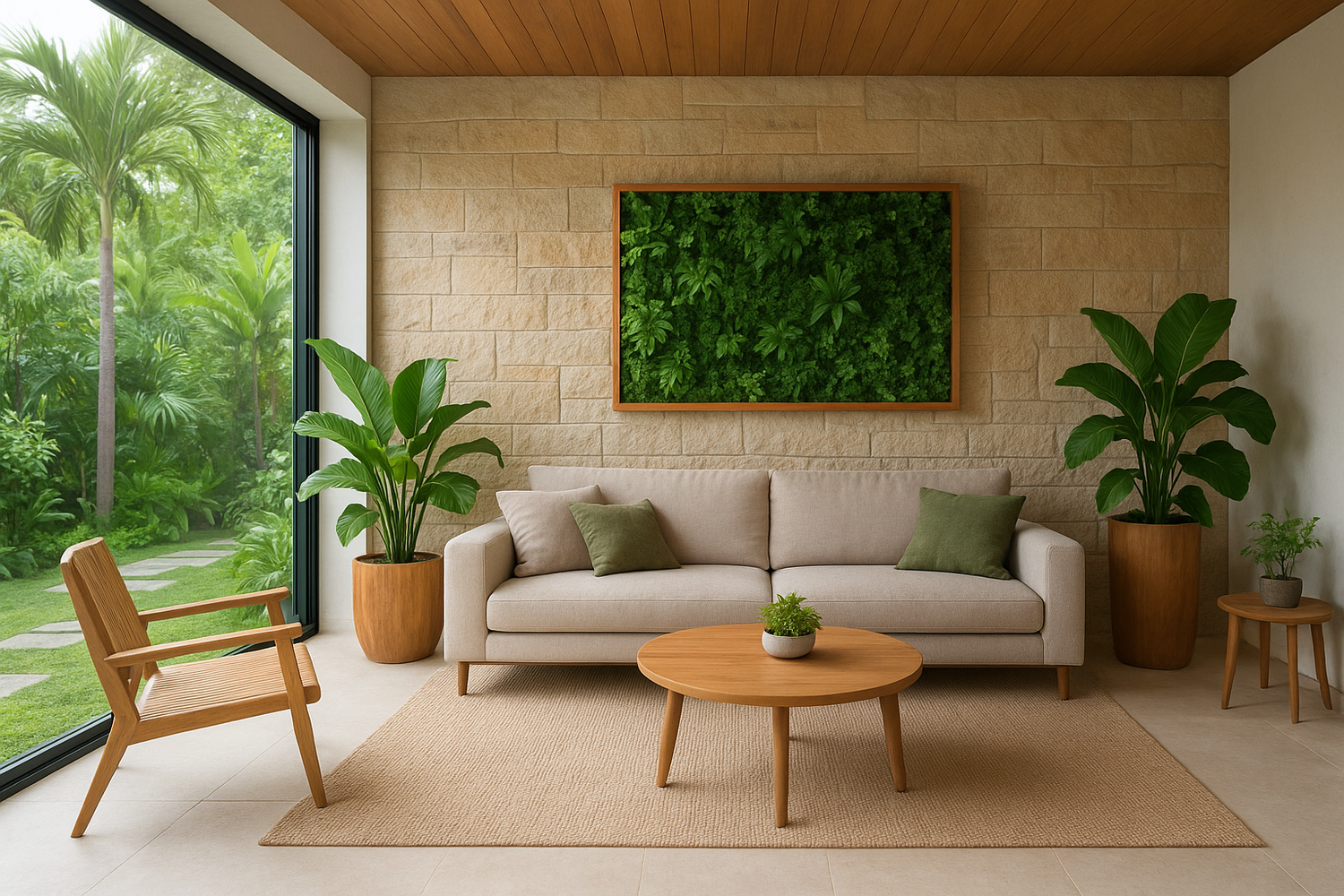
You've probably noticed it without knowing its name, a living wall in a hotel lobby, a skylight flooding a workspace with natural light, or a courtyard that makes a building feel alive. So what is biophilic design? At its core, it's a design approach that intentionally weaves nature into the spaces where people live, work, and gather. It goes beyond placing a few potted plants in a corner. It's a systematic integration of natural elements, light, water, vegetation, natural materials, and organic patterns, into architecture and interiors.
The idea stems from biologist E.O. Wilson's "biophilia hypothesis," which argues that humans have an innate need to connect with nature. When buildings and outdoor spaces honor that need, the results are measurable: lower stress, better focus, improved air quality, and spaces that people genuinely enjoy being in. Research from institutions like Terrapin Bright Green and the Human Spaces report backs this up with hard data.
At Konzept Garden, we see biophilic design principles at work every time we plan a garden or outdoor space for a Malaysian home or commercial property. Our award-winning landscape designs are built around the same idea, that people thrive when nature is thoughtfully brought into their everyday environment. This article breaks down the core principles of biophilic design, explains its proven benefits, and walks through real-world examples so you can understand how this approach shapes better spaces from the ground up.
Why biophilic design matters now
People spend roughly 90% of their time indoors, according to the US Environmental Protection Agency. That number has climbed steadily as remote work, urbanization, and screen-heavy daily routines have become standard. The built environments you inhabit every day, your home, office, and the commercial spaces you visit regularly, largely determine how you feel, how clearly you think, and how quickly you recover from stress. When those environments cut you off from nature entirely, there is a measurable cost to your wellbeing.
The urban disconnect driving the conversation
Cities are expanding fast. The United Nations projects that 68% of the global population will live in urban areas by 2050. As city density increases, access to green space shrinks, and the sensory variety that nature provides, changing light, moving air, organic textures, birdsong, gets replaced by flat surfaces, artificial lighting, and controlled air conditioning. Researchers describe the result as nature deficit, a condition linked to rising rates of anxiety, chronic attention fatigue, and reduced life satisfaction across urban populations.
This is exactly why understanding what is biophilic design has shifted from a niche academic topic to a genuine priority for architects, developers, interior designers, and homeowners. The discipline offers a structured, evidence-backed response to the gap between how human biology evolved and how modern built environments actually function.
The less access people have to nature in their daily environments, the more intentional designers and property owners need to be about bringing it back in.
What the evidence shows
The research supporting biophilic design is not speculative. A foundational report by Terrapin Bright Green, titled "14 Patterns of Biophilic Design," documented measurable improvements in workplace performance when biophilic elements were introduced, including reduced absenteeism and faster cognitive recovery after demanding tasks. The Human Spaces Global Report, which surveyed 7,600 workers across 16 countries, found that employees in environments with natural features reported a 15% higher wellbeing score and a 6% higher productivity score than those working in spaces with no natural elements whatsoever.
Healthcare settings show equally compelling data. A widely cited study by researcher Roger Ulrich found that hospital patients with views of nature recovered faster and required less pain medication than patients in identical rooms facing a brick wall. These findings cross settings from hospitals to schools to retail spaces, which means the principles of biophilic design apply to virtually any environment you build, occupy, or design.
Why Malaysia's context makes this urgent
Malaysia's tropical climate gives it a real structural advantage for biophilic design. Year-round warmth, high rainfall, and exceptional biodiversity mean that integrating vegetation, water features, and natural ventilation into both indoor and outdoor spaces is genuinely practical. The variety of native plant species available to Malaysian landscapers and designers is far greater than what designers in temperate climates work with.
At the same time, rapid urbanization in cities like Kuala Lumpur, Petaling Jaya, and Penang has produced dense residential and commercial zones where green space is routinely the last consideration in a development plan. Residents of high-rise condominiums and landed properties in dense suburbs often end up with outdoor areas that are underused, poorly planned, or treated as low-priority afterthoughts.
Malaysian homeowners and property developers are in a genuinely strong position to push back against that trend. Outdoor living areas, gardens, and courtyards are already embedded in local building culture. Applying biophilic principles to those spaces, selecting the right species, adding water elements, designing for shade and natural airflow, transforms what could be a neglected patch of land into an outdoor environment that actively supports your health, your focus, and your quality of life every single day.
What biophilic design is and is not
Understanding what is biophilic design requires separating it from the surface-level trend of adding greenery to spaces. The term gets used loosely in marketing materials and real estate listings, which means plenty of confusion exists about where decorative choices end and genuine biophilic thinking begins. Getting this distinction right matters because it determines whether your space actually delivers the health and performance benefits the research documents, or just looks good in a photograph.
What it actually is
Biophilic design is a science-informed approach that treats human connection to nature as a fundamental building requirement, not an optional upgrade. It draws on biology, psychology, and environmental science to shape decisions about light, material, spatial layout, vegetation, sound, and airflow. When you apply biophilic principles, every design choice serves a purpose: reducing physiological stress, supporting attention restoration, or creating the sensory variety that human nervous systems respond to positively.
This approach works across scales. You can apply it to a single room, an entire building, or a landscaped outdoor area like a garden or courtyard. The common thread is intentionality. Biophilic design asks you to consider how each element in a space affects your relationship with the natural world, even when that space sits in the middle of a dense urban area.
Biophilic design is not about replicating a forest indoors. It is about identifying which natural qualities most benefit the people using a space and then engineering those qualities into the design deliberately.
What it is not
Biophilic design is not interior decorating with plants. Placing a cluster of potted succulents on a windowsill or hanging a nature-themed mural in a break room does not qualify. Those choices may improve the visual appeal of a space, but they lack the systematic, evidence-based structure that genuine biophilic design requires.
It is also not a luxury reserved for high-budget architectural projects. While large-scale implementations like living walls, skylit atriums, and custom water features require real investment, many biophilic principles are achievable on a standard residential budget. Natural light optimization, thoughtful material selection, outdoor-indoor flow, and carefully considered planting plans all qualify as biophilic strategies. None of them require an expensive contractor or a complete renovation to execute well.
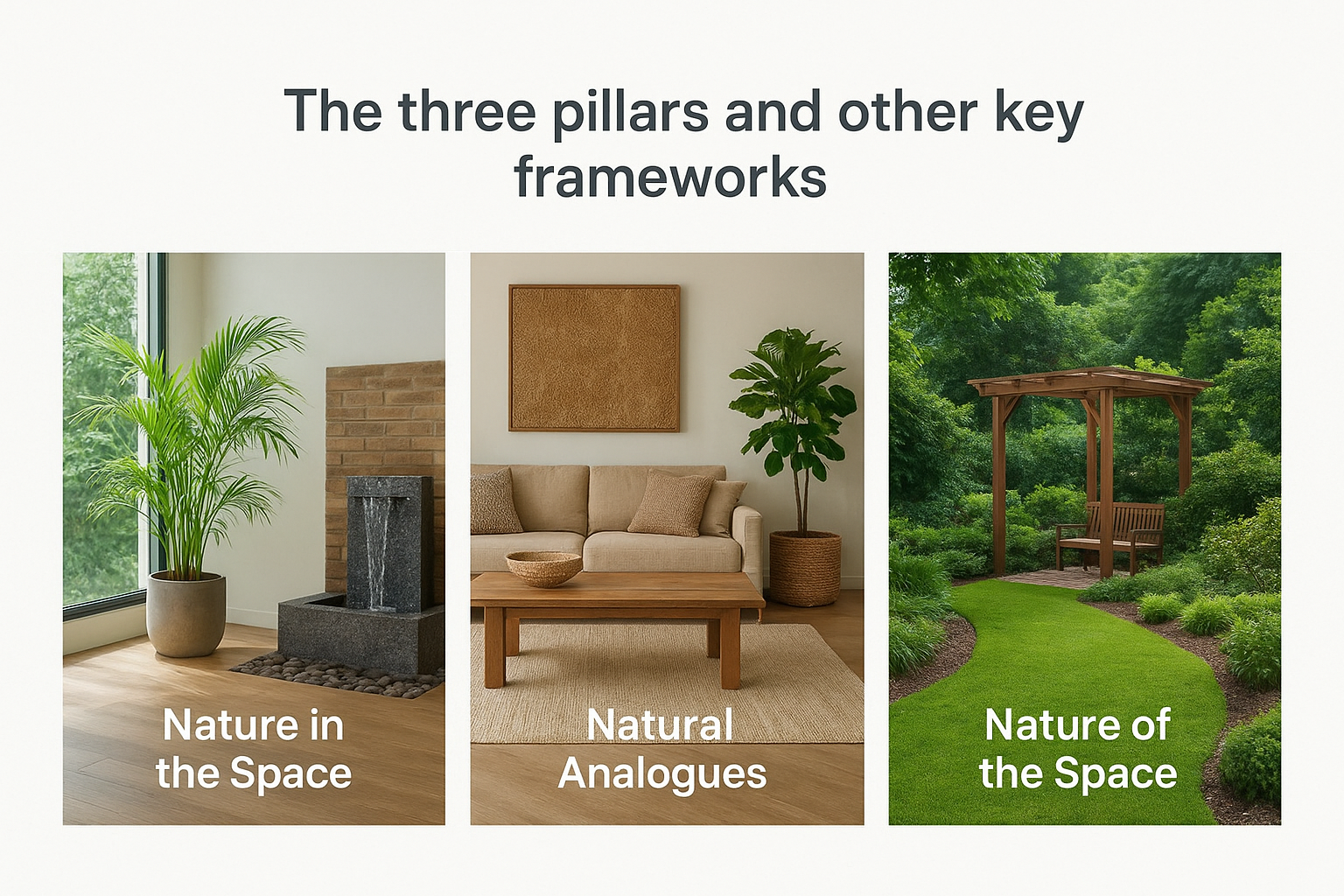
The three pillars and other key frameworks
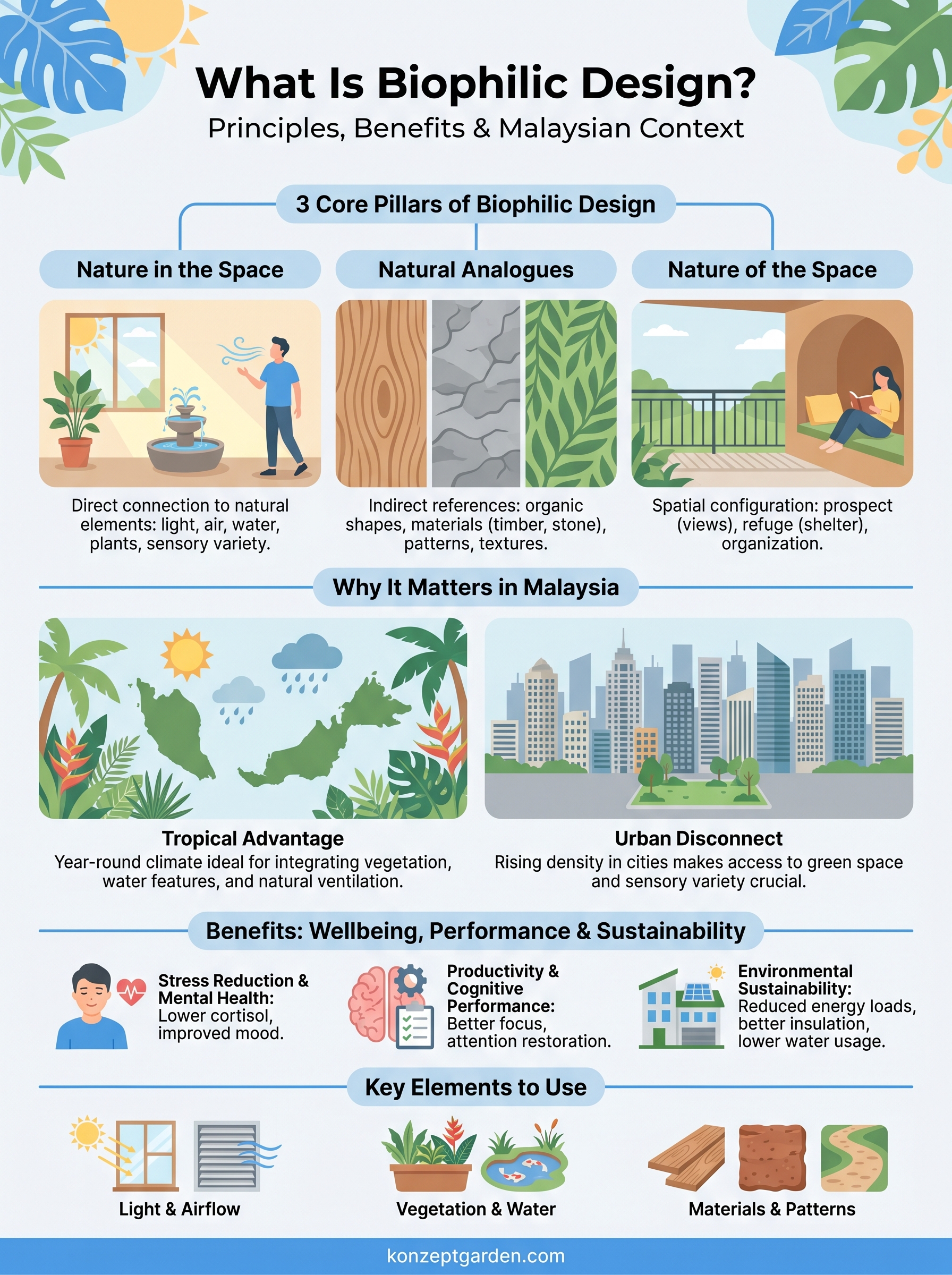
The most practical framework for understanding what is biophilic design comes from Terrapin Bright Green's "14 Patterns of Biophilic Design," which organizes the discipline around three core pillars. Each pillar represents a different way that nature connects with the people inside a built environment, and together they give designers and property owners a clear structure for making decisions rather than guessing which natural elements will actually deliver results.
Nature in the Space
This first pillar covers the direct, physical presence of nature within a space. It includes living plants, water features, animals, natural light, fresh air, and dynamic weather conditions visible from inside. When you add a garden courtyard to your home or install a water feature along an outdoor path, you are working within this pillar. Sensory variety is the goal here: your nervous system responds positively to the changing quality of natural light throughout the day, the sound of moving water, and the visual complexity of real vegetation in ways that flat, controlled interiors simply cannot replicate.
The more directly you bring nature into contact with the people who use a space, the stronger the measurable impact on their stress levels and attention.
Natural Analogues
This second pillar addresses indirect references to nature when direct contact is not possible or practical. Natural materials like timber, stone, and rattan belong here, as do organic shapes, patterns, and textures that echo natural forms without replicating them literally. A wooden ceiling with visible grain, a stone pathway through a garden, or terracotta planters all work through this pillar. For Malaysian homes and commercial spaces, locally sourced materials like bamboo, laterite stone, and tropical hardwood make natural analogues both accessible and contextually appropriate without requiring imports or premium pricing.
Nature of the Space
Spatial configuration rather than materials or vegetation drives this third pillar. It draws on research into how humans instinctively read physical environments for safety and comfort. Concepts like prospect (an open view that lets you survey your surroundings) and refuge (a sheltered, enclosed area where you feel protected) appear throughout this framework. A well-designed garden that combines an open lawn with shaded seating areas, a pergola, or a covered terrace applies this pillar directly. You do not need elaborate materials to trigger these responses, because thoughtful spatial planning alone can shift how safe, calm, and at ease someone feels the moment they step into an outdoor space.
Elements of biophilic design you can use
Knowing what is biophilic design in theory only gets you so far. The real value comes from identifying specific elements you can apply to your home, office, or outdoor space without needing to rebuild from scratch. The elements below map directly onto the three pillars covered earlier, giving you concrete entry points across different budget levels and space types.
Light, airflow, and sensory variety
Natural light is the highest-impact, lowest-cost biophilic element available to you. Position seating areas and workspaces to receive direct or indirect daylight throughout the day. Cross-ventilation, achieved by aligning openings on opposite sides of a room or outdoor structure, brings in moving air that shifts humidity and temperature in ways air conditioning cannot replicate. Even small interventions, like removing a solid fence panel and replacing it with a louvered screen, change how a space feels hour to hour.
The sensory variation that comes from natural light and shifting airflow is something no artificial system fully substitutes for.
Vegetation and water features
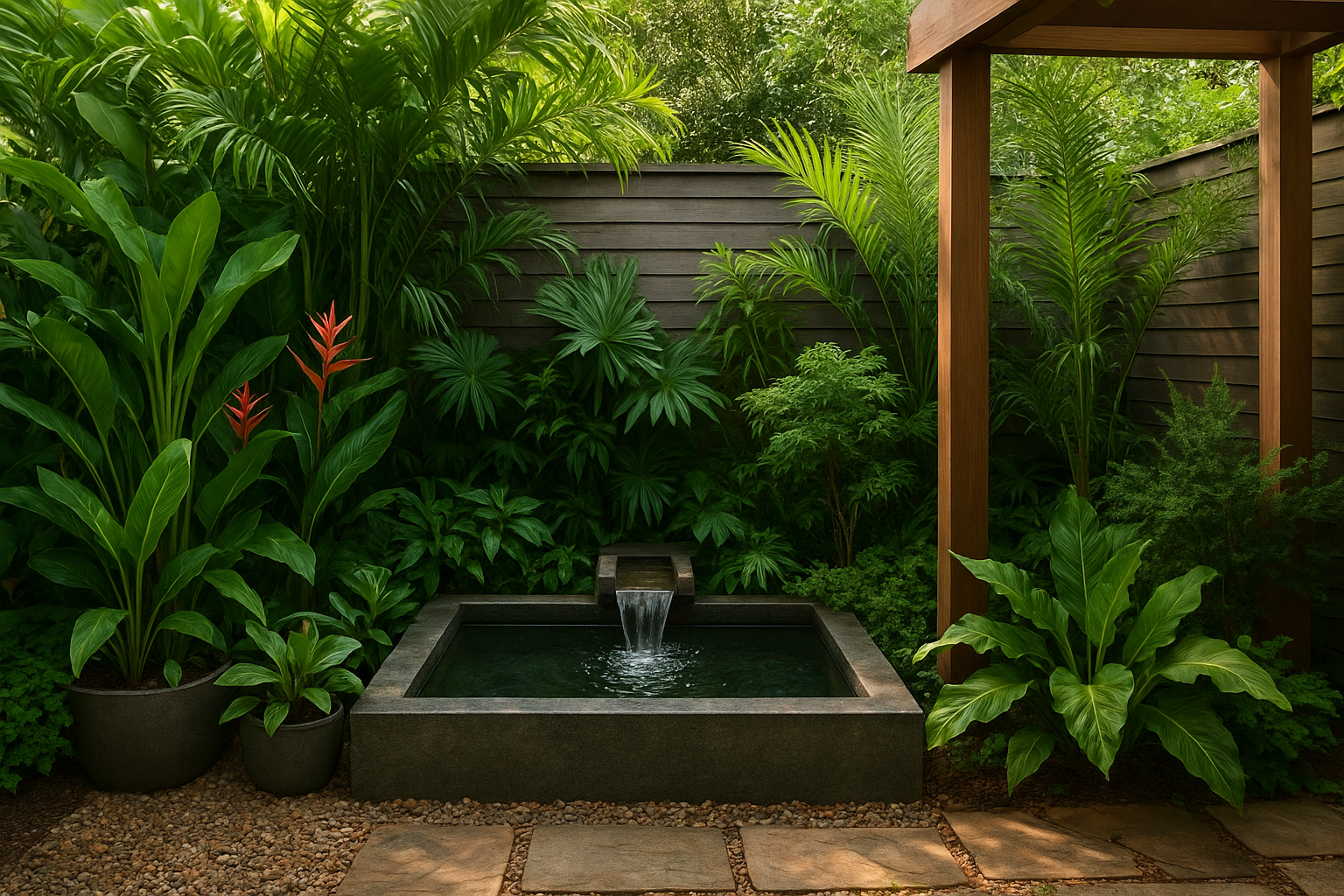
Plants are the most visible biophilic element, but selection and placement determine whether they actually deliver results. Native and climate-appropriate species require less maintenance, establish faster, and attract local wildlife that adds sound and movement to a space. For Malaysian gardens, this means drawing on species like heliconias, gingers, and palms rather than high-maintenance imports. Water features, whether a simple basin, a recirculating stream, or a full koi pond, add acoustic variety and movement that static planting cannot achieve on its own.
Here are practical starting points organized by space type:
- Small garden or balcony: clustered potted specimens, a tabletop water bowl, and a louvered shade structure
- Landed home garden: a planting border with layered heights, a recirculating water feature, and a shaded pergola
- Commercial outdoor space: a planted entrance, a covered seating area with vertical greenery, and natural stone paving
Materials and organic pattern
Timber, stone, bamboo, and rattan work as biophilic materials because they carry visual texture and variation that manufactured surfaces lack. Run your hand across rough-sawn timber versus a painted wall and the difference registers immediately. Selecting organic shapes for pathways, planter edges, and structures, curves rather than sharp grids, extends the biophilic effect into the spatial layout of your outdoor area without requiring additional planting or water elements.
Benefits for wellbeing, performance, and sustainability
Understanding what is biophilic design helps clarify why the benefits extend well beyond aesthetics. When you integrate natural elements deliberately into a space, you are addressing a genuine biological need that shaped human cognition over thousands of years. The returns show up in three measurable areas: how people feel, how well they perform, and how sustainably the built environment operates over time.
Stress reduction and mental health
Exposure to natural elements directly reduces the physiological markers of stress. Research published through institutions like the World Health Organization links access to green space and natural environments with lower cortisol levels, reduced heart rate, and improved mood outcomes across different age groups. When you design a garden or indoor space with layered vegetation, moving water, and natural light, you are giving your nervous system genuine recovery conditions rather than neutral ones.
The difference between a space that depletes you and one that restores you often comes down to whether natural elements are present in a meaningful, sustained way.
Restorative design works because your attention system operates on two distinct modes: directed attention, which requires conscious effort and depletes with use, and involuntary attention, which natural environments activate passively. A well-planted garden or a room with a view of living greenery allows your directed attention to recover, which is why time spent in biophilic spaces leaves most people feeling clearer and more capable, not just relaxed.
Productivity and cognitive performance
The productivity data behind biophilic design is specific and consistent. The Human Spaces Global Report, drawing on responses from 7,600 workers, found that employees in offices with natural features scored 15% higher on wellbeing and 6% higher on productivity than those working in spaces without them. For commercial property owners and office designers, those numbers represent a tangible return on the investment in plants, natural materials, and daylight access.
Students show similar improvements in environments designed with biophilic principles, including better attention spans and higher test scores in classrooms with natural light and views of vegetation compared to sealed, artificially lit rooms.
Environmental sustainability
Biophilic design also reduces a building's environmental footprint in practical ways. Planted roofs and green walls provide insulation that cuts cooling loads. Strategic tree placement lowers ambient temperatures around a structure. Native planting schemes require less water and fewer inputs than conventional landscaping, which matters in high-rainfall climates like Malaysia's, where responsible water management still carries real value.
How to bring biophilic design into Malaysian spaces
Malaysia's tropical climate is one of the strongest natural assets you have when applying biophilic principles to your property. Year-round sun, consistent rainfall, and extraordinary plant biodiversity mean that the raw material for meaningful biophilic design already surrounds you. The challenge is not sourcing nature; it is making deliberate choices that translate that natural richness into your specific space, whether you own a landed home in Subang Jaya, a condo in Mont Kiara, or a commercial property in Penang.
Work with your climate, not against it
Malaysia's heat and humidity push many property owners toward sealed, air-conditioned interiors that cut off any connection to the outside. Resisting that instinct partially, by designing shaded outdoor transition zones like covered terraces, louvered screens, and pergolas, gives you spaces that remain usable year-round while keeping the sensory variety that defines what is biophilic design at its most effective.
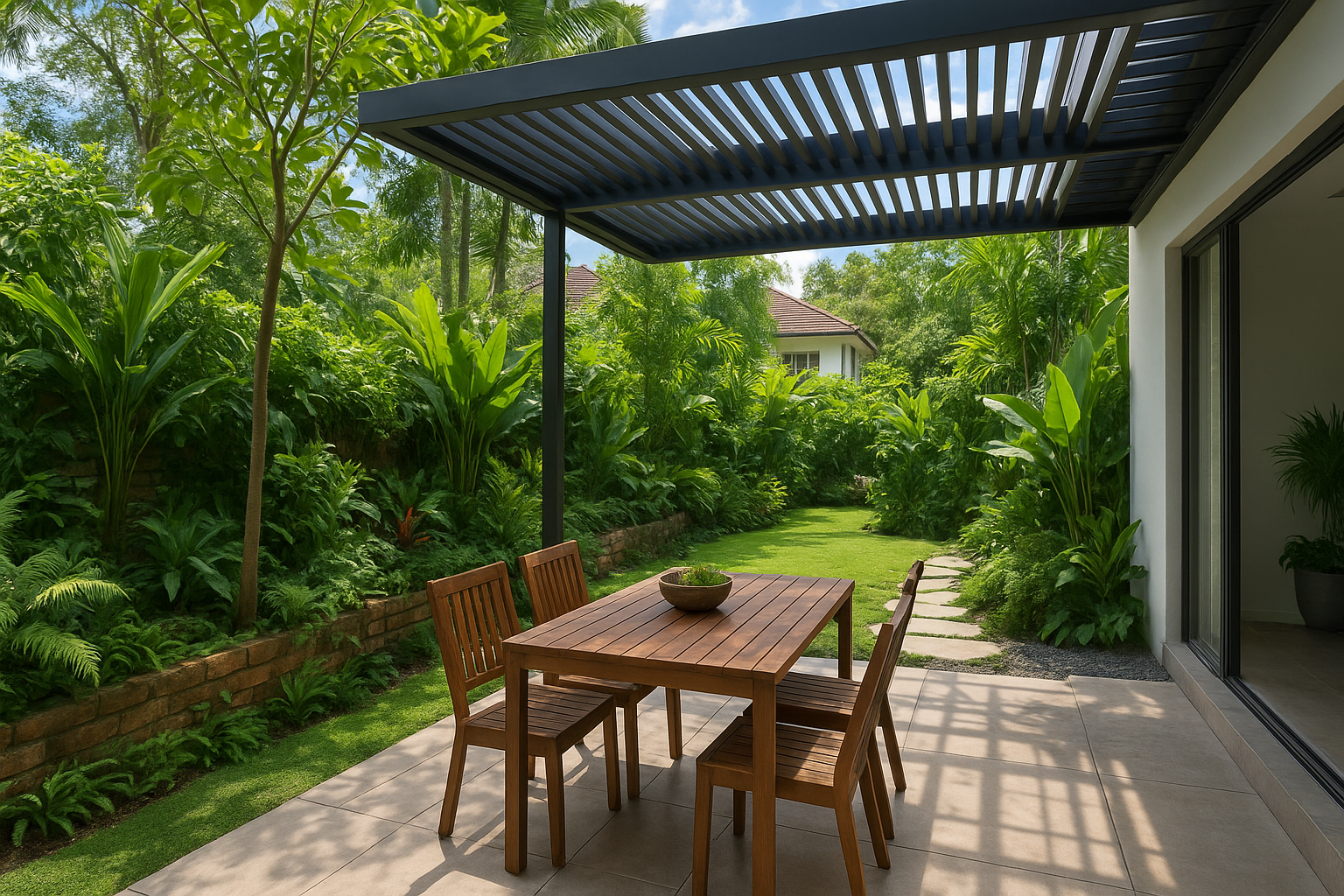
Cross-ventilation strategies that channel prevailing breezes through your garden and into interior spaces reduce your cooling load while delivering moving air that fixed air conditioning cannot replicate. Even a simple adjustment, replacing a solid boundary wall section with a planted screen, shifts how your outdoor space performs thermally and experientially throughout the day.
Prioritize your garden as a functional room
Your outdoor space deserves the same planning depth that you give any room inside the house. That means setting a clear brief: who uses it, at what time of day, and for what purpose. Once you answer those questions, a landscape designer can layer shade structures, planting, water features, and pathways in a sequence that makes the garden genuinely livable rather than decorative.
A garden that functions like an outdoor room gives you a daily restoration space that no interior redesign can fully substitute for.
Choose plants and materials that belong here
Native and naturalized species like heliconias, musas, and local ferns establish faster, need less maintenance, and support local pollinators far more effectively than imported specimens. Pair them with locally sourced materials such as laterite stone, tropical hardwood, or bamboo for surfaces and structures that carry natural texture without premium import costs.
Here is a quick reference for matching plant choices to space type:
| Space Type | Recommended Approach |
|---|---|
| Small garden or balcony | Clustered potted tropical specimens, a water bowl feature |
| Landed home garden | Layered native planting borders, recirculating water feature |
| Commercial outdoor area | Planted entrance, vertical greenery on shade structures |
These choices reduce long-term maintenance while keeping your outdoor space rooted in the character of the Malaysian landscape.
Final takeaways
Understanding what is biophilic design gives you a practical lens for evaluating every space you inhabit. It is not a decorating trend or a luxury add-on. It is a science-backed design discipline built around a straightforward premise: people function better when their environments maintain a meaningful connection to nature. Whether you apply it to a single outdoor area or plan a full landscape transformation, the principles hold the same regardless of scale.
Your garden is one of the most direct ways to put biophilic principles into practice right now. Layered planting, natural materials, shaded structure, and a well-placed water feature can shift how you experience your outdoor space every single day. If you want to explore what that looks like for your specific property, a custom koi pond design from Konzept Garden is one of the highest-impact starting points available to Malaysian homeowners.