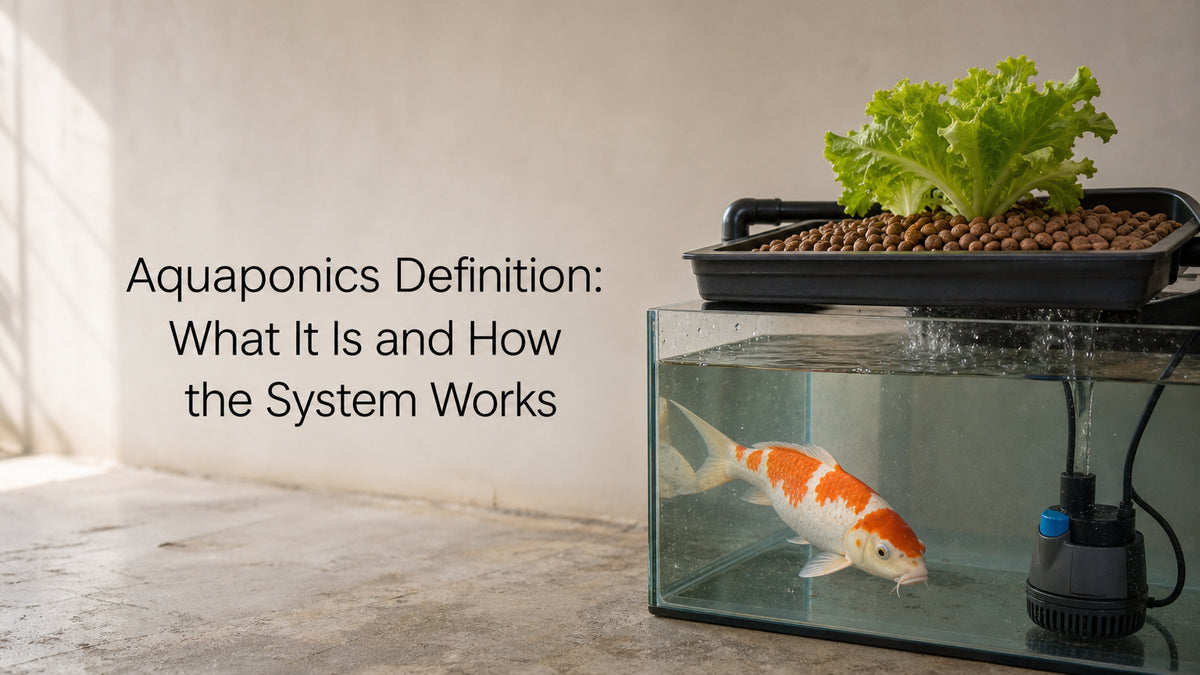
Here is the aquaponics definition in one sentence: aquaponics is a food production system that combines raising fish (aquaculture) with growing plants without soil (hydroponics) in one recirculating water loop. Fish waste feeds beneficial bacteria, the bacteria turn that waste into plant nutrients, and the plants absorb the nutrients and clean the water before it flows back to the fish. The name blends the two parent methods, and a setup only counts as aquaponics when both halves truly share the same water.
A dictionary line only gets you so far. This article explains why the idea matters and what it costs, how the nitrogen cycle works step by step, and how aquaponics differs from hydroponics and aquaculture. You will also see the three grow-bed designs, a worked example for sizing a pump, the fish and plants that suit a system, and the problems to expect.
At Konzept Garden we design and build koi ponds and planting schemes for homes and businesses in Malaysia. The fish half and the plant half of aquaponics sit close to our daily work, so we explain both with practical figures in metric units.
Why aquaponics matters for growers and gardeners
Aquaponics matters because it grows food from a single input, fish feed, and keeps water and nutrients circulating instead of discarding them. You get vegetables, and fish too if you choose edible species, with no bought fertilizer and little water loss. It also asks more of you than a pot of soil does, so weigh the gains and the costs together before you build anything.
What you gain from a working system
A healthy system turns one stream of waste into two harvests. The fish excrete, bacteria convert, and the plants absorb, so nutrients come from the fish rather than a fertilizer bag. Because the water recirculates, you only top up what evaporates or leaves with the plants, which makes the setup water-efficient compared with watering soil beds.
Extension guidance from Oklahoma State University lists the practical advantages:
- No soil to prepare and no weeding.
- Limited to no pesticide use, since sprays that reach the water would harm the fish.
- Flexibility in location, from a greenhouse to a terrace or indoor room.
- Year-round production in controlled environments.
- Less water-quality monitoring than hydroponics, and less disease than hydroponics.
Aquaponics turns one input, fish feed, into two outputs: plants that need no fertilizer bag and water you reuse.
What it costs you
Aquaponics has high upfront costs and higher operating costs than soil gardening. Pumps and aeration run on electricity, the fish need daily attention, and you must understand two fields, fish keeping and plant growing. The same extension sources note that there are several ways for the whole system to fail, and that your plant choice is more limited than in a soil bed.
Researchers at the Leibniz Institute of Freshwater Ecology and Inland Fisheries in Berlin make a sharper point. They argue that aquaponics is only sustainable when fish and plant production are efficiently coupled, and they propose measuring how much water a facility uses per kilogram of produce each year. A system with leaks or oversized pumps running around the clock can lose the very savings that attract people to it.
Who it suits
Aquaponics suits people who like hands-on routines and can check a system every day. A small home setup works well as a learning project, and people who already keep a pond have the hardest part, a stable fish tank, in place.
It suits you less if the property sits empty for weeks, or if you want a garden that tolerates neglect. A tank that loses power or a pump that stops can harm fish within hours, so the daily routine is part of the price. If you want low effort, a self-watering planter or a soil bed will serve you better.
How an aquaponics system works
An aquaponics system works as a loop: fish produce waste, bacteria convert it into nutrients, plants absorb those nutrients, and the cleaned water returns to the fish tank. Three living groups carry the whole process, and your job is to keep all three comfortable at once.
The three living partners
The fish are the engine. Their feed is the main input to the system, and they turn it into urine and solid waste rich in ammonia. Ammonia is toxic to fish and plants in high amounts, so it cannot be left to build up.
The nitrifying bacteria are the translators. They live on any wet surface that gets oxygen, such as the gravel in a media bed or the filter material, and they convert ammonia into forms that plants can use. The plants are the final filter. Their roots take up nutrients and leave the water cleaner for the fish.
The nitrogen cycle step by step
The conversion happens in a fixed order. Each step feeds the next, and a stall at any point shows up as stressed fish or pale plants.
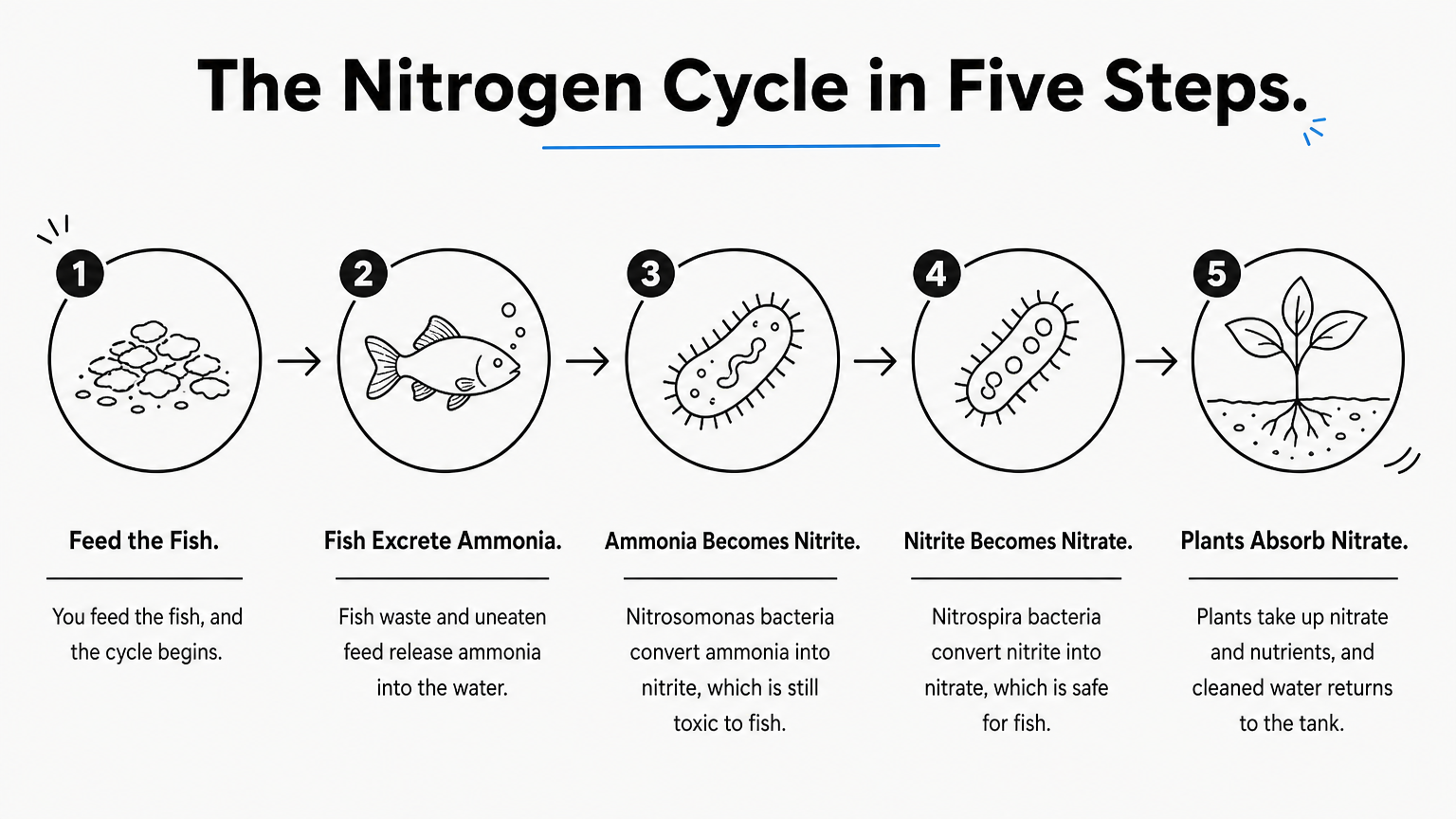
- You feed the fish.
- The fish excrete ammonia, and uneaten feed and solids add more.
- Nitrosomonas bacteria convert ammonia into nitrite, which is still toxic to fish.
- Nitrospira bacteria convert nitrite into nitrate, which is safe for fish and readily available to plants.
- The plants absorb nitrate and other nutrients, and the cleaned water returns to the tank.
Nitrogen is not the only nutrient. Other nutrients from fish waste collect in the media and the water, and extension guidance says a functioning system does not need the supplemental nutrients that other soilless systems rely on. The nutrients take time to build up, which is why new systems start with light-feeding plants.
If ammonia cannot become nitrate, the loop breaks, so the bacteria matter as much as the fish and the plants.
The conditions that keep the loop healthy
Fish, bacteria and plants each prefer a different range, so you aim for the overlap. The table sets out the targets from Oklahoma State University's fact sheet.
| Factor | Target | Why it matters |
|---|---|---|
| pH | 6.8 to 7.0 (fish 6.5-8.0, bacteria 6.0-8.0, plants 5.0-7.0) | Fish are the most sensitive, so you base the target on them |
| pH action points | Correct below 6.4 or above 7.4 | Nitrification becomes inhibited below 6.0 |
| Bacteria temperature | 25 to 30°C ideal | Activity stops near 4°C, and bacteria die above about 49°C |
| Dissolved oxygen | Set by the fish species, better a little high than low | Fish and bacteria both need oxygen |
| Chlorine | Gone before fish go in | Chlorinated tap water needs a couple of days of running to off-gas |
Water temperature itself depends on the fish you choose, and warm water holds less dissolved oxygen. That is why aeration and shade appear again in the sections on setup and problems.
How aquaponics differs from hydroponics and aquaculture
Aquaponics is a combination of the two parent methods, not a variation of either. Aquaculture raises aquatic animals. Hydroponics grows plants in water without soil. Aquaponics links them so that one water loop serves both.
Aquaponics, hydroponics and aquaculture side by side
The clearest difference is where the plant nutrients come from. A hydroponic grower mixes and doses a nutrient solution and controls it fully. An aquaponic grower lets the fish and bacteria make the nutrients, which gives up some control in return for lower input costs.
| Method | What grows | Where nutrients come from | Main skill needed |
|---|---|---|---|
| Aquaculture | Fish or other aquatic animals | Feed given to the animals | Fish health and water treatment |
| Hydroponics | Plants without soil | A nutrient solution you mix and dose | Nutrient and plant management |
| Aquaponics | Fish and plants together | Fish waste converted by bacteria | Both skills, plus keeping the bacteria healthy |
Extension specialists warn against treating aquaponics as hydroponics with fish added. It creates a small ecosystem, so it has its own problems and methods. If you plan to build one, learn how a recirculating fish tank behaves first, because understanding only one half is not an option.
Where trans-aquaponics fits
Researchers distinguish strict aquaponics from trans-aquaponics. In the strict sense, aquaponics means fish kept in recirculating tanks, where filters treat the water, combined with hydroponic plant growing. Trans-aquaponics stretches the term to other combinations, such as the carp-in-rice-field farming practiced in southern China for around 1,200 years.
The principle is old, since the fish fertilize the plants and the same water serves both. The modern recirculating form became popular worldwide after about 2000. When you read a definition, check which meaning the author uses, because it changes what counts as aquaponics.
Aquaponics is not hydroponics with fish added. It is two disciplines sharing one water loop.
Media beds, rafts and NFT: the three grow-bed methods
Most aquaponics systems use one of three grow-bed methods: media beds, deep-water culture rafts, or the nutrient film technique (NFT). They differ in how the plant roots meet the water and in how the system filters solids.
Media beds
A media bed is a container of inert gravel or clay pebbles where the plants root. It plays two roles: it holds the plants, and it filters solids and hosts the bacteria. Beds work best at 30 to 35 cm deep with media about 12 to 19 mm across, which is large enough not to wash into the plumbing and small enough to encourage roots.
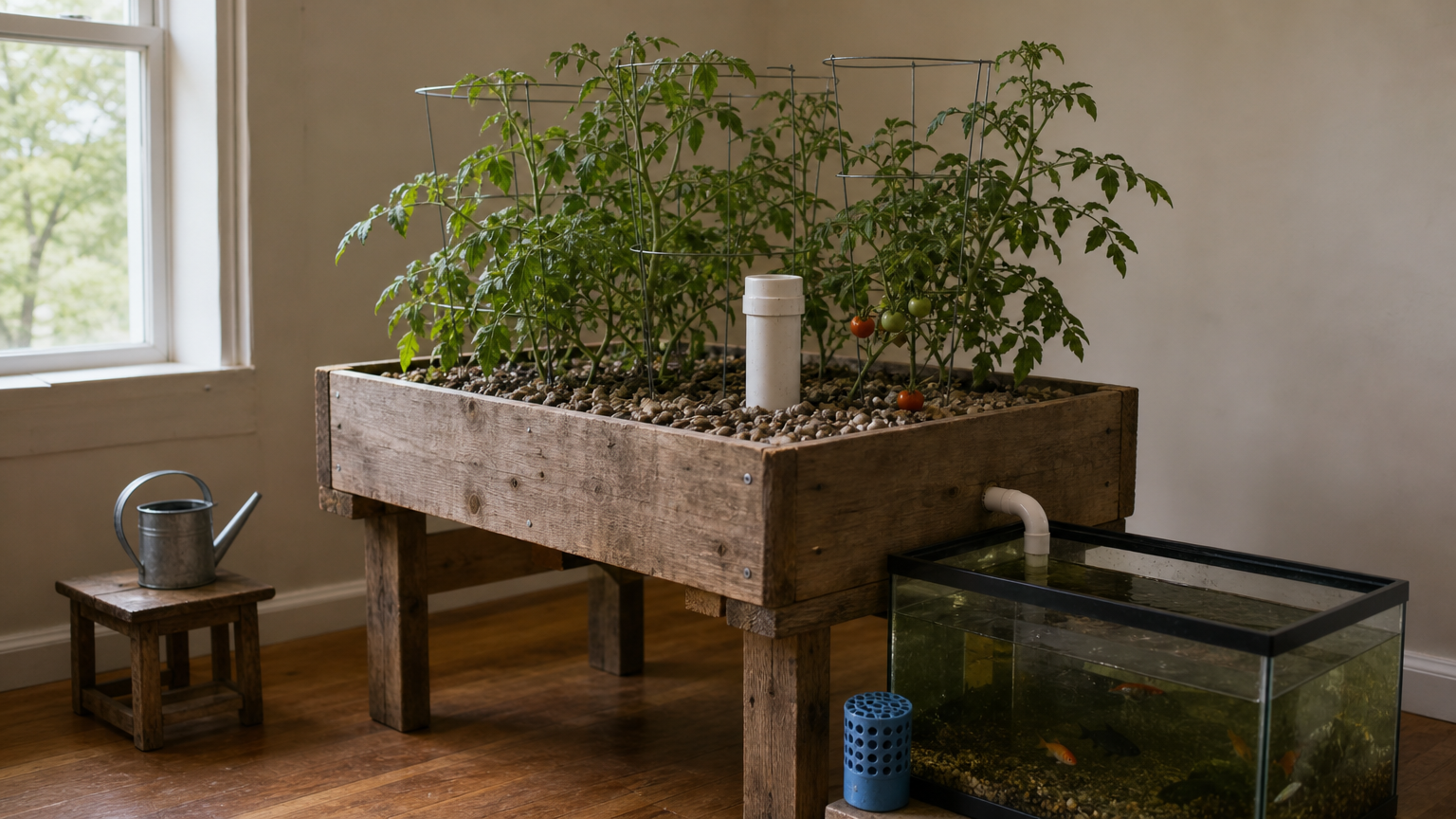
The media must be inert and must not change the water's pH. Avoid soil, wood chips and peat, and test and rinse gravel first, since some contains limestone. In the common flood and drain design, a timer fills the bed for about 15 minutes each hour, or a bell siphon floods and drains it automatically. Media beds suit fruiting crops. They are harder with short crops such as lettuce, because you must clean the media off the roots at harvest.
Rafts and NFT
In a raft system (deep-water culture), plants sit in holes in foam rafts that float on the water, with the roots fully submerged. It offers the highest production capability, and lettuce comes off the raft with a quick trim of the roots. In NFT, a thin film of nutrient-rich water runs through pipes, and the plant roots take up what they need as it passes.
Both need extra work on the water. Rafts need aeration, filtration and microbe control. NFT is sensitive to temperature swings that disturb plant and microbial growth. Neither filters solids by itself, so the water often passes through a media bed or another filter before returning to the fish. A system mixing a media bed with raft beds is called a hybrid.
Choosing a method
Pick the method from your crops and your tolerance for upkeep. If you want fruiting crops and a forgiving system, start with media beds. If you want fast leafy crops and can manage filtration, rafts give the most output.
| Method | Main advantage | Main drawback | Best crops |
|---|---|---|---|
| Media bed | The bed also acts as the filter | Needs periodic cleaning | Tomatoes, peppers, eggplant |
| Raft (DWC) | Highest production capability | Extra aeration, filtration and microbe control | Lettuce, parsley, Swiss chard |
| NFT | Constant flow raises oxygenation and reduces solids build-up | Sensitive to temperature changes | Lettuce, parsley, Swiss chard |
For a first system, a media bed gives you plants, filter and bacteria housing in one container.
How to start a small aquaponics system
Start with a media-bed flood and drain system: one fish tank, one or two grow beds, one submersible pump, and a timer or bell siphon. This is the simplest design, and it teaches you how the cycle behaves before you add complexity.
Plan the layout and ratios
Size the grow beds from the fish tank. Extension guidance uses a 1:1 to 2:1 ratio of grow bed volume to fish tank volume, and a 1:1 ratio is the easy place to start. For example, a 200 L fish tank pairs with two 100 L beds.
Think about weight before you place anything. Water weighs about 1 kg per litre, so the 200 L tank holds 200 kg of water, plus the tank and the fish. Once filled it will stay put, so choose a level, strong base in a spot where people cannot fall into it. Shade or cover the tank to limit algae.
Build only with safe materials. Tanks, beds and pipes should be non-toxic, food-safe and inert. PVC and CPVC are common and safe choices. Avoid unlined metal, uncoated concrete and some recycled plastics, which can leach into the water.
Size the pump with a worked example
The pump has to cycle the system about once an hour and lift water to the highest point. The extension formula is: bed volume, plus the fish tank volume times two. Using the 200 L tank and two 100 L beds:
- Bed volume: 2 × 100 L = 200 L
- Fish tank cycled twice an hour: 200 L × 2 = 400 L
- Pump flow needed: 200 + 400 = 600 L per hour
Then measure the head height, the distance from the water surface in the tank or sump to the highest point the water must reach. If the beds sit 1.2 m above the water surface, the pump must deliver 600 L per hour at 1.2 m of head, so read the pump's flow chart rather than its label. Do not economize here. The pump leaks nothing into the water in a good unit, and a backup pump is worth having.
Cycle the system, then plant and stock in order
Order matters because the bacteria need time to build up and need ammonia to feed on. Follow these steps:
- Fill the system and run it for a couple of days so chlorine from tap water off-gasses, then check the pH again. If your supplier uses chloramine, it does not off-gas, and you need an activated carbon or UV filter or another water source.
- Add a small number of fish. Low stocking means low ammonia and a small bacteria population, so grow the fish load gradually.
- Test ammonia, nitrite and nitrate regularly. Ammonia and nitrite should fall as nitrate appears.
- Plant light-feeding crops first, such as lettuce and herbs.
- Add heavy feeders such as tomatoes and cucumbers once nutrients have built up.
- Adjust pH slowly, and recheck every few hours after each correction.
Add fish slowly and plant light feeders first, because the bacteria need weeks to catch up with the fish.
Which fish and plants suit aquaponics
Choose fish for your water temperature and purpose, then choose plants that match how much waste those fish produce. The two choices pull on each other, so decide the fish first.
Fish choices
Extension sources list tilapia, trout, catfish, bass, goldfish, koi and pacu as common choices. Ask three questions: what water temperature can you hold, do you want to eat the fish, and which species are permitted where you live? Check local rules before buying.
| Fish | Edible | Optimal water temperature | Time to maturity | Oxygen needs |
|---|---|---|---|---|
| Tilapia | Yes | 23 to 27°C | 9 to 12 months | Low |
| Catfish | Yes | 24 to 29°C | 12 to 18 months | Low |
| Trout | Yes | 13 to 18°C | About 12 months | High |
| Koi | No | 18 to 24°C | About 3 years | Low |
| Goldfish | No | 18 to 24°C | About 3 years | Low |
In Malaysia's climate, warm-water species such as tilapia and catfish are the practical choices. Trout need cold, highly oxygenated water, which is hard to hold here. Tropical heat can push tank water above the optimum, and warm water holds less oxygen, so shade the tank and add aeration.
Ornamental koi and goldfish work as a nutrient source if you do not plan to eat the fish. If you already have a koi pond, you have the fish half of the system, and a design such as our Zen Bio Natural Koi Pond 1 at RM6,950 comes with a pump, canister filter, UV light and good bacteria. Whether a given pond can feed a grow bed depends on its plumbing and filtration, so ask a designer before you cut into it.
Plant choices
Match the plants to the fish load. Low-nutrient crops such as lettuce, herbs and broccoli need only low or normal fish stocking. High-nutrient crops such as tomatoes, peppers and cucumbers need a higher stocking density to supply enough nutrients.
| Crop | Nutrient demand | Days to harvest | Suits |
|---|---|---|---|
| Lettuce | Low to normal | 24 to 32 | Media, raft, NFT |
| Parsley | Low to normal | 20 to 30 | Media, raft, NFT |
| Swiss chard | Low to normal | 25 to 35 | Media, raft, NFT |
| Cucumbers | High | 55 to 65 | Media, raft |
| Peppers | High | 60 to 95 | Media |
| Tomatoes | High | 50 to 70 to first harvest | Media, raft |
Temperature narrows the list further. Lettuce prefers about 15 to 22°C and flowers above about 24°C, so it struggles in lowland heat. Peppers tolerate daytime temperatures up to about 30°C, and cucumbers up to about 28°C. Match the crop's preferred range to your site rather than copying a chart from a cooler country.
Pick the fish first, because the fish decide the water temperature, and the water temperature decides which plants will thrive.
Common aquaponics problems and how to avoid them
Most failures come from five causes: ammonia and nitrite spikes, pH drift, low oxygen, clogged plumbing and power loss. All five are preventable with routine checks and a few spare parts.
Water chemistry problems
Overfeeding and overstocking push ammonia up faster than bacteria can convert it. Cut feeding and add aeration first, then retest. Low oxygen is especially damaging, because bacteria deprived of oxygen die off slowly or even reverse the process, and a clogged bed that starts to smell of ammonia signals it.
Use the table to diagnose quickly.
| Symptom | Likely cause | What to do |
|---|---|---|
| Ammonia smell from a bed | Clog or low oxygen in the bed | Clear the clog and add aeration |
| pH below 6.4 | Nitrification gradually acidifies the water | Add calcium hydroxide or calcium carbonate slowly, and recheck every few hours |
| pH above 7.4 | Alkaline source water or too much base | Add a suitable acid-based product slowly |
| Fish gasping at the surface | Low dissolved oxygen, warm water | Add aeration, shade the tank, reduce feeding |
| Ammonia rising after a hot spell | Fish feeding surged and bacteria lagged | Cut feed and monitor the bacteria's recovery |
Add pH correctors slowly. A fast correction causes a pH spike that stresses fish and bacteria more than the original drift.
Equipment and power failures
A pump failure stops the flow, and then the bacteria and fish lose oxygen. Keep a backup pump and put the aeration on a separate or backup power supply so the fish keep breathing during an outage. If a pump sits in a sump tank, never let the water level fall low enough to run it dry.
Leaks and clogs are the other routine risks. Bulkhead fittings and similar seals are more reliable than marine-grade silicone, which is cheapest but needs reapplying. Inspect every component for solids build-up periodically, because all of them can clog.
A daily and weekly routine
A short routine catches most problems early. You can adapt it to your system:
- Daily: look at the fish and their feeding, confirm the pump is running, check the water level, and glance at plant roots and leaves.
- Weekly: test pH, ammonia, nitrite and nitrate, and clean any filter or bed that is slowing.
- Every time you add fish or plants: retest within a day or two.
Check the pump, the fish and the pH every day, because a small problem becomes a full system failure within hours.
What to take away from the aquaponics definition
Aquaponics is fish farming and soilless plant growing joined in one recirculating loop, with bacteria converting fish waste into plant food. It saves water and fertilizer, but only when you keep the fish, bacteria and plants in balance. It rewards a small, well-planned start: a media bed, a correctly sized pump, a few fish, and light-feeding plants first.
If you are planning a pond, a planting area or both, talk to the Konzept Garden team about what suits your site. You can also visit our showroom at Taman Sains Selangor, Petaling Jaya, open daily from 9am to 6pm.