

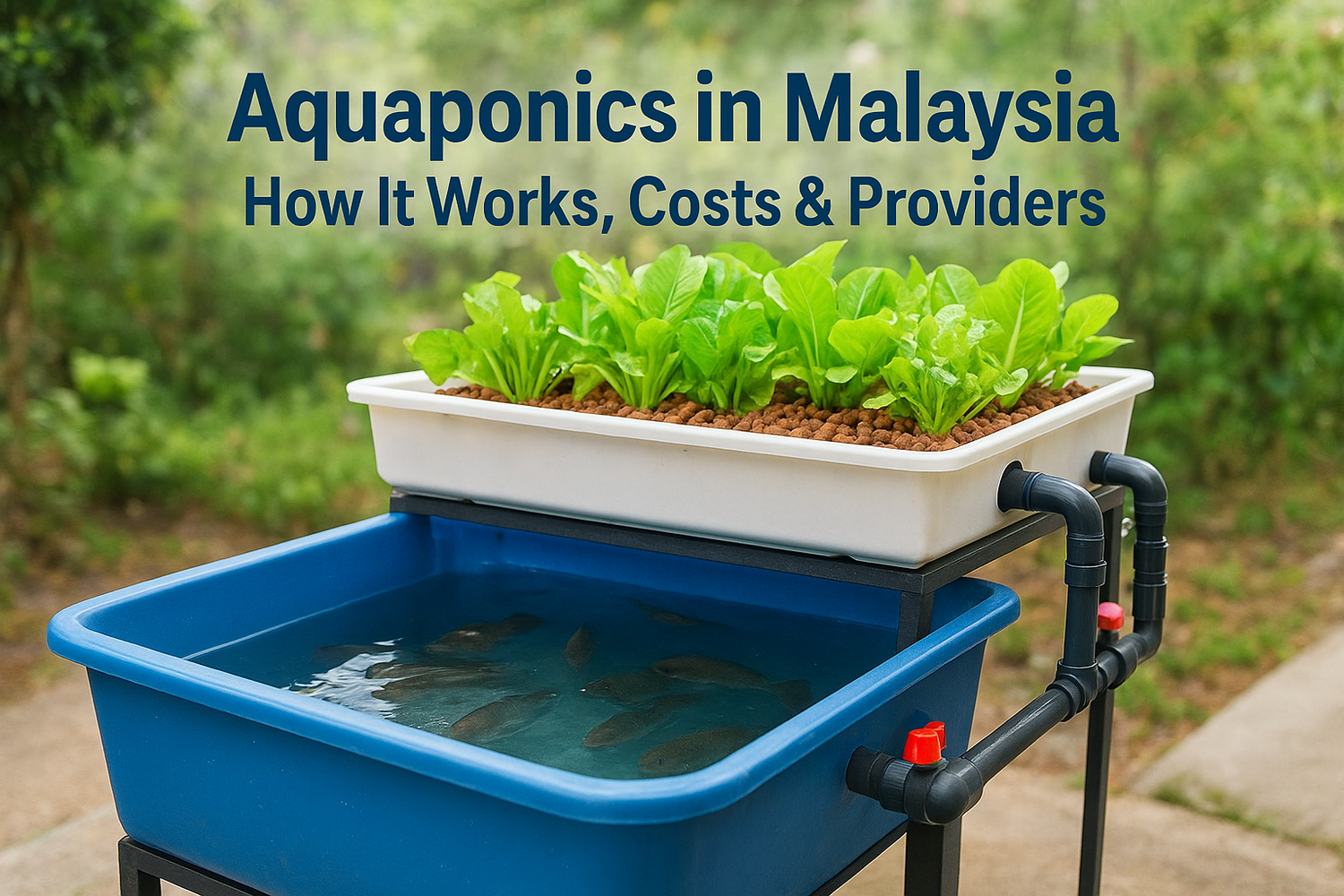
If you have searched aquaponics in Malaysia and landed on ten different sales pages promising a miracle system, you are not alone. Most homeowners and small farmers just want a straight answer: how does this actually work in our climate, what does it cost, and who can you trust to build one that survives the tropical heat and monsoon rains. This article gives you that answer without the sales pitch.
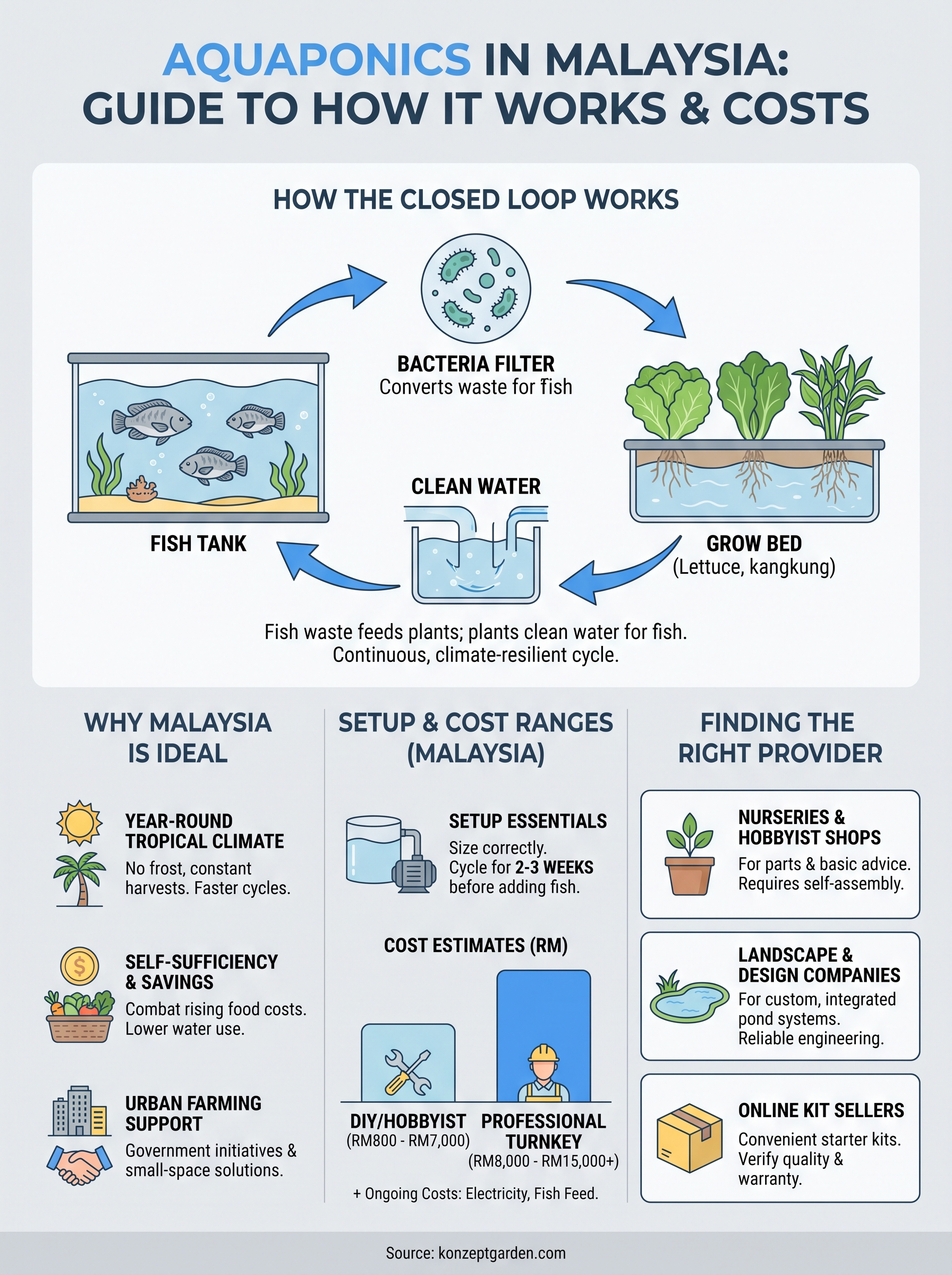
Aquaponics combines fish farming with soil-less plant growing in one closed loop, where fish waste feeds your plants and the plants clean the water for the fish. In Malaysia, this system suits everything from a backyard koi setup to a commercial vegetable and tilapia operation, provided you get the tank sizing, pump cycle, and plant selection right for our year-round warm weather.
Below, we break down exactly how the system functions, what a realistic budget range looks like for DIY versus professional builds, and which local providers and suppliers actually deliver working systems rather than kits that fail within months. Whether you are exploring a small pond conversion or a full commercial setup, you will leave with a clear picture of what to expect.
Why aquaponics is gaining ground in Malaysia
Malaysia's climate does most of the heavy lifting for anyone building an aquaponics system. Unlike Europe or North America, you never lose growing weeks to frost or short daylight, so your fish stocking density and plant harvest cycles can run on a near-constant loop all year. That single fact explains why so many backyard hobbyists in Klang Valley and Penang have quietly switched from raised-bed vegetable patches to fish-and-plant setups over the last few years, and why commercial operators are now pitching aquaponics as a serious alternative to open-field farming.
Tropical growing conditions that never switch off
Tropical warmth keeps water temperatures in the 24 to 30 degree Celsius range that tilapia, catfish, and most leafy greens thrive in, so you skip the heating equipment that eats into profit margins in temperate countries. This means a home aquaponics setup in Selangor can cycle through three or four harvests of kangkung or lettuce in the time a soil garden in a colder climate manages two.
Malaysia's year-round warmth turns aquaponics from a seasonal hobby into a continuous production system.
Rising food and water costs pushing families toward self-sufficiency
Rising grocery prices and repeated vegetable supply disruptions during the pandemic pushed many Malaysian households to look at growing their own food, and aquaponics offers a way to do that in a fraction of the space a traditional garden needs. Water use also drops sharply because the system recirculates the same water between fish tank and grow bed instead of draining it into the soil.
| Growing method | Water use (relative) | Land needed for similar yield |
|---|---|---|
| Soil farming | High | Large |
| Hydroponics | Moderate | Moderate |
| Aquaponics | Low | Small |
Government and community programs backing urban farming
Local authorities and agencies like the Department of Agriculture have started promoting urban farming initiatives as part of broader food security planning, and aquaponics fits neatly into that push because it works on rooftops, balconies, and small plots where soil farming simply isn't practical. Community groups in places like Ipoh and Kuching have also started small demonstration setups, which has done more to build public confidence than any marketing campaign could, since neighbors can walk over and see a working system rather than take a seller's word for it.
How to set up an aquaponics system at home
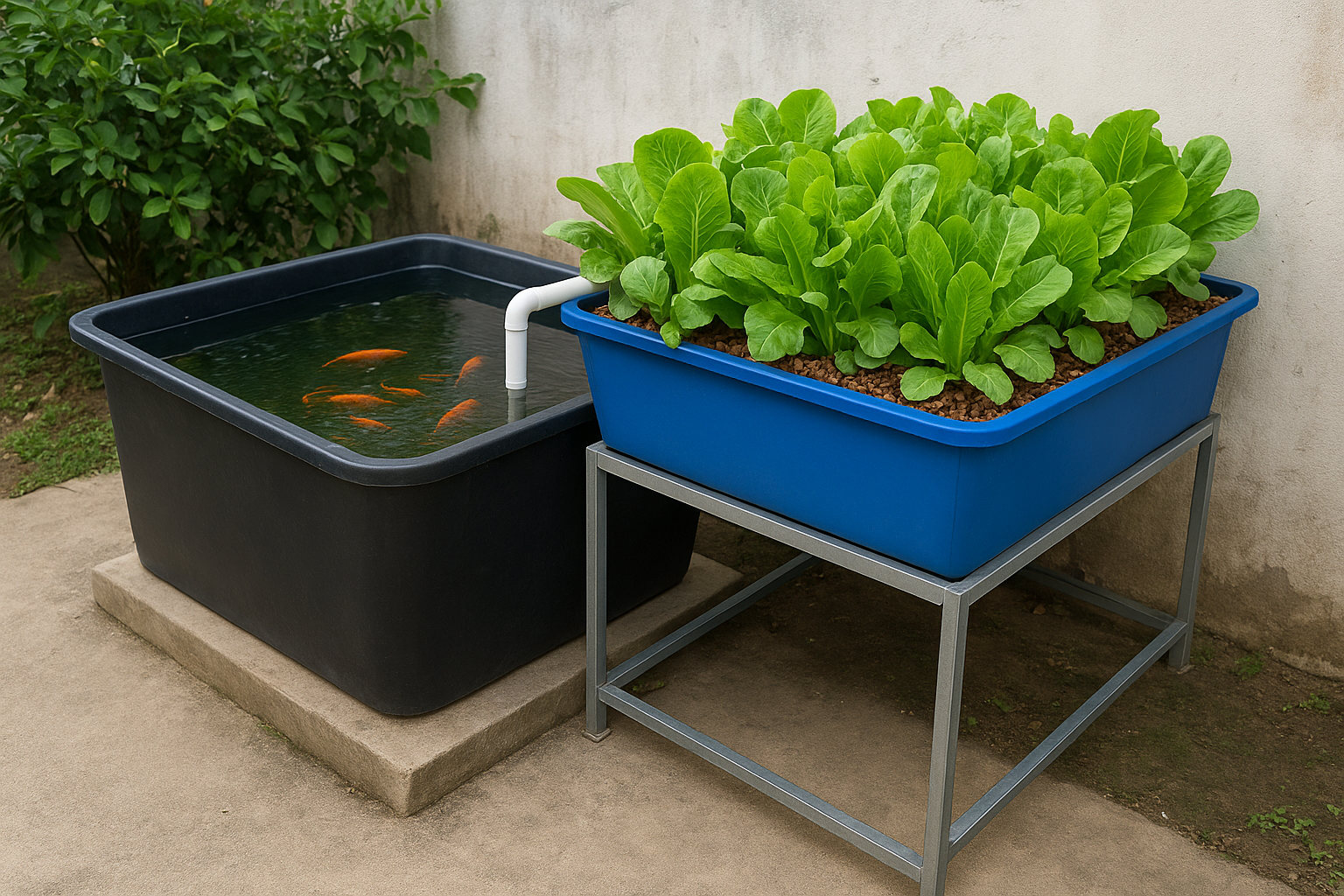
Building a working system starts with picking the right footprint for your space, not the biggest tank you can afford. Most Malaysian homeowners start with a fish tank of 500 to 1,000 liters paired with a grow bed roughly the same surface area, using either a media bed filled with expanded clay or a floating raft setup for leafy greens. Getting this ratio wrong is the single biggest reason beginner setups fail within the first few months.
Sizing and placing your tank and grow bed
Placement matters as much as size. Choose a spot that gets four to six hours of sun, away from direct monsoon runoff, and close enough to a power outlet that your water pump doesn't need a long extension cord running across a wet patio. Concrete or raised platform bases work better than bare soil, since Malaysia's heavy rains can shift unstable ground under a full tank.
Cycling the system before adding fish
Before you add a single fish, you need to cycle the system for two to three weeks so beneficial bacteria can establish themselves in the grow bed. Skipping this step is the fastest way to kill your first batch of tilapia.
A system that hasn't cycled properly will poison its own fish within days.
A basic setup checklist looks like this:
- Install tank, grow bed, and submersible pump
- Fill system and run water for 48 hours to check for leaks
- Add ammonia source (fish food works) and let bacteria colonies build for 2-3 weeks
- Test ammonia, nitrite, and nitrate levels with a basic aquarium test kit
- Introduce hardy fish like tilapia once nitrate readings stabilize
- Plant seedlings once fish waste starts producing visible nitrate
Following this sequence, rather than rushing straight to stocking fish, is what separates a lasting home aquaponics setup from one you're rebuilding by October.
How much aquaponics costs in Malaysia
Cost is the question everyone asks first, and the honest answer is that aquaponics in Malaysia can run anywhere from RM800 for a scrappy backyard build to over RM15,000 for a professionally engineered system with automated dosing and monitoring. What you pay depends almost entirely on tank material, pump quality, and whether you hire someone to install it or wire the pipework yourself on a Sunday afternoon.
DIY builds versus professional installation
Going the DIY route saves money upfront but shifts the risk onto you, since a cheap pump or a poorly sealed grow bed can flood your patio or kill a batch of fish overnight. Professional installers charge more, but they size the fish-to-plant ratio correctly from day one and usually back the build with a warranty on pumps and plumbing.
| Setup type | Typical cost (RM) | Best for |
|---|---|---|
| Basic DIY (barrel/tote tank) | 800 - 2,500 | Hobbyists testing the concept |
| Mid-range media bed kit | 3,000 - 7,000 | Serious backyard growers |
| Professional turnkey system | 8,000 - 15,000+ | Homeowners wanting reliability |
A cheap pump failure can cost you more in dead fish than the money it saved.
Ongoing running costs you shouldn't ignore
Running costs matter more than the initial build, since electricity for the pump and air blower runs continuously, adding roughly RM30 to RM80 a month depending on tank size. Feed for tilapia or catfish costs another RM50 to RM150 monthly, and you should budget a small buffer for replacing test kits, occasional fish restocking, and pump maintenance every year. Skipping this ongoing budget is why many first-time builders quietly abandon a home aquaponics setup within its first year.
Where to buy aquaponics systems and find providers
Finding a reliable supplier for aquaponics in Malaysia takes more digging than searching "aquaponics near me," since the market splits between hobbyist shops selling parts and full-service companies that design and install a complete loop. Knowing which type of provider matches your project saves you from buying a tank from one place, a pump from another, and then discovering nobody will stand behind the whole system when something leaks.
Local nurseries and hobbyist suppliers
Garden nurseries and aquarium shops in towns like Puchong, Ampang, and Johor Bahru often stock the basic components: submersible pumps, grow media, and hardy fingerlings such as tilapia or catfish. These outlets suit anyone building a small backyard setup piece by piece, though you should expect to do your own sizing and troubleshooting since staff usually specialize in fish or plants, not the combined system.
Landscape and garden design companies for custom builds
Homeowners who want a system that blends into the garden rather than sitting like a science project usually turn to landscape design firms with experience in water features and koi ponds. This is where the build quality difference shows up fastest, since a company that already engineers filtration for ornamental ponds understands water flow, aeration, and structural loading far better than a generic contractor.
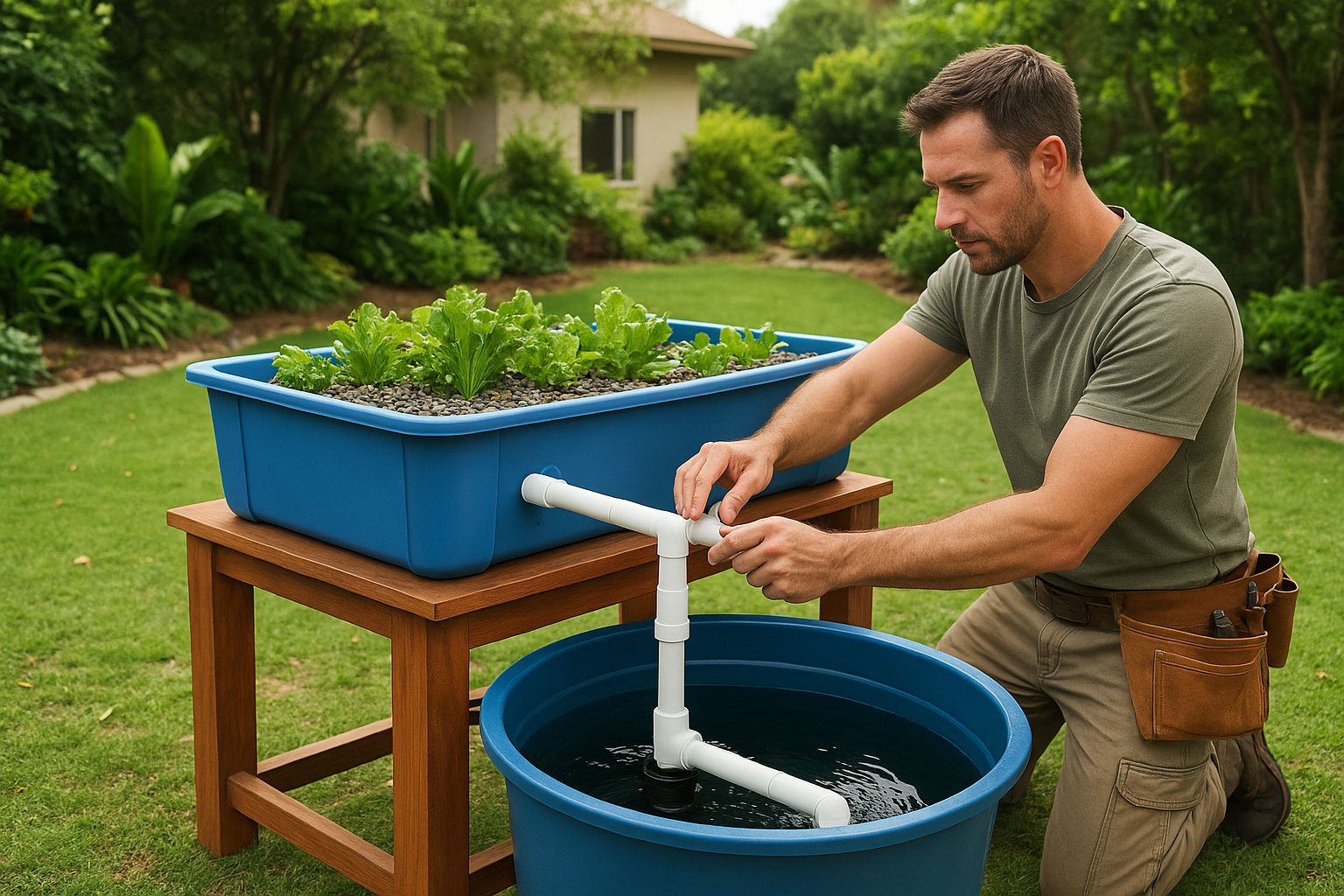
The gap between a hobby kit and a proper installation almost always comes down to who engineered the water flow.
Online marketplaces and DIY kit sellers
Online platforms sell everything from complete starter kits to individual grow beds, which works if you are confident cycling a system yourself. Compare a few sellers before buying:
- Check if the pump wattage matches your tank volume
- Confirm grow media is chemically inert, not just cheap gravel
- Ask whether fish stock is included or sourced separately
- Look for any warranty on plumbing fittings and pumps
Spending an extra week comparing these details beats replacing a failed setup twice.
Bringing aquaponics into your own garden
Aquaponics in Malaysia works because our climate does the hard part for you, running fish and plants on a near-constant cycle instead of the stop-start seasons other countries fight against. Getting there still means sizing your tank correctly, cycling the system before adding fish, and budgeting for the ongoing costs most beginners underestimate. None of that is complicated once you know what to check, and none of it excuses buying parts from three different sellers who won't stand behind the finished loop.
Combining a fish pond with a garden that actually looks designed, rather than bolted together, is where a landscape team with real pond engineering experience pays off. If you're picturing a koi pond that doubles as the backbone of a planted system, look at our Zen Bio Koi Pond designs and talk to us about building something that fits your space and survives the monsoon season.