

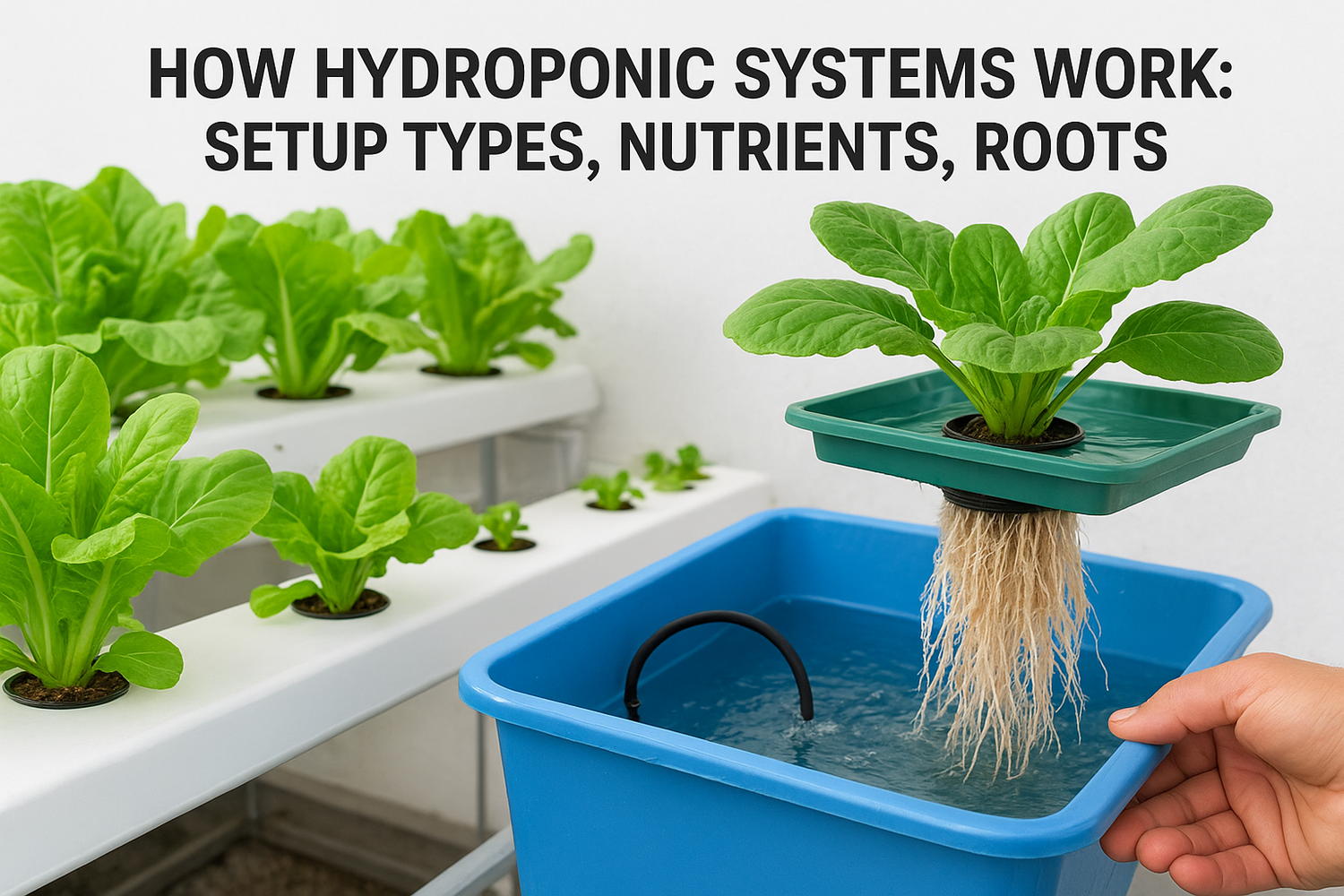
Plants don't actually need soil to grow. What they need is water, nutrients, light, and structural support for their roots. That single insight is the foundation behind every hydroponic system ever built, and understanding how hydroponic systems work gives you a real advantage when planning any modern garden, whether it's a balcony herb setup or a full-scale vertical wall.
At its core, hydroponics replaces soil with a nutrient-rich water solution delivered directly to plant roots. This means faster growth, less water waste, and precise control over what your plants consume. But the method you choose, deep water culture, drip systems, nutrient film technique, and others, shapes everything from your daily maintenance routine to the types of plants you can grow successfully.
At Konzept Garden, we design and build outdoor spaces across Malaysia that blend function with aesthetics, and our product line includes the Ziant Hydro Planter for exactly this reason. Hydroponic principles aren't just for commercial farms; they're increasingly part of residential garden design, rooftop spaces, and vertical gardens. We work with these systems because they solve real problems, limited space, poor soil quality, high maintenance demands.
This article breaks down the biology of how roots absorb nutrients without soil, walks through each major hydroponic system type, and explains what actually matters when choosing one. By the end, you'll understand the mechanics well enough to decide which setup fits your space and goals.
Why hydroponics works without soil
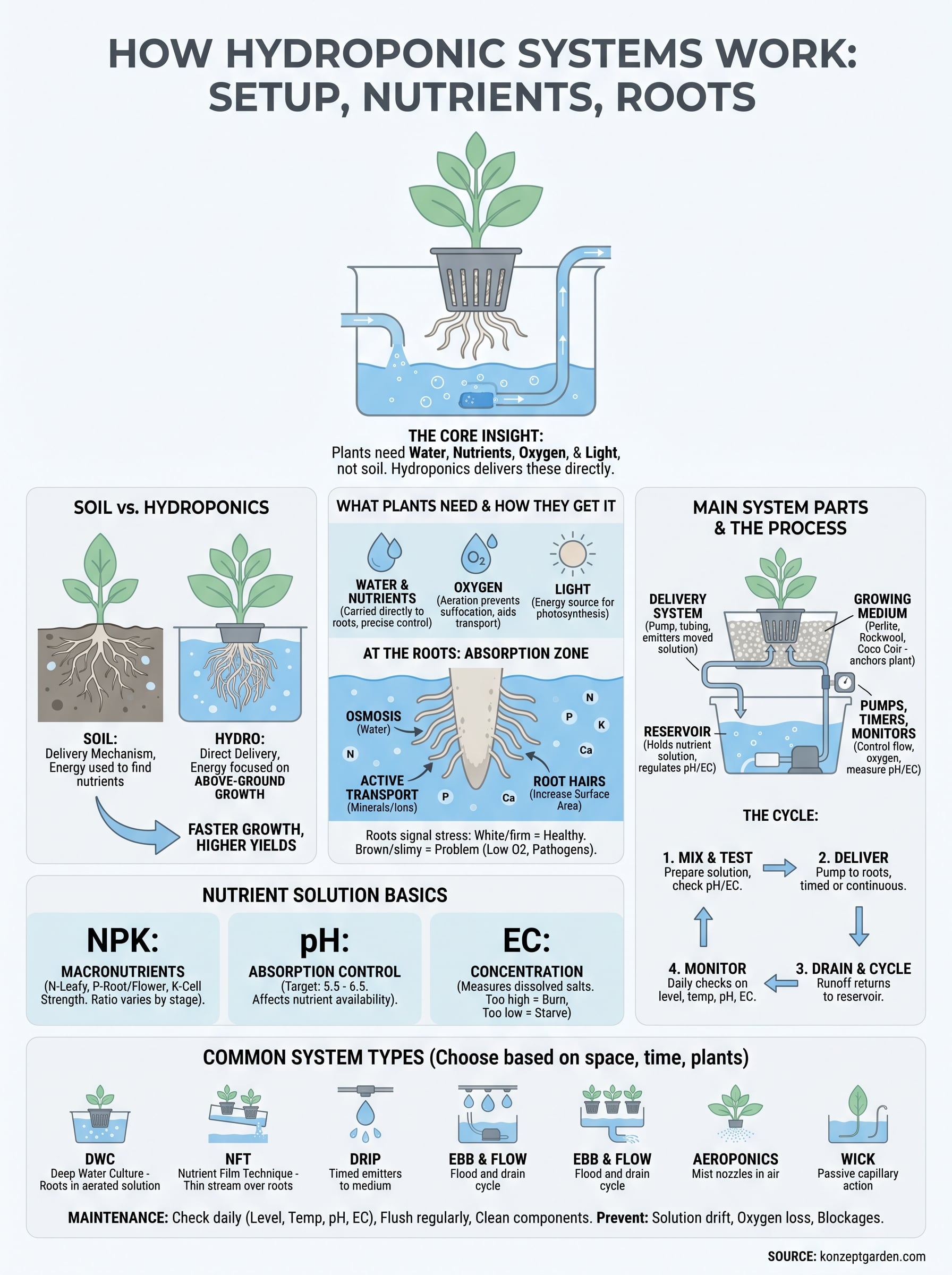
Most people assume plants need soil to survive. The reality is that soil is a delivery mechanism, not a biological requirement. Plants evolved to extract water, minerals, and gases from their environment, and soil just happens to be where those resources are typically found. When you strip away the soil and replace its functions with a controlled nutrient solution, plants grow just as well, and often faster, because there's less interference between the root and what it needs.
What soil actually does for plants
Soil performs three core functions: it anchors the plant physically, holds water and nutrients in place, and houses the microbial activity that breaks organic matter into absorbable mineral ions. None of these functions require soil specifically. A growing medium like perlite, rockwool, or coco coir can anchor roots. Water does the holding. In hydroponics, you skip the microbial breakdown step entirely by delivering pre-dissolved mineral nutrients directly to the root zone.
This is why hydroponics can outperform soil growing in controlled conditions. In soil, a plant expends energy extending its root system to find nutrients scattered unevenly through the medium. In a hydroponic setup, the nutrient solution reaches the roots on a scheduled cycle or a constant flow, so the plant redirects that energy into above-ground growth: more leaves, faster fruit development, and larger yields overall.
When roots don't have to search for nutrients, plants focus energy on growth rather than survival.
How roots absorb nutrients from water
Roots absorb nutrients through osmosis and active transport. Water moves from areas of lower solute concentration outside the root to higher concentration inside the root cells through semi-permeable membranes. Mineral ions like nitrogen, phosphorus, and potassium don't flow in passively; the plant actively pumps specific ions through membrane proteins, a process that requires energy from the plant itself.
In a soil system, these ions must first dissolve into the soil water before roots can uptake them. Soil pH, mineral composition, and microbial activity all affect how available those ions actually are at any given moment. In hydroponics, you control all of that directly. You set the pH of the solution and the concentration of each mineral, which means the root environment stays consistent and predictable throughout the plant's life cycle.
Why this matters for your garden design
Understanding why hydroponics works without soil changes how you think about growing space. You're no longer limited by ground quality, drainage problems, or poor soil structure. In Malaysia, where heavy rainfall and clay-heavy soils create ongoing challenges for residential gardens, a hydroponic or semi-hydroponic setup removes those variables from the equation entirely.
This is also why understanding how hydroponic systems work at a mechanical level helps you make smarter decisions about your setup. Whether you're planning a compact balcony planter or a larger vertical garden installation, the same core principles apply. The system type you choose determines how nutrients reach the roots, how oxygen enters the root zone, and how much daily involvement the system actually demands from you.
What plants need: water, nutrients, oxygen, light
Every plant, whether it grows in a backyard bed or a hydroponic container, depends on four core inputs: water, dissolved nutrients, oxygen, and light. Remove any one of them and growth stalls. Understanding what each input does is central to grasping how hydroponic systems work, because the entire design of these setups is built around delivering all four inputs more precisely and efficiently than soil ever could.
Water and nutrients: the delivery system
Water carries dissolved mineral ions directly to the root surface in a hydroponic setup. Unlike soil growing, where nutrients get locked up by pH fluctuations or microbial competition, hydroponics gives you direct control over what your plant receives at every stage of its life. You adjust the nutrient concentration based on the growth phase: lower levels for seedlings, higher levels during fruiting or flowering. That level of precision is what separates a well-run hydroponic system from most conventional garden beds, where nutrient availability is unpredictable at best.
Getting your nutrient solution right is the single most important variable you control in any hydroponic setup.
Oxygen: why roots need air
Roots consume oxygen through aerobic respiration, which powers the active transport of mineral ions into root cells. Without enough oxygen in the root zone, roots suffocate, harmful pathogens like pythium spread quickly, and plant health drops fast. This is why the air-to-water balance at the root zone matters just as much as the nutrient mix. Systems like deep water culture use air pumps and stones to oxygenate the solution continuously, while setups like nutrient film technique expose roots to open air between feeding cycles to achieve the same result.
Light: the engine behind growth
Plants convert light energy into chemical energy through photosynthesis, producing the sugars that fuel everything from root development to fruit production. In an outdoor or semi-outdoor hydroponic setup in Malaysia, natural sunlight is often sufficient, but you still need to match light hours and intensity to the specific plants you're growing. Leafy greens and herbs tolerate lower light levels well, while fruiting plants like tomatoes or cucumbers need significantly more direct exposure. Aligning your plant selection with your available light is one of the first practical choices you'll make when planning any hydroponic system.
What happens at the roots
The root zone is where understanding how hydroponic systems work becomes concrete. In a soil garden, roots spend significant energy growing outward to locate water and mineral deposits. In a hydroponic setup, the solution comes to the roots, and that shift changes how the root system develops, how efficiently it absorbs nutrients, and how clearly it signals stress when something goes wrong.
Root structure and the absorption zone
The outermost tips of plant roots, called root caps, protect the growing cells as they extend through the growing medium or solution. Just behind each root tip, a dense layer of root hairs forms. These microscopic extensions dramatically increase the surface area of the root, giving the plant far more contact with the surrounding nutrient solution than the root's main body could achieve alone. In a well-designed hydroponic system, these root hairs sit in direct contact with oxygenated, nutrient-rich water, which is why uptake rates are so much faster than in soil.
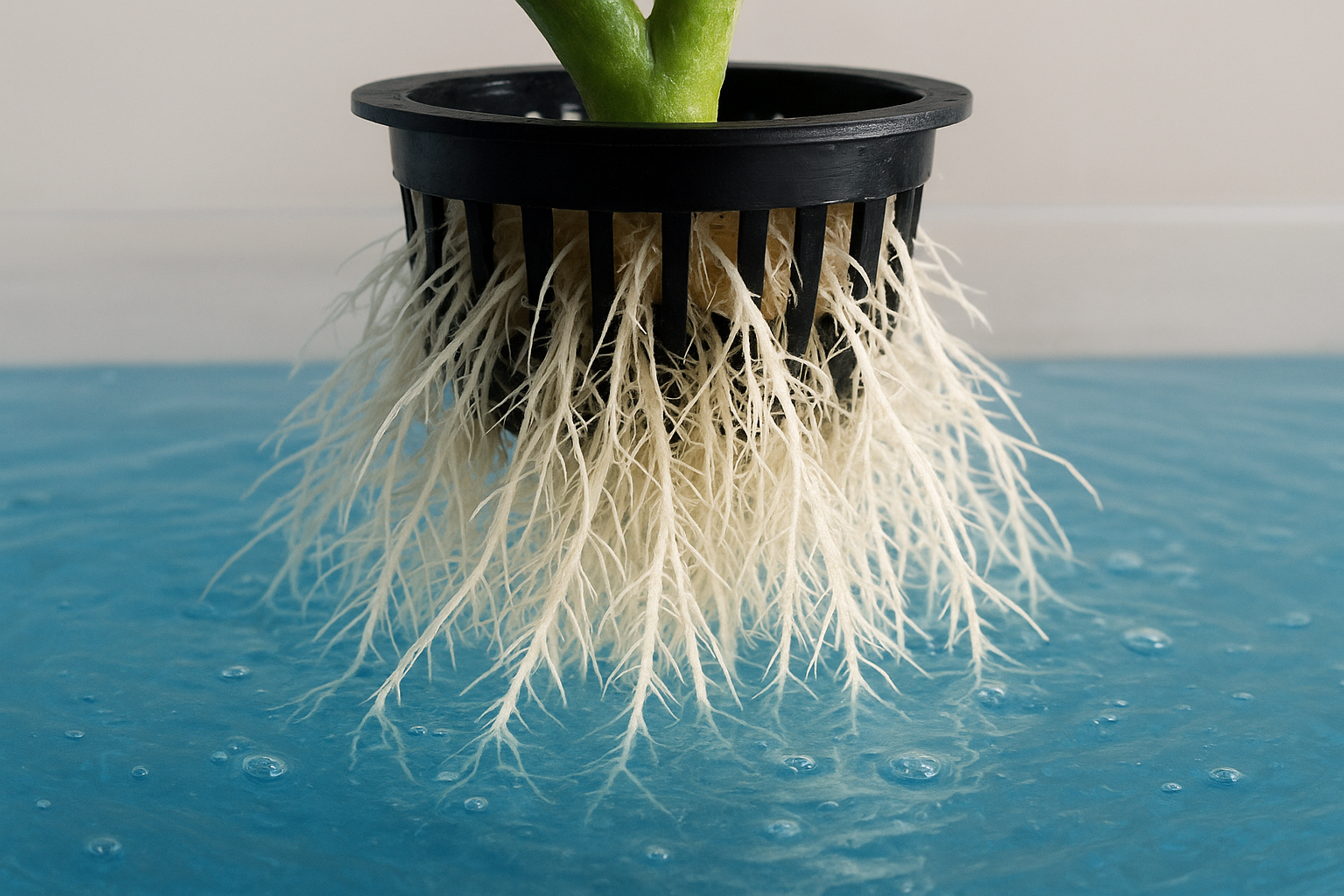
Root hairs do most of the actual absorption work, so protecting them from disease and physical damage keeps your system running at full capacity.
Each root hair cell absorbs water through osmosis and pulls in mineral ions through active transport channels embedded in its membrane. These channels are selective: the root takes in what it needs and can block excess minerals from entering. This selectivity is one reason why managing your solution's ion balance matters so much in hydroponics. Flood the solution with one mineral and you risk blocking uptake of another, even if that second mineral is present in adequate amounts.
How roots signal nutrient stress
Roots respond visibly when something is off in the solution. White, firm roots with dense hair coverage indicate a healthy system. Brown, slimy, or sparse roots usually point to low oxygen, pathogen pressure, or an imbalanced solution. Because hydroponic roots are accessible and often visible, you can catch these early warning signs before they affect the plant above the waterline.
When roots detect a drop in specific mineral availability, the plant redirects energy away from new growth: it may slow leaf expansion, drop older leaves, or show discoloration in predictable patterns based on which nutrient is deficient. Learning to read these signals gives you the ability to correct problems at the root level before they reach the canopy.
Nutrient solution basics: NPK, pH, EC
The nutrient solution is the engine of any hydroponic setup. Understanding how hydroponic systems work at a chemical level means getting familiar with three measurements you'll check regularly: NPK ratios, pH, and electrical conductivity (EC). These three values tell you what's in the water, whether your plant can actually access it, and whether the concentration is high enough to support healthy growth.
NPK: the three core macronutrients
Every plant needs three macronutrients in larger quantities than anything else: nitrogen (N), phosphorus (P), and potassium (K). Nitrogen drives leafy, vegetative growth. Phosphorus supports root development and flowering. Potassium strengthens cell walls and regulates water movement through the plant. Most hydroponic nutrient concentrates list their NPK ratio on the label, so you can match the formula to your plant's current growth stage.
You adjust the ratio as the plant matures. Seedlings and leafy greens do well with a nitrogen-heavy mix, while flowering or fruiting plants need more phosphorus and potassium to perform well. Getting the right ratio at the right time is more precise in hydroponics than in any soil-based system, and that precision is one of its biggest advantages.
pH: controlling what roots can actually absorb
pH measures how acidic or alkaline your solution is on a scale from 0 to 14. For most hydroponic crops, you want to keep pH between 5.5 and 6.5. Inside that range, roots can access nearly all the mineral ions dissolved in the solution. Outside that range, specific nutrients become chemically locked out, meaning they're present in the water but the plant physically cannot absorb them.
pH is the single variable that can make a perfectly mixed nutrient solution useless if you ignore it.
Test pH with a digital pH meter and correct it using pH-up or pH-down solutions, which are widely available through garden supply retailers. Check the solution every one to two days, especially in smaller reservoirs where evaporation and plant uptake shift the balance quickly.
EC: measuring how much is in the water
EC, or electrical conductivity, tells you how concentrated your nutrient solution is. Pure water conducts electricity poorly, but dissolved mineral salts raise conductivity, so a higher EC reading means more nutrients are present. Most leafy crops thrive at an EC between 1.2 and 2.0 mS/cm, while heavier-feeding plants like tomatoes can handle up to 3.5 mS/cm.
Use a digital EC meter alongside your pH meter to keep both values in check. Running the solution too strong stresses roots and causes nutrient burn, while running it too weak starves the plant before visible symptoms appear above the waterline.
Water quality and temperature control
Water quality and temperature are two variables that experienced growers check before they even mix nutrients. Understanding how hydroponic systems work at a practical level means recognizing that the water you start with sets a ceiling on how well your system can perform. Poor-quality source water introduces competing minerals, harmful pathogens, or chlorine compounds that interfere with nutrient uptake before your plants have a chance to thrive.
Starting with the right source water
Your starting water matters more than most beginners expect. Tap water in Malaysia often contains chlorine or chloramines added during municipal treatment. Both compounds can disrupt the beneficial microbial balance in organic hydroponic setups and stress plant roots directly in some cases. Letting tap water sit uncovered for 24 hours allows chlorine to off-gas, though chloramines require a dedicated water filter or a small dose of sodium thiosulfate to neutralize effectively.
Hard water, meaning water with high calcium and magnesium content, also creates problems. When your source water already carries heavy mineral loads, you risk pushing EC higher than intended before you add a single drop of nutrient concentrate. Running a baseline EC test on your source water before mixing lets you adjust your nutrient formula and avoid accidental overfeeding. Rainwater or reverse osmosis water gives you a near-blank starting point that makes formula control far more straightforward.
Testing your source water before mixing nutrients saves you from diagnosing problems that were built into the solution from the start.
Temperature and its effect on the root zone
Water temperature in the reservoir directly controls how much dissolved oxygen the solution can hold. Cold water holds more oxygen than warm water, which is why experienced growers target a solution temperature between 18°C and 22°C for most crops. In Malaysia's climate, where ambient temperatures regularly exceed 30°C, keeping the reservoir cool is an active task rather than a passive one. Insulating your reservoir with foam or a reflective cover helps slow heat gain significantly.
Warm water also creates the ideal environment for root pathogens like pythium, a water mold that spreads quickly through an oxygen-depleted solution and destroys root systems fast. You can monitor reservoir temperature with a simple digital thermometer. If temperatures climb consistently above 24°C, consider adding a small aquarium chiller or relocating the reservoir to a shaded, ventilated area where ambient heat has less impact.
Main parts of a hydroponic setup
Every hydroponic system, regardless of type or scale, relies on the same core components working together. Knowing what each part does and how it connects to the others is the fastest way to understand how hydroponic systems work in practice. Once you can name each component and explain its role, assembling or troubleshooting any setup becomes far less intimidating.
The reservoir and nutrient delivery
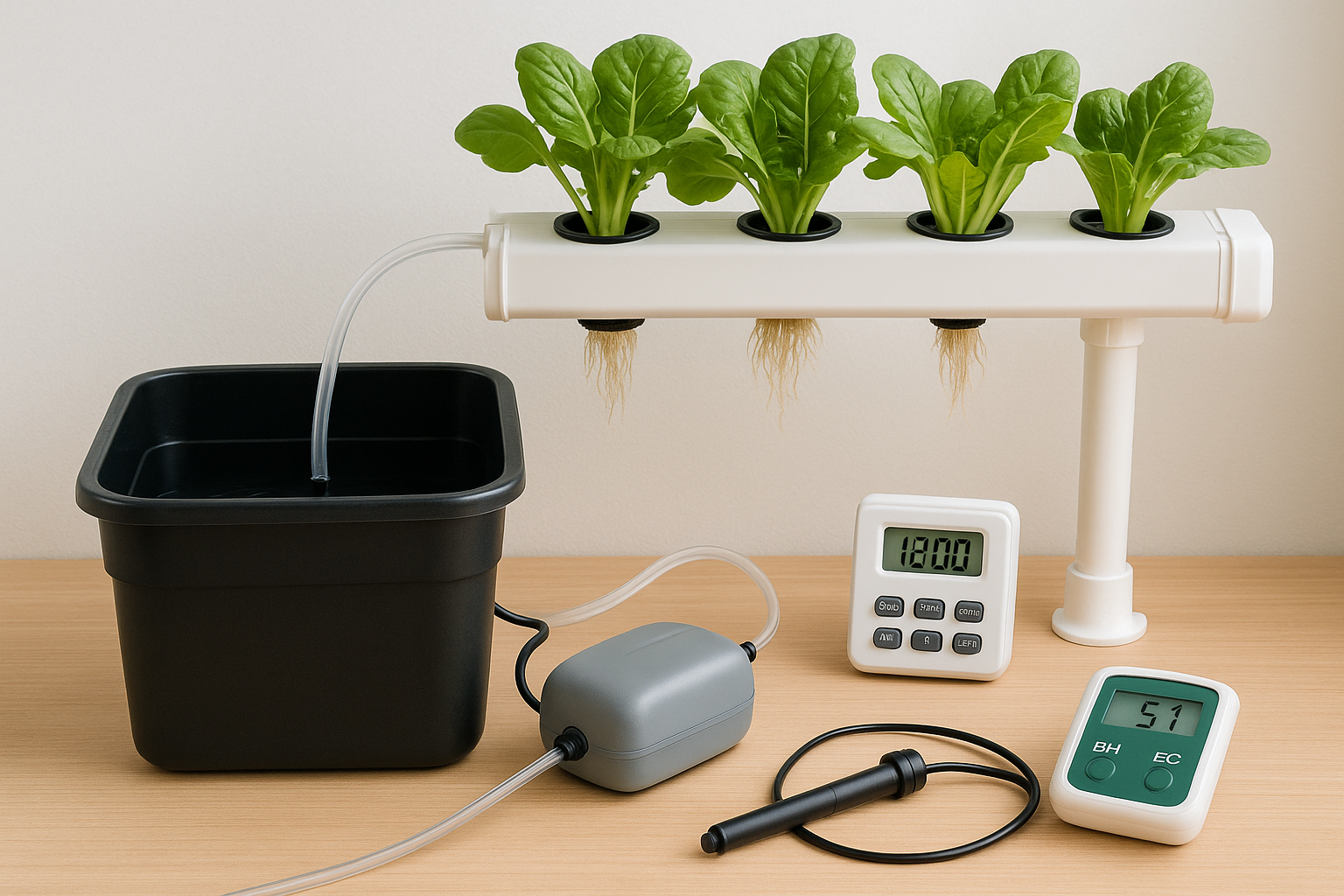
The reservoir is the foundation of any hydroponic system. It holds your nutrient solution and feeds it to the root zone on a timed or continuous basis. Reservoir size determines how often you need to top off or refresh the solution: larger reservoirs buffer against pH and EC swings better than small ones because volume dilutes minor fluctuations before they affect plant health. For most home setups, a dark-colored reservoir is essential because light penetration promotes algae growth, which competes with plants for dissolved oxygen and nutrients.
A delivery system, usually tubing and a submersible pump, moves the solution from the reservoir to the plants. The pump pushes nutrient solution through a network of lines and emitters or channels, depending on the system type. Keeping these lines clean and free of mineral buildup ensures consistent flow rates and prevents blockages that can starve individual plants without any visible warning.
Growing medium and support structure
The growing medium replaces soil as physical support for the root system. Common options include rockwool, perlite, expanded clay pellets (hydroton), and coco coir. Each has a different air-to-water retention ratio. Rockwool and coco coir hold more moisture, making them well suited to systems with intermittent watering cycles, while expanded clay pellets drain quickly and work well in flood-and-drain or deep water culture setups where roots have direct access to oxygenated solution.
Support structures like net pots or mesh cups hold the growing medium in place and suspend the plant above or within the nutrient solution. These cups sit in boards, rails, or towers depending on the system design, and their size should match both the plant's root mass and the spacing requirements of your chosen crop.
Matching your growing medium to your watering frequency is one of the most overlooked decisions in hydroponic setup design.
Pumps, timers, and monitoring tools
Air pumps and water pumps serve different functions but both belong in most setups. An air pump with an airstone oxygenates the reservoir solution, while a water pump circulates the nutrient solution to the roots. A programmable timer controls how often the water pump activates, which directly governs how long roots stay wet versus exposed to air. A digital pH meter and EC meter complete the monitoring toolkit, giving you live readings that tell you whether the solution is balanced and strong enough to support active growth.
How a hydroponic system runs step by step
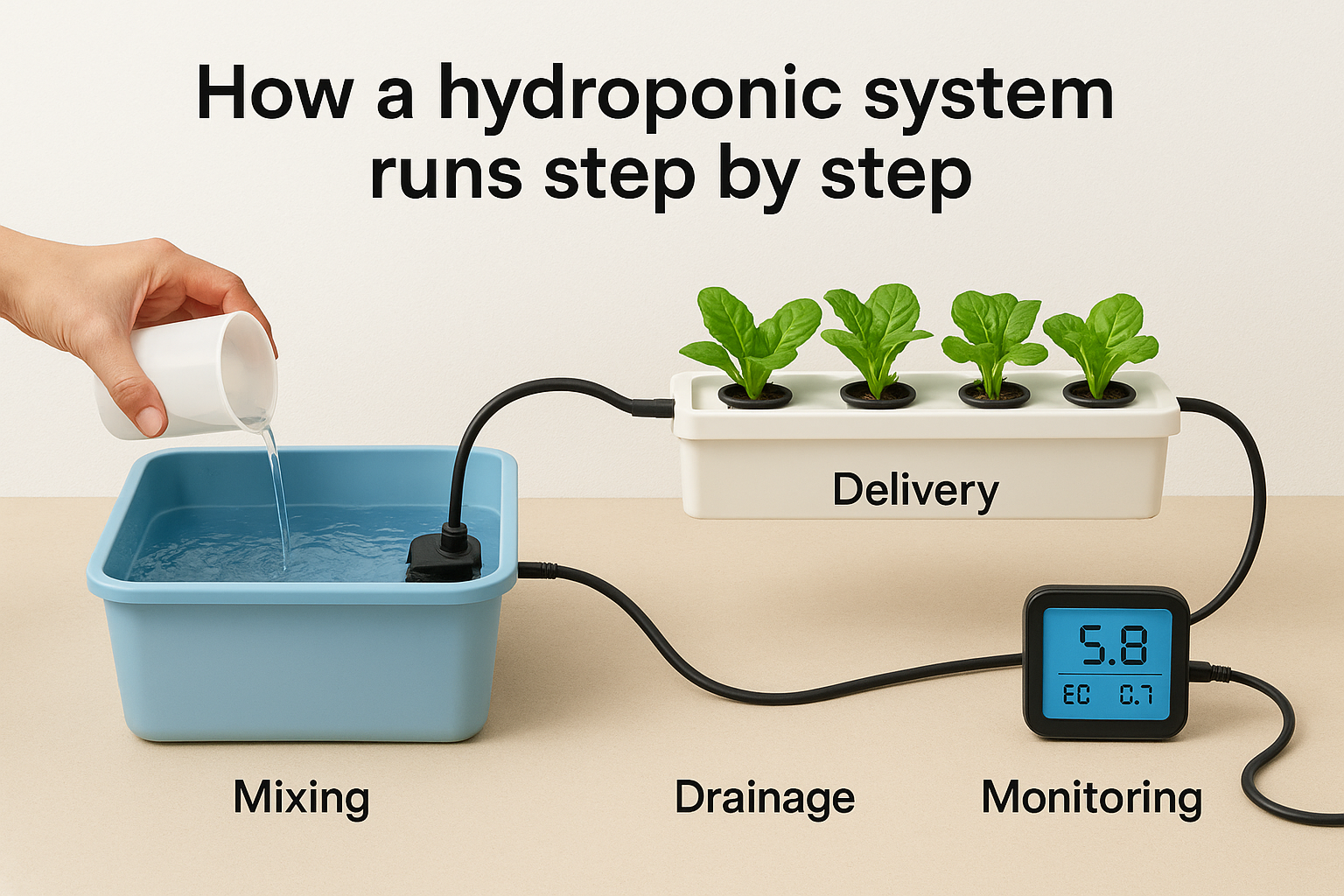
Understanding how hydroponic systems work in theory is useful, but seeing the full cycle from start to finish is what makes the process click. A hydroponic system doesn't operate as a single action. It runs as a repeating loop of mixing, delivery, drainage, and monitoring, and each step in that loop affects the next.
Mixing and testing the solution
Before water reaches any plant, you prepare the nutrient solution in the reservoir. Start by filling the reservoir with your source water, then add your nutrient concentrate according to the manufacturer's dosage for your plant's current growth stage. Mix thoroughly before taking measurements. Check EC first to confirm concentration, then measure pH and adjust up or down using pH correction solutions until the reading falls within your target range, typically 5.5 to 6.5 for most crops.
Run this check every one to two days, not just at initial mixing. Plants actively remove specific ions as they feed, which shifts both EC and pH between checks. Keeping a log of daily readings helps you spot drift patterns early and adjust your top-up routine before the solution moves out of range.
Preparing the solution correctly before the pump activates is the step most beginners skip, and it's usually the source of the first crop problems they can't explain.
Delivering nutrients to the roots
Once the solution is ready, the submersible pump activates on a timer and pushes nutrient-rich water through the delivery tubing to each plant's root zone. In timed systems, this cycle runs for a set number of minutes several times per day. In continuous-flow systems like nutrient film technique, the pump runs uninterrupted and maintains a thin stream of solution across the root surface at all times.
During delivery, roots absorb water and dissolved minerals through the mechanisms covered earlier in this article. The plant draws in what it needs and leaves the rest behind in the returning solution.
Draining and cycling back
After the delivery phase ends, excess solution drains back into the reservoir through gravity-fed return lines. The reservoir collects this runoff, where the air pump continues oxygenating it between pump cycles. This return flow completes the loop, and the timer triggers the next delivery cycle on schedule. Your job is to monitor the reservoir between cycles, top off with fresh mixed solution as volume drops, and flush the system completely every one to two weeks to prevent mineral salt buildup in the lines and growing medium.
Common hydroponic system types and uses
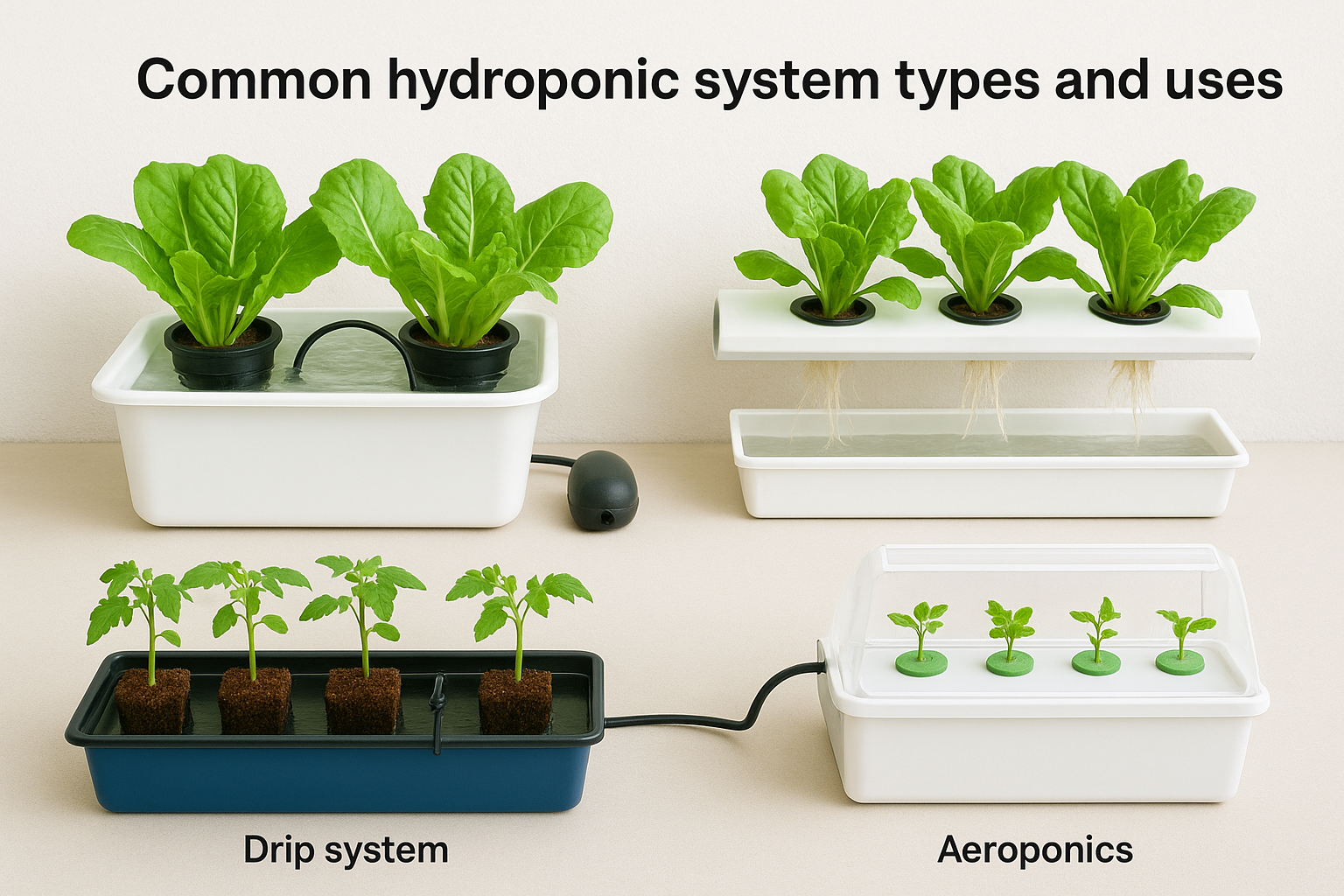
Each hydroponic system type delivers nutrients to roots in a different way, and that difference determines what crops it supports, how much maintenance it demands, and how well it scales. Understanding how hydroponic systems work across different configurations helps you match the right setup to your actual growing goals rather than defaulting to whatever seems simplest. The six main types you'll encounter are deep water culture, nutrient film technique, drip systems, ebb and flow, aeroponics, and wick systems, and each solves a different set of practical growing constraints.
Deep water culture and nutrient film technique
Deep water culture, or DWC, is one of the most widely used systems for beginners and small-scale home growers. Plants sit in net pots suspended above a reservoir, and their roots hang directly into oxygenated nutrient solution kept aerated by a continuous air pump. DWC works especially well for fast-growing crops like lettuce, spinach, and herbs because roots have uninterrupted access to both nutrients and oxygen. The setup involves minimal moving parts, though you need to monitor reservoir level and solution temperature consistently to keep the system stable.
Nutrient film technique, or NFT, runs a shallow, continuous stream of solution through angled channels, passing across root tips before draining back into the reservoir. Only the tips of the roots make contact with the flowing film, while the upper root mass stays exposed to open air. This balance between nutrient contact and oxygen exposure makes NFT highly efficient for leafy greens and strawberries, though it struggles with large, heavy-rooting plants like tomatoes or squash.
Drip systems, ebb and flow, and aeroponics
Drip systems are the most common type in commercial-scale operations worldwide. A pump controlled by a timer pushes nutrient solution through emitters positioned directly above each plant's growing medium. You can run them as recovery systems, where runoff returns to the reservoir, or as non-recovery systems, where runoff drains away. Drip setups accommodate nearly any plant type and scale up more cleanly than most other configurations.
Aeroponics offers the highest oxygen exposure of any system type, which is why commercial propagation facilities use it for root cuttings and seedling production.
Ebb and flow systems flood a growing tray with nutrient solution on a timed cycle, then drain it completely back into the reservoir. Aeroponics suspends roots in open air inside a sealed chamber, where fine mist nozzles spray them with nutrient solution at short, precise intervals. Both systems reward growers who stay on top of timing, equipment checks, and nozzle maintenance.
Choosing the right system for your space
No single hydroponic system fits every situation, and understanding how hydroponic systems work across different types is only useful if you can match those mechanics to your actual space, schedule, and plant goals. The right choice depends on three practical factors: how much time you can commit to daily maintenance, how much physical space you have available, and what you plan to grow. Get those three factors aligned and the system almost selects itself.
Matching system complexity to your time and skill level
If you're new to hydroponics or want a setup that runs with minimal daily intervention, deep water culture is the most forgiving starting point. It has fewer moving parts than drip or NFT systems, and the large reservoir volume buffers against rapid pH and EC swings between checks. You check the solution every one to two days, top off as needed, and the system handles the rest.
The more complex the delivery mechanism, the more often you need to check it for blockages, pressure drops, or timer failures.
Drip systems and ebb-and-flow setups give you more flexibility with plant variety and scale, but they require consistent timer checks and line inspections to stay reliable. Aeroponics offers the fastest growth rates of any setup, but mist nozzles clog without regular cleaning, making it a poor choice for anyone who can't commit to frequent maintenance cycles. Match the system's maintenance demands to the time you genuinely have, not the time you hope to have.
Considering space constraints and plant type
Vertical space and horizontal footprint work differently across system types. NFT and DWC setups run horizontally and work well in long, narrow spaces like balconies or covered outdoor corridors. Tower systems and vertical wick setups stack plants upward, which maximizes yield per square meter in tight residential areas. In Malaysia, where covered outdoor areas and rooftop spaces are common in both landed homes and commercial properties, vertical configurations paired with a compact reservoir often deliver the best balance of output and footprint.
Your plant selection also drives the decision. Leafy greens, herbs, and strawberries thrive in NFT and DWC configurations where root mass stays manageable. Heavy-feeding fruiting crops like tomatoes and cucumbers need more structural support, deeper net pots, and higher solution volumes, which points toward drip systems or larger ebb-and-flow trays built to handle that root expansion over a full growing season.
Maintenance and troubleshooting basics
Keeping a hydroponic system running well comes down to consistent checks on a short list of variables rather than daily intensive labor. Once you understand how hydroponic systems work at a routine level, maintenance stops feeling reactive and becomes predictable. Most problems you'll encounter trace back to just a few root causes: solution drift, oxygen loss, or blocked delivery components, and all three are preventable with a basic weekly schedule.
Routine tasks that keep the system healthy
Your most important daily task is checking reservoir water level and solution temperature. Plants pull water from the reservoir continuously, and as volume drops, both EC and pH shift out of range faster than in a full reservoir. Top off with fresh mixed solution to maintain volume, and confirm temperature stays between 18°C and 22°C to protect dissolved oxygen levels.
A five-minute daily check on water level, temperature, and pump operation catches the majority of system problems before they affect the plants above the waterline.
Every one to two weeks, flush the entire system with plain, pH-adjusted water to clear mineral salt deposits from tubing, emitters, and growing media. Salt buildup reduces flow rates and creates localized hotspots of excess mineral concentration around roots. After flushing, refill with a fresh nutrient solution mixed to the correct EC for your current growth stage. Keep a written log of your pH, EC, and temperature readings so you can spot drift patterns across multiple checks rather than reacting to each reading in isolation.
Diagnosing common problems
When something goes wrong, the visible signs on roots and leaves usually point directly to the cause. Brown, slimy roots with no hair coverage indicate low oxygen or a pathogen like pythium spreading through the reservoir. Check your air pump first, confirm the airstone is still producing bubbles, and inspect the reservoir temperature since warm water accelerates pathogen growth significantly.
Yellow leaves that progress from older growth upward typically signal a nitrogen deficiency, while interveinal yellowing on younger leaves points to an iron or manganese lockout caused by pH sitting too high. In both cases, test pH before adding more nutrients. Correcting pH alone often resolves the visible symptom without changing your nutrient formula at all. Blocked emitters or drip lines cause dry patches in the growing medium that create nutrient stress even when the reservoir is full, so inspect delivery components whenever individual plants show stress that neighbors don't.
Final takeaways
Understanding how hydroponic systems work comes down to one core idea: plants need specific inputs, not a specific growing medium. Soil just happens to deliver those inputs in most natural environments. A well-designed hydroponic setup delivers water, nutrients, and oxygen to the root zone more directly and more precisely than soil ever could, which is why growth rates and yields consistently outperform conventional beds under controlled conditions.
The system type you choose shapes everything from your maintenance schedule to what crops you can realistically grow. Start with your space, your time, and your plant selection, then let those three factors guide you toward the right configuration. Keep your pH and EC in range, protect your root zone from heat and pathogens, and flush your system on a regular schedule.
If you're ready to bring water-smart growing into your outdoor space, talk to our team at Konzept Garden to explore what fits your property.