

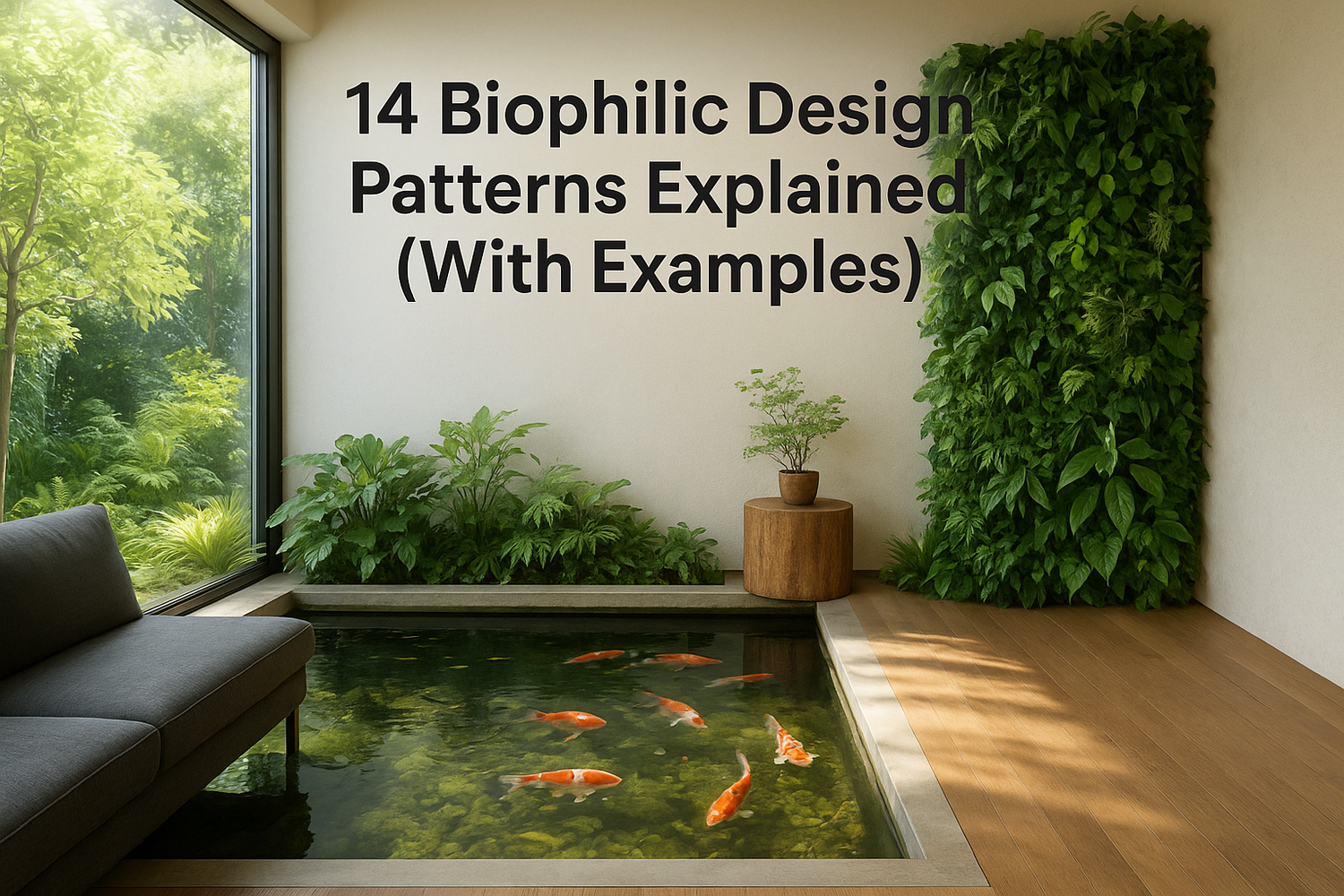
You've probably noticed that some spaces just feel better to be in. A room with natural light and greenery calms you down, while a windowless office with fluorescent lighting drains your energy after an hour. This isn't just a coincidence. Biophilic design patterns give you a proven framework for why nature-connected spaces work, and how to recreate that effect on purpose in a home, office, or garden.
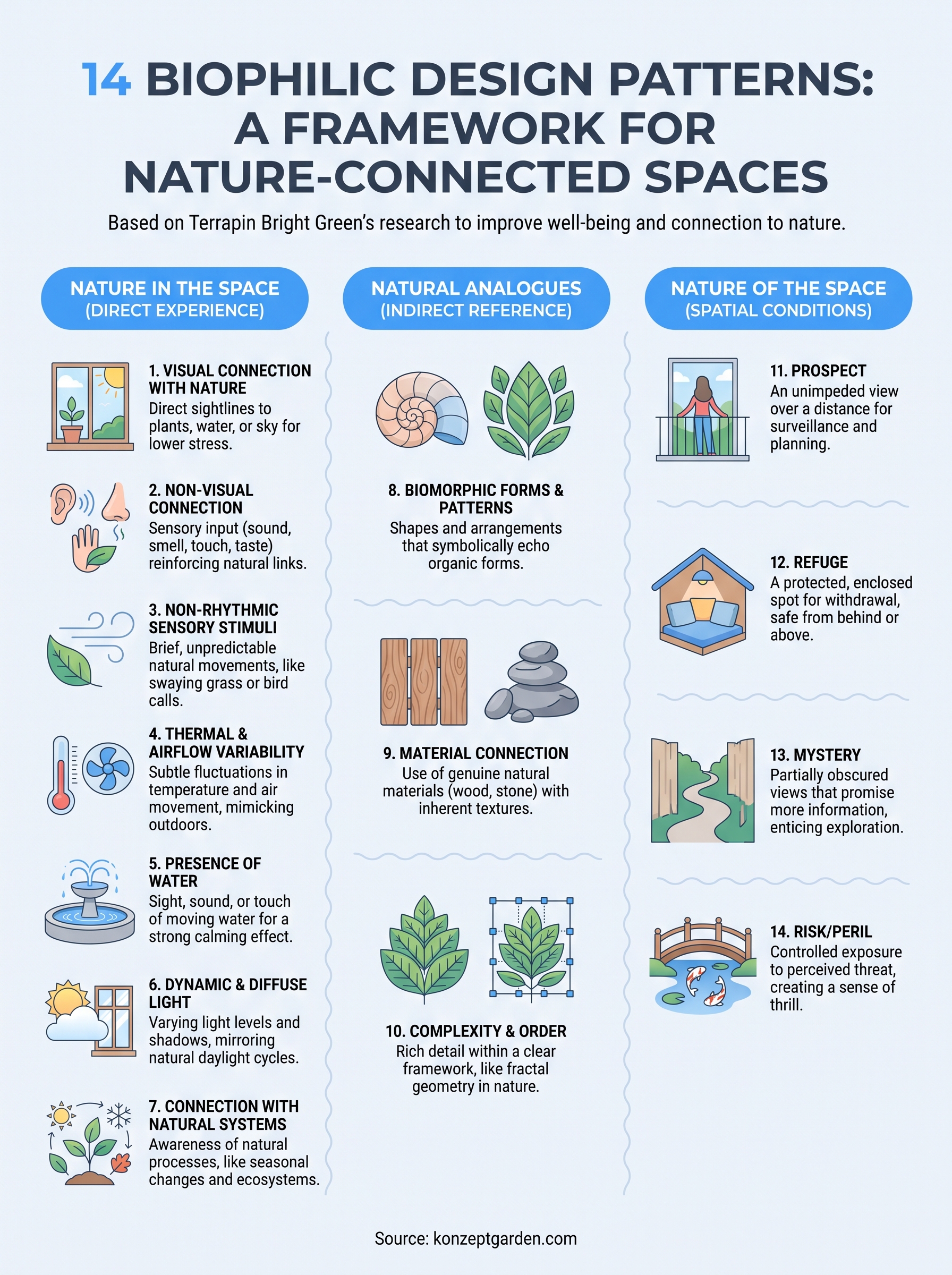
The concept comes from research by Terrapin Bright Green, which identified 14 distinct patterns that explain how humans respond to natural elements in built environments. These patterns fall into three groups: direct nature connections like plants, water, and airflow, indirect nature references such as natural materials and biomorphic shapes, and space and place conditions that shape how we experience a room, from views to refuge-like nooks.
In this article, we break down all 14 patterns with clear examples, so you can spot them in existing spaces or apply them to your own project. As landscape and garden designers based in Malaysia, we see these principles play out daily, whether it's a client's koi pond creating a sense of prospect, or a vertical garden softening a concrete wall. You'll leave with a practical understanding of each pattern and how they connect to real design decisions.
1. Visual connection with nature
What it means
This is the pattern most people think of first when they hear biophilic design patterns: an actual line of sight to something living or natural. That could be a garden bed outside a kitchen window, a potted fig tree in a boardroom, or a green wall visible from a reception desk. Terrapin Bright Green's research, which underpins most modern biophilic frameworks, treats this as the strongest and most immediate pattern because your brain processes visual information faster than any other sense. Direct sightlines to plants, water, or sky trigger a measurable physiological response, even from behind glass.
How to apply it
Start by auditing where people actually spend time and sit or stand for more than a few minutes, then work backward from there. In a home, that's usually the kitchen sink, a home office desk, or a sofa facing a window. In a commercial space, it's meeting rooms and break areas.
- Reposition desks and seating so they face a window, courtyard, or garden rather than a blank wall.
- Add a living feature within eyeline, such as a vertical garden, hanging planters, or a cluster of potted trees.
- Keep window views unobstructed by trimming hedges or repositioning furniture that blocks the sightline.
- Bring in a water feature, like a small koi pond, where it can be seen from indoors.
If you're renovating an outdoor space specifically to create these sightlines, it helps to plan the planting layout before you touch the hardscape, since mature trees and shrubs take years to fill in and block the wrong views if placed carelessly.
Why it matters
Studies referenced by the U.S. General Services Administration have linked views of nature to lower stress hormone levels, faster recovery from mental fatigue, and improved concentration in office settings. This isn't a soft, feel-good claim, it's a repeatable finding across hospital, school, and workplace research.
A single window with a real view of greenery can do more for someone's mood than an entire wall of motivational posters.
We've watched this play out with clients who redesigned a garden specifically to be visible from their living room. The change wasn't cosmetic. People started using that room more, sitting there longer, and reporting that the house felt calmer. That's the visual connection pattern doing exactly what the research predicts, quietly, every single day, without anyone needing to consciously notice it's working.
2. Non-visual connection with nature
What it means
Sound, smell, touch, and even taste can pull you into a natural experience just as strongly as sight, sometimes more so. Think of the smell of rain on hot pavement, the rustle of bamboo leaves, or the texture of rough bark under your palm. Non-visual connection with nature covers any sensory input, other than direct vision, that reinforces a link to the natural world. Terrapin Bright Green groups this separately from visual connection because the two trigger different neurological pathways, and a space can succeed at one while completely missing the other.
How to apply it
Building these cues in usually means layering several senses at once rather than relying on a single feature.
- Add fragrant plants near entrances or windows, such as jasmine, citrus, or herbs like rosemary and mint.
- Introduce moving air through operable windows or ceiling fans, so you catch outdoor scents and temperature shifts naturally.
- Include tactile materials like natural stone paving, timber decking, or a living moss wall people can touch.
- Use ambient natural sound, whether that's real birdsong from a garden or a trickling water feature indoors.
A client's café we worked with placed potted herbs right beside the outdoor seating, and customers started brushing the leaves as they walked past without being asked to.
Why it matters
Research on multisensory environments shows that combining scent, sound, and touch with nature reduces perceived stress faster than visual cues alone, particularly in healthcare and workplace settings.
The smell of a garden can calm someone down before they've even seen it.
For spaces where a full view isn't possible, like an interior room or basement office, this pattern becomes your best available substitute.
3. Non-rhythmic sensory stimuli
What it means
This pattern describes brief, unpredictable moments of sensory input that mimic how nature actually behaves, a leaf skittering across a path, a sudden gust that shifts a curtain, a bird call that stops as quickly as it started. Non-rhythmic sensory stimuli are the opposite of a metronome or a looping soundtrack. Your brain stays subtly alert to these small, random events because that's how it evolved to scan the outdoors for information, and this pattern is one of the core biophilic design patterns researchers point to when explaining why sterile, repetitive environments feel flat.
How to apply it
You can't script randomness, but you can build the conditions for it to happen naturally.
- Plant grasses or bamboo that move unpredictably in wind rather than relying on static hedging alone.
- Add wind chimes or loose foliage near windows or patios so airflow creates variation on its own.
- Position a water feature where ripples and light reflections shift without a fixed pattern.
- Avoid looping ambient soundtracks, which your brain quickly tunes out because they repeat.
A courtyard with tall grasses does this better than almost any mechanical device, since every gust produces a slightly different sway and sound.
Why it matters
Environments that never change go unnoticed, and unnoticed environments don't restore attention the way nature does. Terrapin Bright Green's research links this pattern to sustained attention and lower heart rate variability compared to static or fully rhythmic settings.
A space that never surprises you, even slightly, stops feeling alive.
We see this constantly in koi pond installations. Clients rarely mention the fish specifically, they mention how the light and ripples keep catching their eye without ever feeling repetitive.
4. Thermal and airflow variability
What it means
Step outside on a breezy afternoon and you'll feel small shifts in temperature, humidity, and air movement that a climate-controlled room never gives you. Thermal and airflow variability captures this pattern: subtle, natural fluctuations in air temperature, humidity, and surface temperature that mimic being outdoors rather than sealed inside one static climate zone. Malaysia's tropical humidity makes this pattern especially relevant, since most buildings here fight the outdoor climate instead of working with it.
How to apply it
You don't need to sacrifice comfort to introduce variability, you just need to avoid over-conditioning every square inch.
- Use operable windows or louvers so occupants can let outdoor air in when conditions allow.
- Create shaded outdoor zones, like a pergola or covered patio, where temperature naturally differs from indoor spaces.
- Position ceiling fans or cross-ventilation paths to move air without relying entirely on mechanical cooling.
- Mix hard and soft surfaces outdoors, since stone, water, and planting each hold and release heat differently throughout the day.
A shaded courtyard next to an air-conditioned living room gives residents a genuine choice between two distinct thermal experiences, rather than one uniform setting all day.
Why it matters
Research cited by Terrapin Bright Green links exposure to mild thermal variation with improved alertness and comfort, compared to environments locked at a single, unchanging temperature. Static climates feel comfortable at first but grow monotonous fast.
A body that never has to adjust to its environment eventually stops paying attention to it.
Offices and homes that offer even a small outdoor breakout space tend to get used far more than those relying solely on air conditioning.
5. Presence of water
What it means
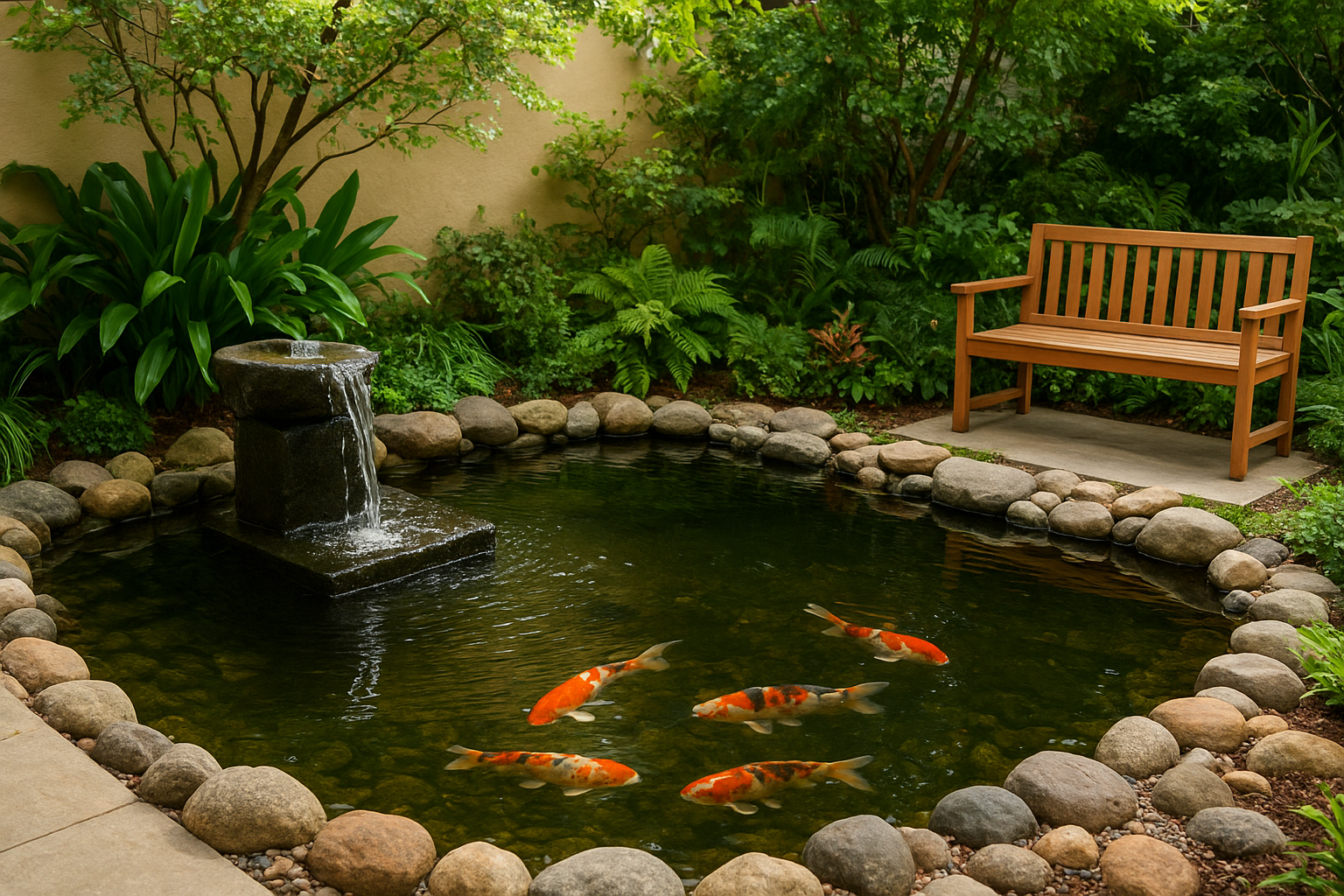
Water is its own pattern within biophilic design patterns because humans respond to it differently than to plants or light. The sight, sound, or touch of water, whether it's a fountain, a koi pond, or even a birdbath, activates a calming response that's separate from general visual connection with nature. Terrapin Bright Green singles this pattern out because moving, multisensory water (something you can see, hear, and sometimes touch) produces a stronger effect than a static image of water ever could.
How to apply it
You don't need a swimming pool to bring this pattern into a space. Small, well-placed water features often do more work than large, purely decorative ones.
- Install a koi pond or Himalaya Rock Fish Pond near a patio or entrance where sound and movement carry indoors.
- Add a tabletop or wall fountain in interior spaces without garden access.
- Position water features near seating areas, not just as a passing view, so people can hear the trickle while relaxing.
- Combine water with reflective light, since rippling reflections extend the pattern's effect onto nearby walls and ceilings.
Why it matters
Studies referenced by Terrapin Bright Green associate the sound and sight of water with reduced stress levels and lower blood pressure, more consistently than almost any other single natural element.
Nothing calms a room faster than the sound of moving water.
We install koi ponds regularly for clients across Malaysia, and the feedback is nearly always the same: they didn't expect to notice the sound as much as they do, but once it's there, the space feels unfinished without it.
6. Dynamic and diffuse light
What it means
Sunlight changes constantly, shifting angle, intensity, and color from dawn to dusk, and your body reads those shifts as cues for alertness and rest. Dynamic and diffuse light describes this pattern within biophilic design patterns: varying levels of light and shadow that mimic natural daylight rather than the flat, unchanging glow of a fluorescent tube. Diffuse simply means the light is softened, filtered through leaves, blinds, or clouds, instead of hitting a surface directly and harshly.
How to apply it
Getting this right usually means rethinking window placement and shading rather than adding more fixtures.
- Use sheer curtains or louvers to soften direct sun without blocking it out entirely.
- Position skylights or clerestory windows so light shifts across a room as the sun moves.
- Plant deciduous trees or trellised vines near windows, letting dappled shade change with the seasons.
- Avoid uniform overhead lighting that erases natural variation, especially in workspaces used all day.
A pergola with climbing plants does this cheaply and effectively, casting a moving, patterned shade that no fixed awning can replicate.
Why it matters
Static, artificial lighting keeps your circadian rhythm guessing, which research from the U.S. Environmental Protection Agency on indoor environmental quality links to fatigue and poor concentration indoors. Dynamic light, by contrast, mirrors the daily rhythm your body evolved to read.
Light that never changes eventually feels like no light at all.
We notice this most in outdoor dining areas we've designed under pergolas, where clients linger far longer than they do under a plain covered patio with static overhead lighting.
7. Connection with natural systems
What it means
Gardens and buildings that ignore the seasons feel disconnected, even when they're full of plants. Connection with natural systems is the pattern that accounts for time, change, and ecological processes, think of a garden bed that visibly shifts from wet season growth to dry season dormancy, or a pond that supports its own small ecosystem of fish and plants. This is one of the less obvious biophilic design patterns, since it's not about a single feature but about a space behaving like a living system rather than a fixed backdrop.
How to apply it
Applying this pattern means designing for change over months and years, not just for how a space looks on installation day.
- Choose seasonal or deciduous planting that visibly changes with the calendar instead of static, evergreen-only beds.
- Design ponds as ecosystems, with fish, plants, and filtration working together rather than a purely decorative water feature.
- Leave room for natural succession, letting groundcover fill in and mature rather than replacing plants the moment they look imperfect.
- Track and celebrate seasonal shifts, such as flowering periods or migratory birds visiting a garden.
Why it matters
Ecological cycles ground people in a sense of time and place that static landscaping can't provide. Terrapin Bright Green's research links visible natural processes to a stronger sense of connectedness and lower feelings of isolation from the environment.
A garden that changes with the seasons reminds you that you're part of something bigger than the room you're standing in.
Homeowners who let a koi pond mature into a full mini-ecosystem tell us it feels less like decor and more like a living part of the property.
8. Biomorphic forms and patterns
What it means

Humans respond to organic shapes differently than to straight lines and hard angles, even when no actual plant or animal is present. Biomorphic forms and patterns cover shapes, curves, and arrangements that echo nature symbolically, think of a spiral staircase that mirrors a nautilus shell, a honeycomb tile layout, or furniture with leaf-like curves. This is one of the biophilic design patterns that works indirectly, since it references nature without requiring a living plant or water feature at all.
How to apply it
Most spaces already have some biomorphic potential hiding in flooring, furniture, or structural details.
- Choose curved furniture profiles over rigid rectangles, especially for seating and tables in living areas.
- Use organic tile or paving patterns, like pebble mosaics or flowing stone paths, instead of uniform grids.
- Select fabrics and wallpapers printed with leaf veins, branching patterns, or wave motifs.
- Design garden pathways with gentle curves rather than straight, rigid lines wherever the layout allows it.
A winding gravel path through a garden bed reads as far more inviting than a straight concrete strip, even across the same distance.
Why it matters
Research cited by Terrapin Bright Green links exposure to biomorphic shapes with lower stress markers and increased comfort, likely because these forms feel familiar to a brain wired to recognize natural growth patterns.
A curved line can feel like nature even when there's no plant in sight.
We use this constantly in hardscaping, curving a pathway or pond edge instead of squaring it off changes how the entire garden feels to walk through, without adding a single extra plant.
9. Material connection with nature
What it means
Some materials carry nature's signature even after they've been cut, shaped, or finished. Material connection with nature refers to using genuine natural materials, wood, stone, wool, rattan, bamboo, rather than synthetic imitations that mimic their look without any of their texture, weight, or aging process. This pattern sits apart from biomorphic forms because it's about the actual substance in your hands, not the shape it's carved into. A teak bench and a plastic bench shaped identically will still feel worlds apart the moment you touch either one.
How to apply it
Swapping in real materials often costs more upfront but pays back in how a space ages.
- Choose solid timber or bamboo for decking, screens, and furniture instead of composite or plastic alternatives.
- Use natural stone paving rather than stamped concrete that only imitates the pattern.
- Bring in rattan or wicker furniture for patios and covered outdoor seating.
- Let materials weather naturally, since patina and grain changes reinforce the sense that a surface came from something living.
A timber pergola that silvers with age tells a more honest story than a powder-coated steel frame ever will.
Why it matters
Terrapin Bright Green's research links contact with real natural materials to measurable comfort and lower stress compared to synthetic substitutes, even when the visual difference is subtle. Your hands and eyes pick up on grain, temperature, and imperfection in ways that flat, uniform surfaces can't replicate.
A material that came from something alive still carries a trace of that life.
We steer clients toward real stone and timber whenever budget allows, because the difference shows up years later, not on installation day.
10. Complexity and order
What it means
Nature is never chaotic and never perfectly uniform either, it sits in a sweet spot between the two. Complexity and order describes spatial arrangements rich with detail, like a fern's fractal leaves or a stone wall built from irregular rocks, that still follow an underlying organizing structure your brain can grasp. Fractal geometry, the kind mathematicians use to describe coastlines and tree branches, sits at the heart of this pattern within biophilic design patterns. Too much order feels sterile, too much complexity feels overwhelming, and this pattern asks you to find the balance nature already figured out.
How to apply it
Getting the balance right usually means layering detail within a clear framework, not scattering it randomly.
- Repeat a plant species in varied groupings rather than a single specimen or total randomness.
- Use fractal-patterned tiles or screens, where a repeating motif still shows organic variation up close.
- Layer planting heights with a consistent border but varied texture inside it.
- Design facades with rhythmic but irregular elements, like staggered timber slats.
A garden bed with a defined edge but varied planting inside almost always reads as more inviting than either a wild tangle or a clipped monoculture.
Why it matters
Terrapin Bright Green's research links fractal complexity to measurable stress reduction, since your visual system processes these patterns with less effort than either extreme.
Nature never chooses between order and detail, it holds both at once.
We see this constantly in mixed planting schemes, where a structured layout carrying genuine variety consistently outperforms both rigid formality and unplanned wildness in how long clients actually spend outdoors.
11. Prospect and refuge
What it means
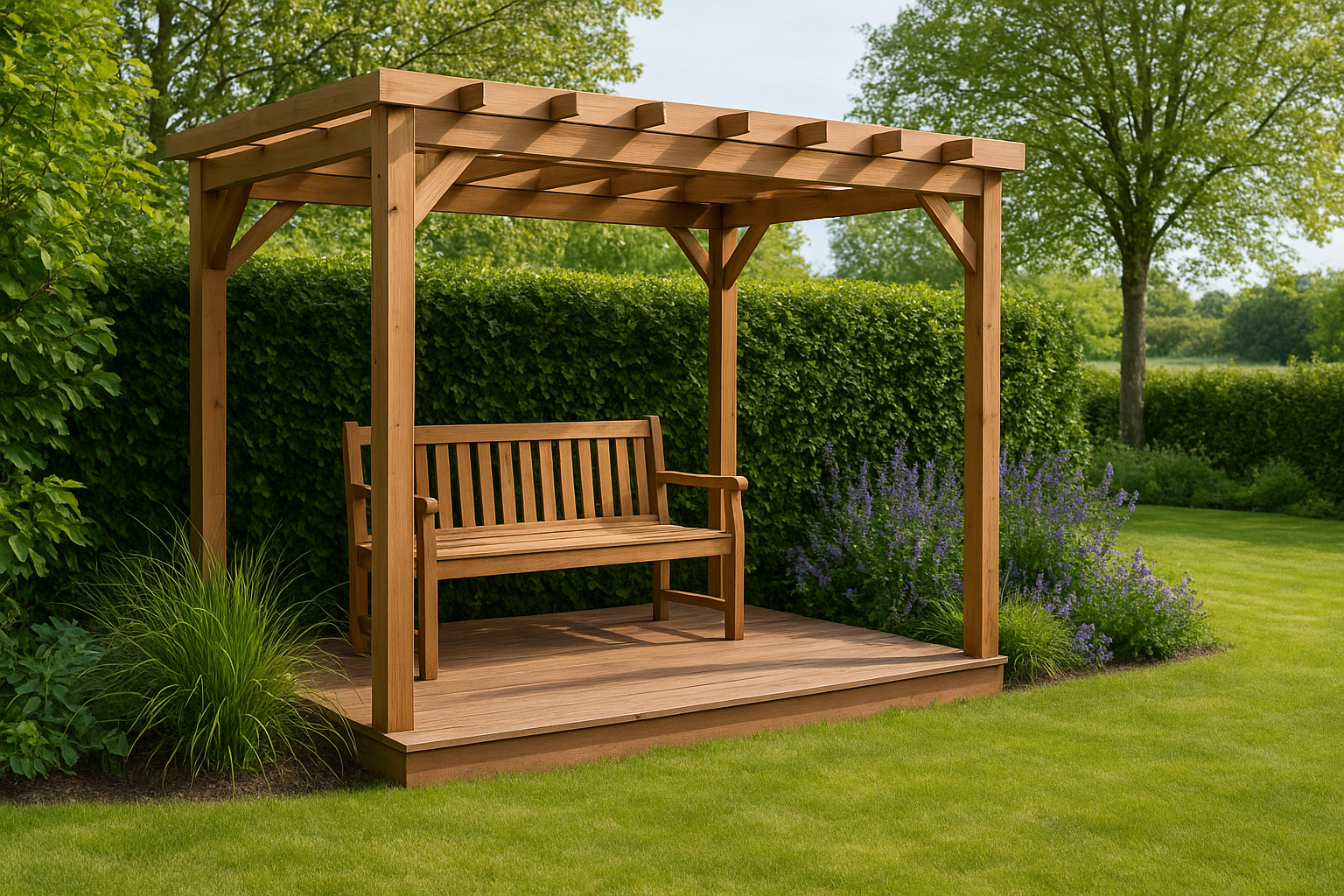
Humans instinctively seek spots where they can see out without being seen themselves, a habit left over from when spotting danger early meant survival. Prospect and refuge describes this pairing: an open view combined with a sheltered, enclosed spot to observe it from. Think of a garden bench tucked under a pergola that still overlooks the lawn, or a window seat nestled into an alcove facing the street. Among biophilic design patterns, this one shapes how safe and settled a space feels, not just how it looks.
How to apply it
Building this pattern in usually means combining an enclosed backdrop with an unobstructed sightline outward.
- Position seating with its back to a wall, hedge, or screen, facing open lawn, water, or a view.
- Add a covered nook or pergola at the edge of a larger open space rather than in the middle of it.
- Use raised platforms or decks that let people survey a garden from slightly above ground level.
- Avoid fully exposed seating in the center of open areas, which tends to feel unprotected even outdoors.
A reading corner tucked beside a bookshelf but facing a garden window captures this balance indoors just as well as a garden bench does outside.
Why it matters
Spaces offering both shelter and a clear outward view consistently rank higher for perceived safety and relaxation in environmental psychology research cited by Terrapin Bright Green.
A view means little if you feel exposed while taking it in.
We design garden nooks with this pairing constantly, and clients gravitate toward them over open, unshaded seating almost every time, even on cooler days.
12. Mystery and risk or peril
What it means
A path that curves out of sight pulls you forward in a way a straight path never does. Mystery describes partially obscured views that promise more information just beyond reach, like a garden bend hiding what's around the corner or a trellis screen that only half-reveals the space behind it. Risk or peril, the second half of this pattern, refers to a controlled sense of exposure, a footbridge over a koi pond, a slightly elevated deck edge, something that triggers a small thrill without any real danger attached. Among biophilic design patterns, this pairing is the one most often skipped, since it takes confidence to hide part of a design on purpose.
How to apply it
Creating mystery usually means holding something back rather than revealing everything at once.
- Curve pathways around dense planting so the destination isn't visible from the entrance.
- Use screens, arbors, or tall grasses to partially block a view rather than remove it.
- Add a stepping-stone crossing over a pond or shallow water feature for mild, safe risk.
- Reveal a garden in stages, with each turn or gate opening onto something new.
Why it matters
Spaces that reveal themselves gradually hold attention longer than those you can take in with a single glance. Terrapin Bright Green's research links this pattern to heightened engagement and a stronger emotional pull toward exploring further.
A garden that hides part of itself is more interesting than one that shows everything at once.
We design winding paths into larger gardens specifically for this reason, clients explore the full space instead of glancing at it from the patio and calling it done.
Bringing these patterns into your own space
You don't need all 14 patterns crammed into one project to feel the difference. Start with one or two that fit your space, like a visual connection with nature through a window view, or the presence of water near a patio, and build from there. Most gardens we've designed over the years succeed because they layer a handful of these patterns well, not because they chase every box on a checklist.
Biophilic design patterns give you a way to explain why some spaces feel alive and others feel flat, and more importantly, a way to fix it deliberately. If you're ready to bring prospect and refuge, a koi pond, or any of these patterns into your own garden, get in touch with our team and we'll help you figure out where to start.