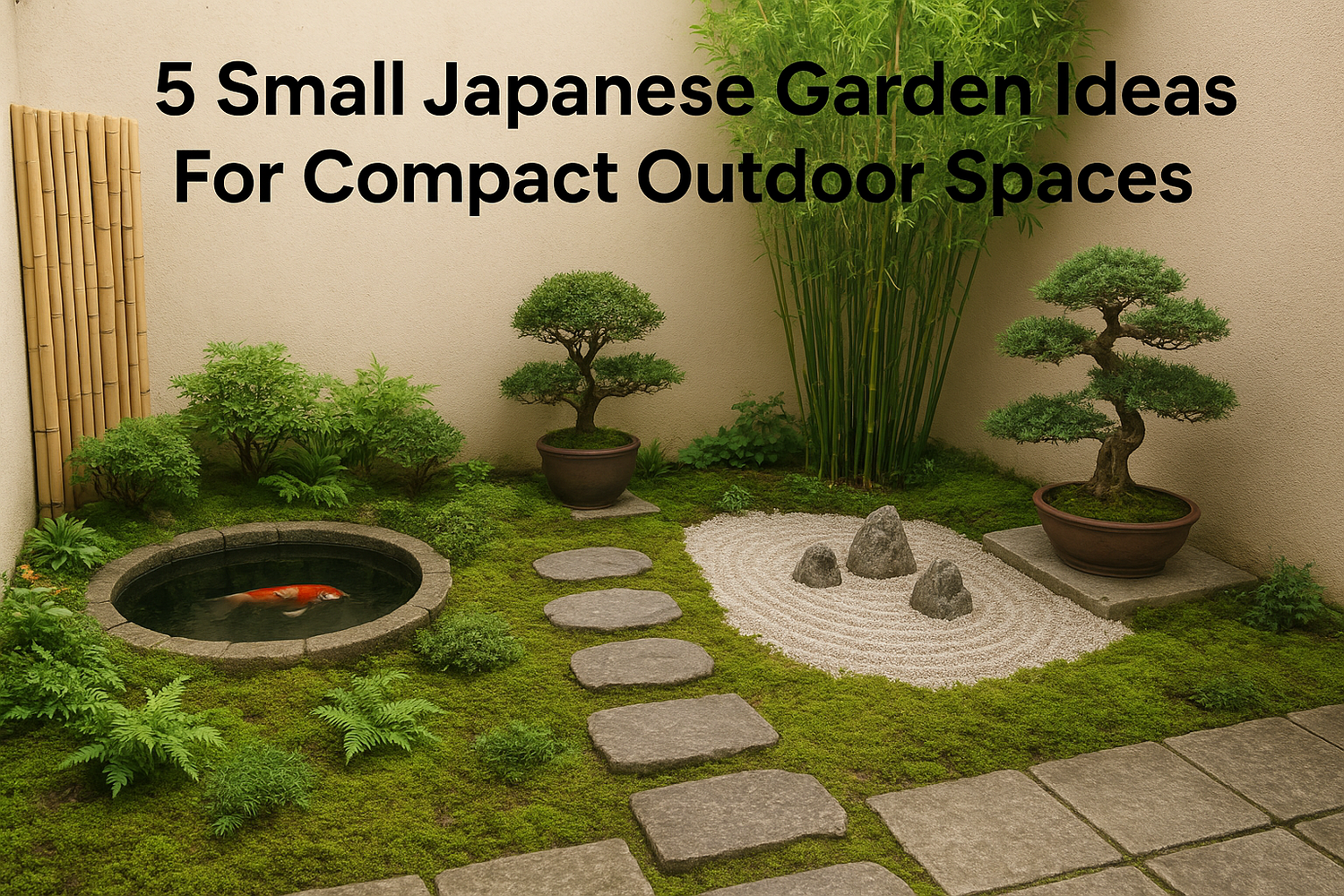
A tiny courtyard or narrow side yard in Malaysia's climate feels impossible to turn into anything peaceful, especially when you're picturing sprawling Kyoto-style gardens with room to spare. That's the trap most homeowners fall into: assuming Japanese garden design only works on large plots. In reality, small japanese garden ideas rely on restraint, not size, and a compact space often forces the discipline that makes these gardens beautiful in the first place.
If you're searching for ways to bring calm, structure, and greenery into a limited outdoor area, this guide gives you practical layouts and plant choices suited to Malaysia's tropical heat and humidity. We focus on space-saving techniques like gravel paths, dwarf pines, and framed views that make a few square meters feel intentional rather than cramped, while keeping low-maintenance upkeep realistic for our local climate.
Below, we walk through five distinct approaches, from minimalist zen corners to water features that suit a koi pond enthusiast, each one drawn from real design principles our team applies on residential projects across Malaysia. Whether you're working with a balcony, a courtyard, or a narrow strip beside your house, you'll find a concept here that fits.
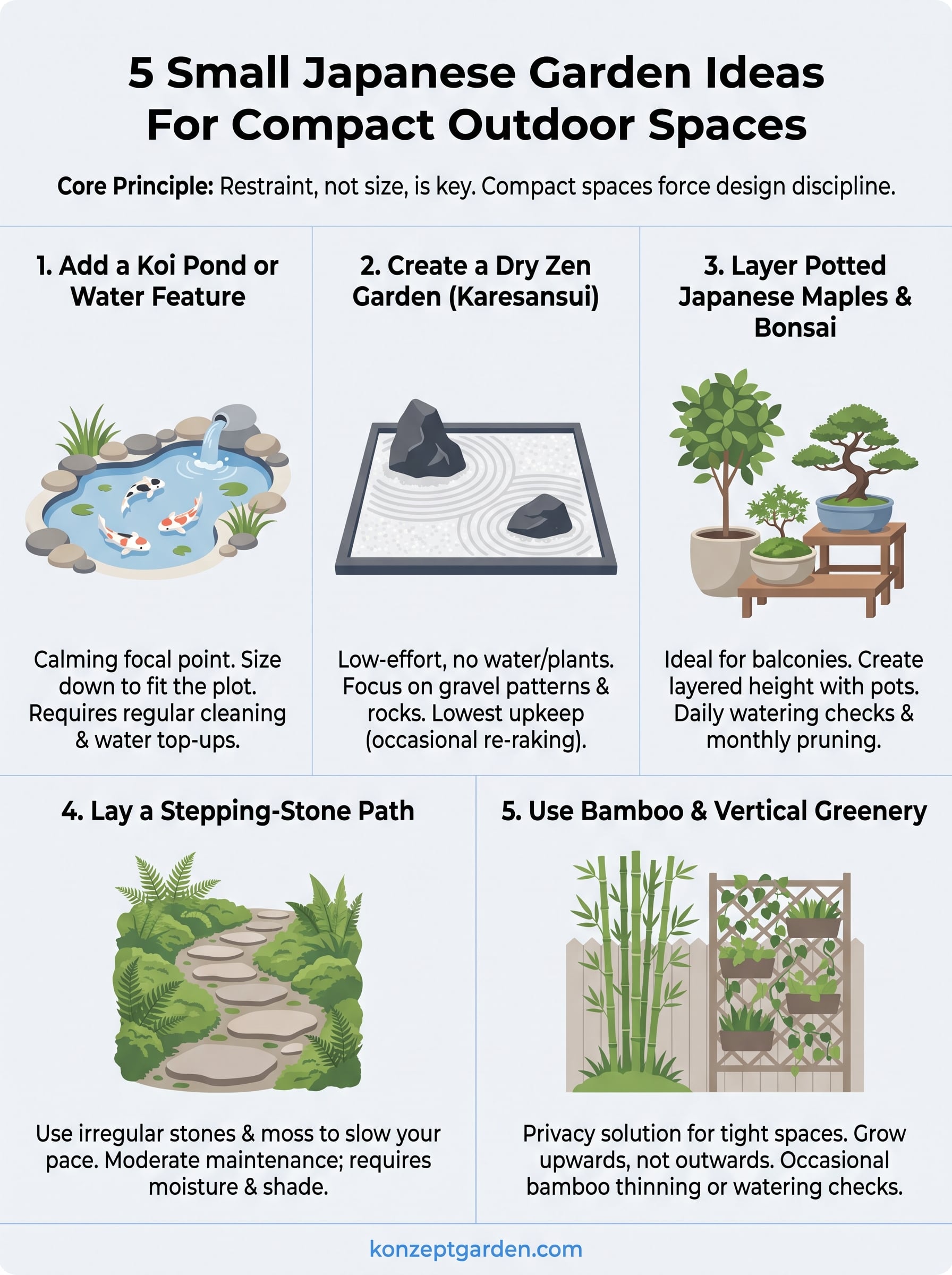
1. Add a koi pond or water feature for a calming focal point
Water does most of the emotional work in a Japanese garden, and in a small space, one pond or basin carries the whole design. A koi pond or a simple bubbling basin gives your eyes a single place to rest, which matters more in a compact courtyard than in a sprawling garden where attention naturally wanders. Konzept Garden builds these as custom features precisely because the size and shape need to match the plot, not the other way around.
How it works
The trick is scale. A tsukubai (a small water basin) or a shallow koi pond tucked into a corner creates the sound and movement of water without demanding the footprint of a full pond. Position it where you'll see it from your main seating area or window, since the whole point is a calming focal point you interact with daily, not a feature buried at the back of the yard.
Plants and materials to use
Keep the surrounding materials simple so the water stays the star.
- Zen Bio Koi Pond or Himalaya Rock Fish Pond style builds, sized down for compact plots
- River pebbles and dark basalt rock edging
- Dwarf bamboo or low sedges planted around the rim
- A single stone lantern or water spout for texture
A well-placed water feature does more for a small Japanese garden than any amount of extra planting ever will.
Maintenance level
Ponds ask for more upkeep than gravel or moss, but it's manageable if you plan for it. Expect to clean filters monthly, top up water during Malaysia's dry stretches, and watch for algae in direct sun. Choosing hardy koi varieties and a proper filtration system from the start saves you constant troubleshooting later, and it's why we recommend a professional build rather than a DIY liner pond for anything meant to last.
Best garden size
This idea works even in a 3 to 5 square meter courtyard, provided you're willing to give up floor space for depth rather than width. Balconies can work too, using a raised basin instead of an in-ground pond. If your plot is genuinely tiny, a wall-mounted water spout gives you the same auditory effect without the maintenance of live fish.
2. Create a dry zen garden with raked gravel and rocks
A dry zen garden, or karesansui, strips the design down to gravel, rock, and negative space. There's no water, no lush planting, just raked lines that suggest movement and a few boulders that stand in for mountains or islands. For a small courtyard, this is often the lowest-effort way to get an authentic Japanese garden feel without fighting Malaysia's heat.
How it works
You lay a bed of gravel, usually 5 to 8 cm deep, and rake it into parallel lines or circles around placed rocks. The pattern itself becomes the visual interest, so you don't need much floor area for it to read as intentional. A framed gravel bed against a wall or fence works especially well in narrow side yards where planting space is limited anyway.
Plants and materials to use
Keep the plant list short and let the gravel and stone carry the design.
- White or grey granite gravel, raked in straight or wave patterns
- Two or three asymmetrical boulders, uneven in size
- A single dwarf pine or cloud-pruned shrub as an anchor
- Moss patches at the gravel's edge for contrast
A dry zen garden proves that restraint, not abundance, creates the strongest sense of calm.
Maintenance level
This is the lowest-maintenance option on this list. You'll re-rake occasionally and clear leaves, but there's no watering schedule or pest control to manage.
Best garden size
Even a 2 square meter courtyard corner works, making it ideal for genuinely tight plots.
3. Layer potted Japanese maples and bonsai trees
Potted trees give a small courtyard the layered, mature look of a full-sized garden without needing garden beds at all. Container planting lets you group different heights and textures on a patio or balcony, then rearrange them whenever the space needs a refresh. This is the approach we suggest most often for clients with rooftop terraces or covered courtyards where there's no soil to dig into.
How it works
Group three to five pots of varying heights so the eye moves naturally through the arrangement, mimicking the layered canopy of a forest floor. Place your tallest specimen at the back or center and step the shorter pots down around it, the same way a bonsai display is staged in exhibitions.
Plants and materials to use
True Japanese maples struggle in Malaysia's humidity, so we swap them for heat-tolerant substitutes that give a similar silhouette.
- Dwarf podocarpus or ficus bonsai as the anchor tree
- Glazed ceramic pots in muted green or charcoal tones
- Moss ground cover inside each pot for a finished look
A well-staged group of potted trees can carry the same visual weight as a mature garden bed.
Maintenance level
Expect daily watering checks and monthly pruning to maintain shape, plus occasional repotting every two to three years.
Best garden size
A balcony as small as 2 square meters handles this comfortably, since everything stays contained in pots.
4. Lay a stepping-stone path through moss and ferns
A stepping-stone path turns a plain strip of ground into a slow, deliberate walk, which is exactly the effect you want in a small Japanese garden. Instead of a straight concrete walkway, you set irregular flat stones into a bed of moss or low ferns, forcing anyone who crosses it to slow down and watch their footing. That pause is the whole point, and it works even in a side passage barely a meter wide.
How it works
You space flat stones (called tobi-ishi) at a natural walking stride, then fill the gaps with moss, fine gravel, or low groundcover so the stones look like they've settled into the landscape rather than been placed on top of it. Curving the path slightly, even in a short run, makes the space feel longer than it is.
Plants and materials to use
Choose textures that thrive in shade and humidity, since Malaysia's climate favors moss and ferns over anything sun-loving.
- Flat granite or sandstone stepping stones, uneven edges preferred
- Java moss or local shade moss between stones
- Bird's nest fern or asparagus fern along the border
- Fine river gravel where moss won't establish
A path you have to walk slowly changes how you experience the entire garden.
Maintenance level
Moderate. Moss needs consistent shade and moisture, so you'll water lightly during dry spells and remove fallen leaves weekly.
Best garden size
Works in narrow side yards as tight as 1 meter wide, making it one of the most flexible ideas here.
5. Use bamboo and vertical greenery for privacy
Compact courtyards in Malaysia often back onto neighboring walls or windows, and a bamboo screen solves the privacy problem without eating into your floor space. Growing upward instead of outward is the whole strategy here, and it's one of the fastest ways to make a small plot feel enclosed and intentional rather than exposed.
How it works
You plant bamboo in a row along a fence line or install a trellis system with climbing greenery, then let the height do the work that a fence alone can't. Vertical greenery also softens hard boundary walls, which is common in Malaysian terrace and semi-detached homes where the garden sits close to the property line.
Plants and materials to use
Stick to clumping varieties so growth stays manageable in a tight footprint.
- Clumping bamboo (Bambusa multiplex) rather than running varieties
- EcoWall vertical garden panels for instant greenery without root spread
- Timber or bamboo trellis frames
- Trailing philodendron or pothos for the panel gaps
Height, not width, is what makes a small garden feel private.
Maintenance level
Clumping bamboo needs occasional thinning to stop it from crowding, while vertical panels require regular watering checks since soil volume is limited.
Best garden size
A strip as narrow as 60cm along a wall is enough, making this ideal for side passages and boundary fences.
Creating your own peaceful retreat
None of these five ideas need a sprawling plot to work. A koi pond in a 3 square meter corner, a raked gravel bed against a side wall, potted bonsai on a balcony, a mossy stepping-stone path, or a bamboo screen along a boundary fence all prove the same point: small Japanese garden ideas succeed through restraint, not square footage. Pick one that matches your climate exposure and daily foot traffic, and build outward from there rather than trying to cram in every element at once.
If you've settled on a water feature as your focal point, that's usually where our clients see the biggest shift in how a courtyard feels day to day. Konzept Garden has built custom koi ponds for compact Malaysian homes for years, sizing each one to the plot rather than forcing a standard design to fit. Get in touch with our team and we'll help you turn your small space into a garden you actually want to sit in.