

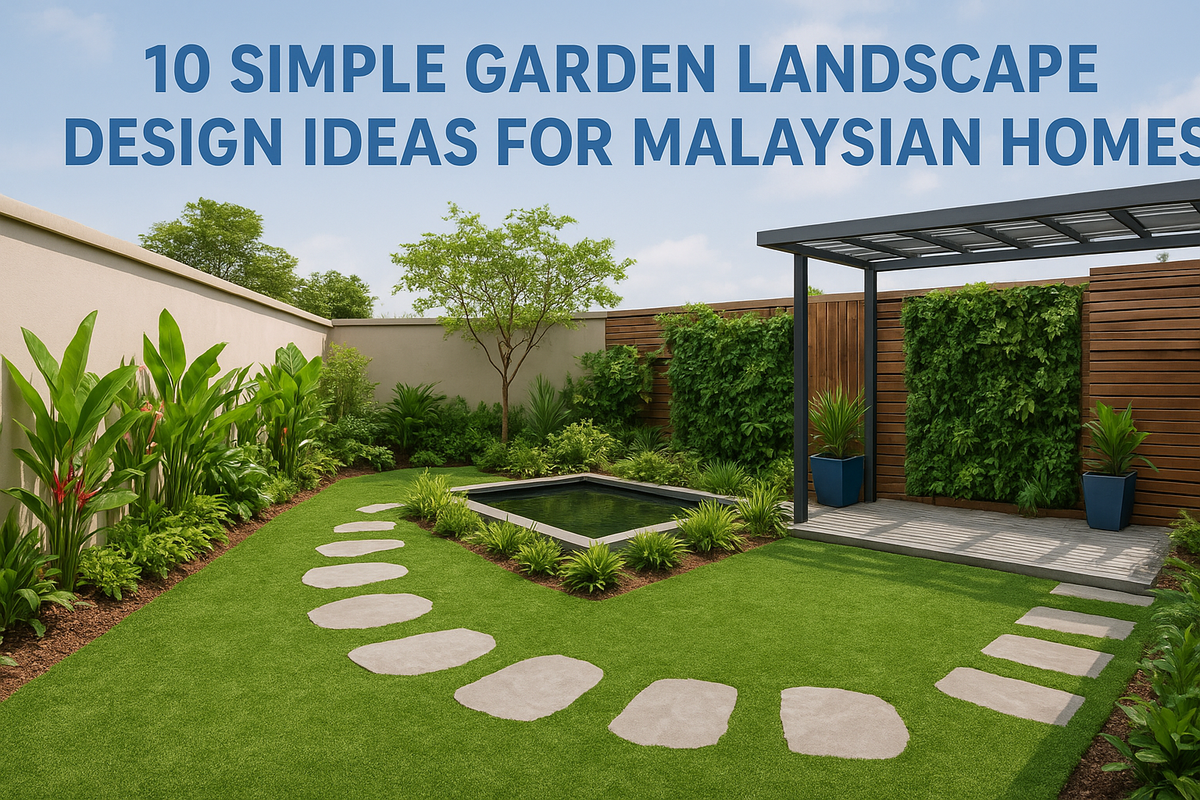
A good simple garden landscape design in Malaysia gives you shade and drainage before decoration, uses plants that handle heat and monsoon rain, and keeps upkeep under an hour a week. If you want certainty, start with a professional plan. If you are designing it yourself, start with a three-zone layout. If you hate mowing, choose artificial grass. If you only have a balcony or a narrow strip, pick a vertical wall or self-watering planters.
Most home garden ideas online come from cooler countries. Copy them here and you get a scorched lawn, rotting timber and a pond full of mosquitoes. A Malaysian garden has to cope with strong afternoon sun, heavy downpours and humidity that never really lets up, and you probably do not have hours to spend on it.
Below are 10 simple ideas, each checked against the same four questions: why it works in our climate, how to set it up, what you need, and who it suits. We design and install gardens at Konzept Garden. You do not need all ten. Pick two or three that fit your space and build from there.
1. Get a simple design plan from a landscape designer
The simplest way to avoid expensive mistakes is to have a designer draw the garden before you buy a single plant.
Why it works in Malaysia
A plan settles the questions that hurt tropical gardens most: where the sun falls at 3pm, where rain pools after a storm, and which plants survive both. A sun-loving shrub in shade or a patio that floods is costly to fix once built. A 3D visualization lets you see the finished garden before any soil moves, so you change your mind on screen instead of on site.
Konzept Garden is an award-winning landscape designer recognized by ILAM. The service covers creative design concepts, garden planting plans, expert botanist consultations, 3D visualizations and full implementation, so one team handles both the design and the build.
A plan costs far less than rebuilding a garden that was set up wrong.
How to set it up
The process is short, and you can start it from your phone.
- Message us with photos and measurements of your space. We use them to prepare a quotation.
- Expect us to contact you within 7 working days.
- If a site visit is needed, a RM200 site visit fee applies. It is deducted from the final quotation if the project goes ahead.
- A proposal typically follows 4 to 5 days after the visit.
- Review the planting plan and 3D visualization, then decide whether to proceed with installation.
What you need
Gather photos from several angles of the garden and the length and width of the space. Note where the sun lands in the morning and in the afternoon, and mark the spots where water collects after rain.
Add a rough budget and the three things you most want, such as a pond, a lawn or a seating area. A designer can then prioritize instead of guessing.
Who it suits
Homeowners with little time or gardening experience get the most from a professional plan. It also suits new houses with bare soil and larger landed gardens, where a wrong decision costs real money.
Skip this route if you only have a balcony and enjoy doing it yourself. Ideas 5 and 6 below cover that case with ready-made products.
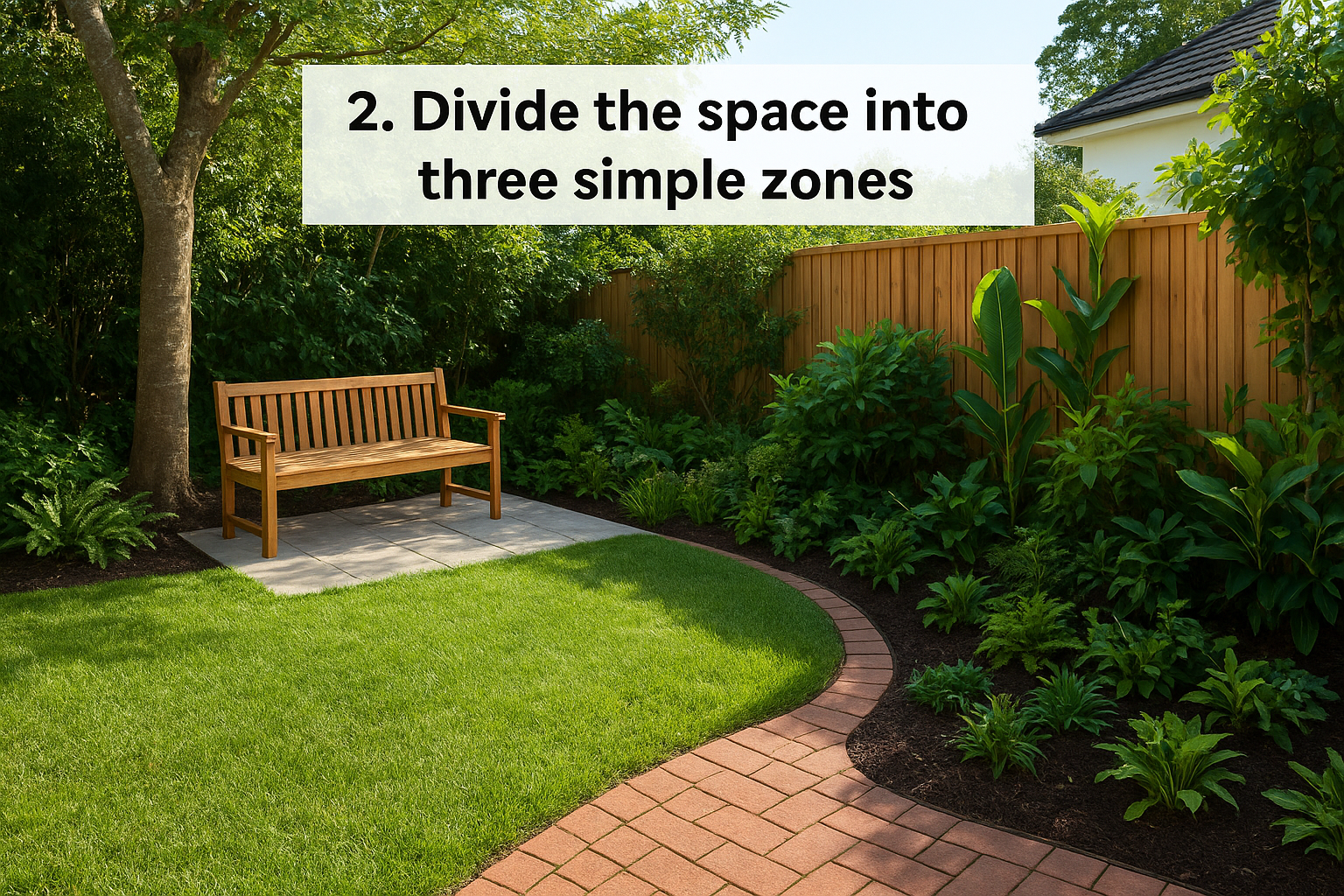
2. Divide the space into three simple zones
Split your garden into a seating zone, a planting zone and a path, and every other decision gets easier. This is the core of simple garden landscape design for any home in Malaysia, from a terrace lot to a semi-detached house.
Why it works in Malaysia
Zones stop a garden from turning into a scatter of pots. In our climate the seating zone matters most, because a bench in full afternoon sun goes unused. The east side of your house falls into shade in the afternoon, so a seating area there stays comfortable much longer than one on the west side.
Drainage belongs in the layout too. Grade the soil with a fall of 1 to 2 cm per metre away from walls, so storm water runs to a drain instead of toward your door.
Decide where you will sit and where the water will go before you choose a single plant.
How to set it up
Work on paper first, then mark the plan on the ground.
- Measure the space and draw it to scale on graph paper.
- Mark where the afternoon sun lands and keep that area for planting or a shade structure.
- Place the seating zone on the shaded side, in view of your living room.
- Draw a path 60 to 90 cm wide linking the door, the seating and the beds.
- Give the rest of the space to planting.
For a 4 m by 6 m back garden (24 m²), this split works well:
| Zone | Size | Share of space |
|---|---|---|
| Seating | about 6 m² (2.5 m × 2.5 m) | 25% |
| Path | about 4 m² (0.8 m × 5 m) | 17% |
| Planting | about 14 m² | 58% |
What you need
A tape measure, graph paper, pegs, string and a garden hose are enough. Lay the hose on the ground to test curved bed edges, then peg the outline before you dig anything.
Who it suits
First-time designers working on a typical terrace or semi-detached plot will find this the easiest start. It also scales well, because you can build one zone at a time as budget allows.
Skip the do-it-yourself route if your plot slopes steeply or needs retaining walls. Those jobs need professional input before you build.
3. Replace the lawn with artificial grass
Artificial grass gives you a green surface with no mowing, no fertilizer and no brown patches, which suits busy households. It is one of the quickest home garden ideas in Malaysia to carry out.
Why it works in Malaysia
A real lawn needs weekly cutting and plenty of sun, and it still turns patchy in shade or after weeks of rain. Natural varieties such as Japanese carpet grass and Philippine carpet grass grow well here, but they ask for regular maintenance. Artificial grass on a drain cell base lets storm water pass straight through, so the surface does not turn into a puddle.
One honest caution. Synthetic turf warms up in direct afternoon sun, so hose it down before barefoot play, and use it where trees, walls or a pergola give some shade.
A lawn you never have to mow still needs drainage underneath it.
How to set it up
Most of the work is in the base, not the grass.
- Measure the area and add about 10% for cuts.
- Clear weeds and roots, then level the ground.
- Compact the base and give it a slight fall so water drains away.
- Lay the drain cell tiles or the roll across the area, following the supplier's installation guide.
- Trim edges with a sharp utility knife and brush the fibres now and then.
A 4 m × 3 m patch is 12 m², which is 12 sets of four 50 cm tiles. With 10% extra you need about 13.2 m², so 13 sets plus one single piece covers it.
What you need
The NobleGrass range at Konzept Garden includes grass rolls and DIY drain cell sets for balconies, gardens and rooftops, delivered anywhere in Peninsular Malaysia. The Valu 30 with drain cell comes as 50 cm × 50 cm tiles, and a set of four pieces covers 1 m². Listed prices run from RM27.90 to RM99.00 depending on the option you choose.
If you would rather have it installed, the NobleGrass page shows installed prices per square foot and offers a free quote. For a DIY job, add a utility knife, edging and a hose to your list.
Who it suits
Families with children and anyone with a small yard where mowing a few square metres feels like a chore will like it. It also works on balconies and rooftops where soil is not an option.
Skip it if you want a cooler garden. Real grass and dense groundcover cool the air better than any synthetic surface.
4. Plant a tough tropical border
A border of sun-loving shrubs gives you colour for most of the year with the least work. It is the plant-based core of simple garden landscape design in Malaysia.
Why it works in Malaysia
These plants evolved for heat and strong light, so they need less water and cope with downpours without sulking. Many of them line Malaysian fences and roadsides for good reason. The most common mistake is mixing thirsty plants with drought-tolerant ones, so group plants by sun and water needs.
Give each plant room. Crowded shrubs trap humidity between leaves and invite fungus, so spacing of 40 to 60 cm is better than packing the bed on day one.
Choose plants that already enjoy your sun, and the garden does most of the work for you.
How to set it up
Prepare the bed once and the border looks after itself.
- Mark a bed at least 50 to 60 cm deep along the fence or wall.
- Mix compost into the soil so it holds moisture without staying soggy.
- Plant 40 to 60 cm apart, tallest at the back.
- Spread a 5 cm layer of mulch to cut evaporation and weeds.
- Water often for the first two weeks, then taper off.
For a 6 m border in one row at 50 cm spacing, you need 12 plants. A 5 cm mulch layer over 6 m × 0.6 m is 0.18 m³, or about 180 litres.
What you need
Buy from a local nursery so the plants are already used to our heat. This table shows plants that suit a simple border.
| Plant | Light | Why it earns a place |
|---|---|---|
| Bougainvillea | Full sun | Long-lasting colour, little water once established, but thorny |
| Hibiscus | Full sun | Malaysia's national flower, large blooms, easy to find |
| Ixora | Full sun to light shade | Compact flowering shrub, good for edging |
| Heliconia psittacorum | Sun to part shade | Upright tropical flowers, tolerates wetter soil |
| Croton (pokok puding) | Bright light | Bold coloured leaves without needing flowers |
| Snake plant | Shade to sun | Very tough, drought tolerant, fills dull corners |
Who it suits
Front gardens in full sun and long boundary fences are the ideal setting. The border also suits owners who want colour but cannot water daily.
Skip the sun-lovers in deep shade. Use snake plants, which are slightly toxic, so keep them away from small children and pets, or ferns there instead.
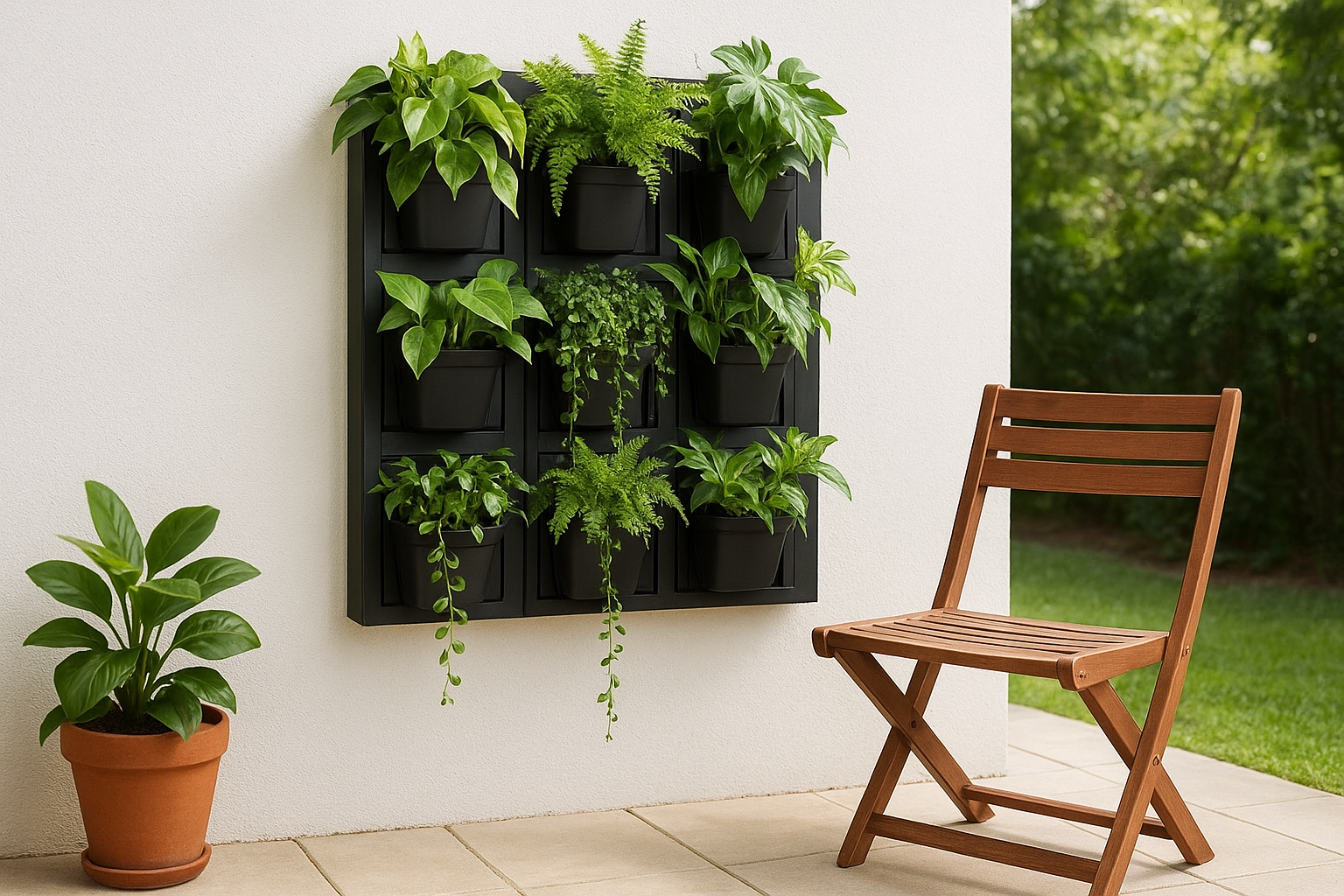
5. Add a vertical garden wall
A vertical garden turns a blank wall into planting space and leaves the floor free for chairs and walking. It answers the problem of small home gardens in Malaysia where ground area runs out first.
Why it works in Malaysia
Plants on a wall sit at eye level, shade the surface behind them and add greenery where a small garden has no ground. In our heat the position matters more than the product. Choose a wall with morning sun and afternoon shade, or leaves will scorch by midday.
Pick plants that tolerate pockets of soil, such as ferns, pothos, philodendron and trailing peperomia. They handle humidity well and fill a frame within a few months.
On a small plot, the wall is the biggest piece of land you are not using yet.
How to set it up
Fix the frame first, then plant.
- Pick a wall that is bright but shaded from afternoon glare.
- Fix the frame holder to the wall at eye level, level and firmly anchored.
- Fill the pots with soil, plant them and slot them into the frame.
- Use the soil, hydrostone and geotextile supplied, following the instructions in the set.
- Water by hand and watch for dry or soggy pots for two weeks before settling a routine.
What you need
Konzept Garden sells two EcoWall options, shown below. Package B is priced by size, so a 3 ft × 4 ft wall is 12 ft², which comes to 12 × RM90 = RM1,080. The Mini Set covers roughly 2 ft × 2 ft, a sensible trial before you cover a bigger wall.
| Option | What is included | Price |
|---|---|---|
| EcoWall Mini Set | Frame holder, 60 cm × 60 cm frame, 9 smart pots, 2 bags of nutrition soil (5 kg each), 600 g hydrostone, geotextiles | RM449 |
| EcoWall Package B | Frame system and plants | RM90 per ft² |
Who it suits
Balconies, narrow side yards and courtyards gain the most, since every square metre of floor stays usable. It also suits anyone who wants a green backdrop for privacy.
Skip it if the wall bakes in afternoon sun with no shade, or if you cannot reach it to water.
6. Use self-watering planters
Self-watering planters keep container plants alive through hot weeks and holidays, which solves a common reason container gardens fail. They are among the easiest home garden ideas in Malaysia for balconies and patios.
Why it works in Malaysia
Soil in an ordinary pot can dry out in a day or two under tropical sun, and plants wilt as soon as you are late. A reservoir feeds the roots steadily instead. The Ziant Hydro Planter is self-watering for up to 2 weeks and is UV-resistant, for indoor or outdoor use.
Fewer, larger planters also look tidier than a crowd of small pots. Three big containers set at different heights give structure and order with less to water.
Fewer, larger planters beat a crowd of small pots on both looks and effort.
How to set it up
Think in clusters of three.
- Choose three planters of different sizes for one cluster.
- Place them against a wall or railing so they do not eat floor space.
- Fill with potting mix and plant.
- Fill the reservoir and check it weekly, topping up before it runs dry.
- Group plants with similar water needs in the same planter.
What you need
Two sizes from the range suit a garden or balcony:
| Model | Size | Good for |
|---|---|---|
| Ziant Hydro ZP003-M | 70 × 70 × 40 cm | A feature shrub with low plants around it |
| Ziant Hydro ZP002-S | 71 × 30 × 28 cm | A slim row along a wall or railing |
For a desk or shelf, the XXS set with a live Sansevieria is listed at RM48.90 (regular price RM89.90). Snake plants suit most of these planters because they tolerate both sun and shade.
Who it suits
Frequent travellers and busy professionals benefit most, along with anyone gardening on a balcony where carrying water is a hassle.
Skip them for succulents and cacti, which prefer to dry out between waterings. Keep those in ordinary pots.
7. Lay a stepping stone path that drains
A simple path of stepping stones or pavers protects the soil, shows people where to walk and gives the garden structure. It also lets you add one more layer to simple garden landscape design without much cost.
Why it works in Malaysia
A grass path turns to mud in the wet season, and solid paving sheds a downpour toward your walls. Gaps between stones and a permeable base let water soak away instead. A path also helps a small garden feel larger, because a change of surface divides the space visually.
Keep it narrow. 40 to 60 cm is enough for stepping stones in a small garden, and it leaves more room for planting.
A path that lets rain through protects both the garden and your walls.
How to set it up
Lay out the route before you dig.
- Mark the route with string between the door, the seating and the beds.
- Test the stone spacing by walking it, aiming for a natural stride.
- Dig out about 5 cm for each stone.
- Spread and compact a layer of sand, then set each stone level with the soil.
- Fill the gaps with gravel or a low groundcover.
A 6 m path with pavers set 60 cm apart, centre to centre, takes 10 pavers.
What you need
Pick the material that matches your style and shade.
| Material | Strength | Watch out for |
|---|---|---|
| Cement pavers | Last longer than wood, many ready-made shapes | Slippery algae in damp shade |
| Natural stepping stones or river stones | Natural look, river stones give a foot-massage feel | Can shift and sit unevenly |
| Pea gravel | Water drains straight through | Needs edging so it does not spread |
| Treated timber | Warm look | Rots or attracts termites if untreated |
Who it suits
Any garden with a lawn or beds benefits, especially where people cut across plants to reach the gate.
Skip stepping stones if you need pram or wheelchair access. Use continuous pavers at least 90 cm wide instead.
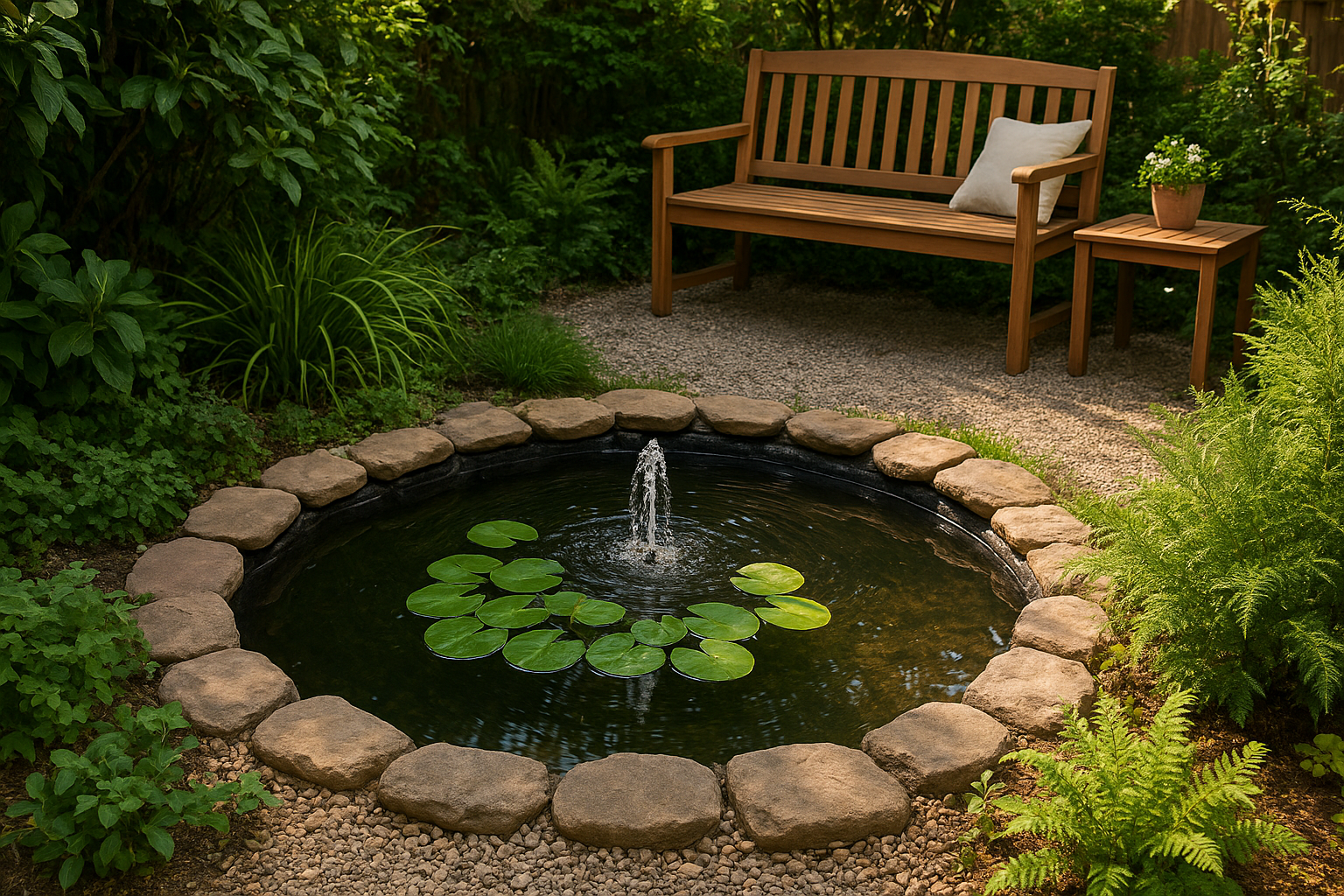
8. Add a small pond or water feature
A small pond adds sound and movement, and it makes the seating area feel calmer and cooler. Done simply, it is the focal point that most Malaysian home gardens are missing.
Why it works in Malaysia
Moving water masks street noise and attracts birds and dragonflies. The risk is mosquitoes, because stagnant water breeds them. Keep the water moving with a pump, add fish, and place the pond in partial shade so algae does not take over in midday sun.
Three things decide whether a pond stays healthy: water temperature, pH and cleanliness. A small pond warms quickly in the tropics, so shade matters more than size.
Moving water and shade keep a small pond clear, cool and mosquito-free.
How to set it up
A ready-made kit removes most of the guesswork.
- Pick a shaded spot visible from your seating area.
- Prepare a level base on soil or paving.
- Position the pump and lava stone according to the kit instructions.
- Add water and plants, then run the pump for several days before adding fish.
- Power the pump from an outdoor-rated socket with an RCD.
What you need
Konzept Garden's Magic Garden Fish Pond 1 costs RM880. It includes a Ziant Hydro ZP003-M (70 × 70 × 40 cm), a ZP002-S (71 × 30 × 28 cm), lava stone, a pump and installation. Plants are not included, and it requires no hacking.
For a larger garden, look at the Zen Bio Koi Pond or the best-selling Himalaya Rock Fish Pond. Water lilies, lotus and duckweed make good pond plants because they shade the water and help balance it.
Who it suits
Homeowners who want a focal point and enjoy watching fish will get the most from it. It works well beside a seating area, where you hear it as much as see it.
Skip it if you have toddlers who play unsupervised, since open water is a drowning risk, or if you will not commit to regular cleaning.
9. Build a pergola for shade
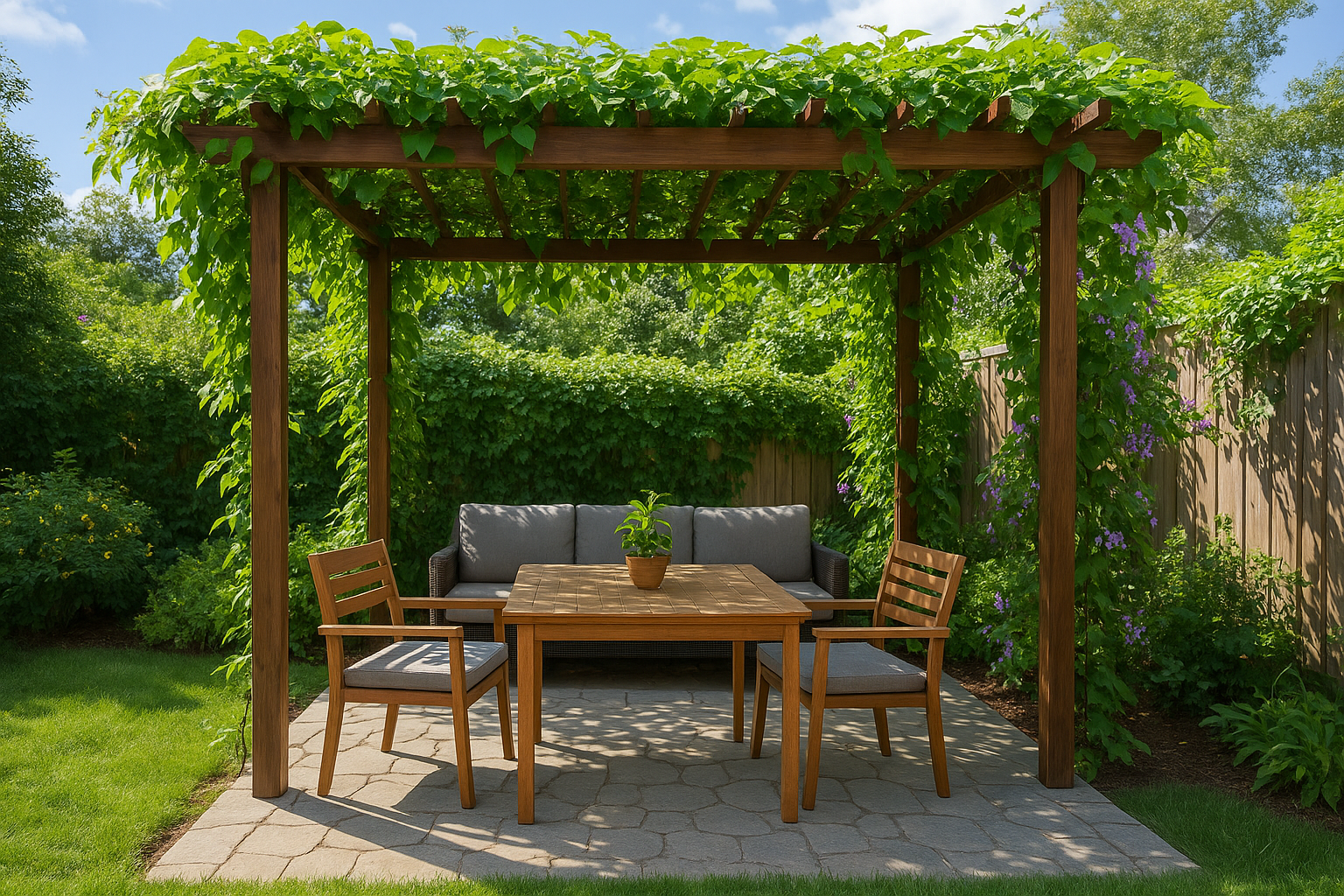
A pergola gives partial shade over a seating area and carries climbing plants, which makes the garden usable at midday. It is the simplest shade structure for a Malaysian home garden.
Why it works in Malaysia
A gazebo has a full roof, while a pergola has an open frame that gives partial shade. In humid heat that open frame is a strength, because air keeps moving instead of getting trapped under a solid roof. Climbers such as morning glory and Madagascar jasmine fill the frame with leaves over time, which cools the space further.
One caveat: a pergola does not keep rain out. If you want to sit during storms, add clear polycarbonate panels over the seating.
An open pergola shades the afternoon and lets the heat escape.
How to set it up
Put the shade where the sun is worst.
- Place the frame on the side of the seating that gets the harshest afternoon sun.
- Size it to the furniture. A 3 m × 3 m frame covers a table for six.
- Anchor the posts in concrete footings.
- Build it about 2.4 m high so hot air rises above your head.
- Plant climbers at the base and train them up with string or wire.
Before building anything permanent, check with your local council and, if you live in a gated community, your management body.
What you need
Durable materials matter more than looks. Iron, wood and bamboo are all used for pergola frames, and each has trade-offs.
- Powder-coated steel or aluminium: low upkeep, no termites.
- Treated timber: warm look, but needs regular sealing in our humidity.
- Bamboo: cheap and natural, and shorter-lived outdoors.
- Climbers: morning glory, Madagascar jasmine, or any vigorous local vine.
Who it suits
Landed homes with a patio or back garden are the natural fit, especially where the seating area gets full afternoon sun.
Skip it on a tiny balcony, or if what you really need is rain cover. In that case choose a gazebo or an awning.
10. Light the garden for evenings
Warm, low lighting makes the garden usable after dark, when Malaysian evenings are far more comfortable than afternoons. It also makes a small garden feel deeper.
Why it works in Malaysia
Most of us use the garden after work, so light extends its hours. Layer the light at different heights: low path lights, an uplight on a feature plant and string lights overhead. Choose warm white 2700K to 3000K bulbs, which suit green foliage and tend to attract fewer insects than cool white.
Solar lights are simple, but they dim in rainy spells. For reliable brightness, use low-voltage LED spotlights on a transformer.
Light your garden in layers, and a small space feels twice as deep at night.
How to set it up
Start with the path, then add accents.
- Set path lights every 2 m, 30 to 40 cm tall.
- Place one uplight at the base of a palm or feature shrub.
- Hang string lights over the pergola or seating area.
- Fit a timer or dusk sensor so lights switch on automatically.
- Aim fittings away from your eye line to avoid glare.
A 6 m path with lights every 2 m needs four lights, counting both ends.
What you need
Look for an IP65 rating or better, which is a common standard for outdoor fittings. A basic kit includes:
- Solar stake lights for paths
- 12V LED spotlights with a transformer for plants and walls
- Outdoor-rated string lights for seating areas
- A timer or dusk sensor
Who it suits
Evening entertainers and anyone who works long hours will get the most from it. Lighting also adds security along paths.
Skip it if you rarely use the garden after dark, and spend on shade first. Have a licensed electrician install any mains-voltage wiring.
Start with one idea and build from there
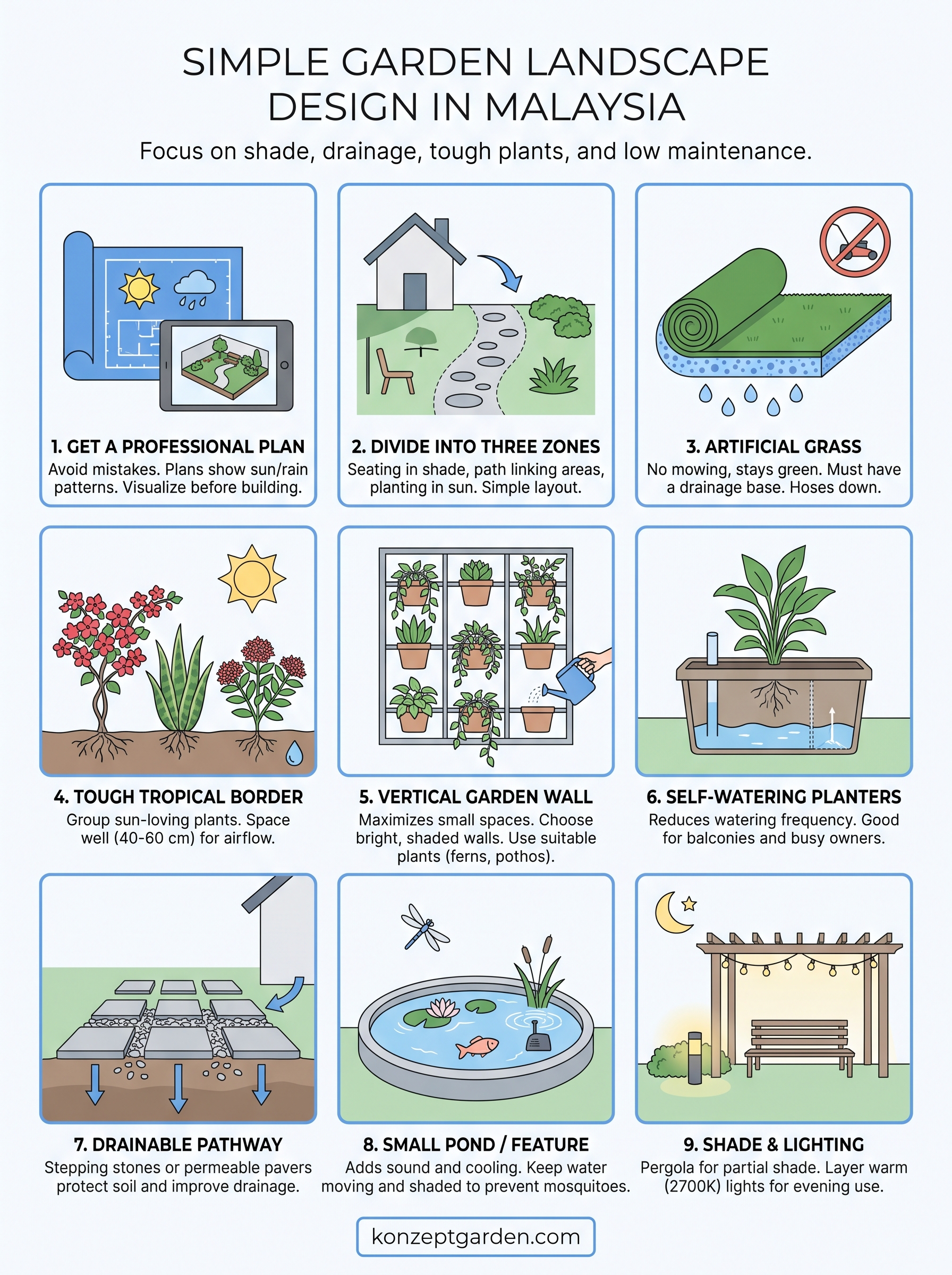
All ten ideas follow the same principle: shade first, drainage always, tough plants and as little upkeep as you can design in. A simple garden landscape design in Malaysia does not need many features. It needs the right few, placed where the sun and rain make them work.
If you are unsure where to begin, draw the three-zone layout first, since it costs nothing. Then add grass or a planted border, and use a vertical wall or self-watering planters if floor space is tight. Water features, pergolas and lighting can follow once the basics are settled.
If you would rather have a designer take care of it, contact the Konzept Garden team with photos and measurements of your space, and we will tell you what would work.