
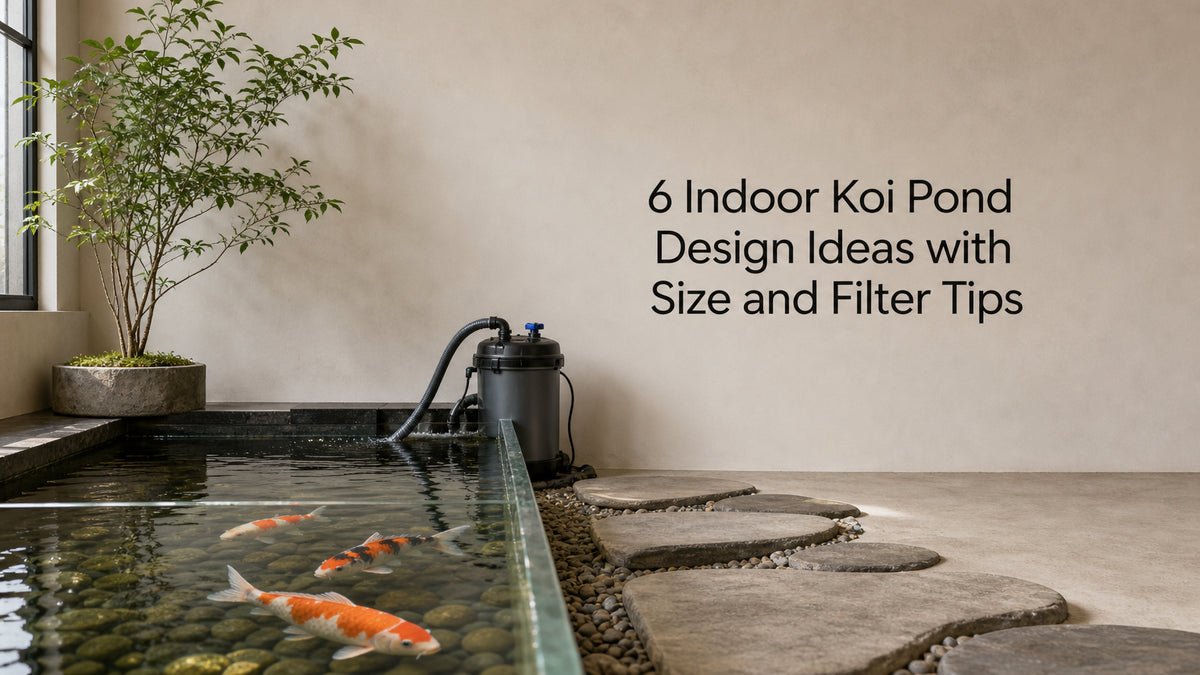
The best indoor koi pond design gets depth, filtration and a safe edge right before it worries about looks. A ready-built package suits you if you want one team to handle everything. A raised pond with a glass side suits families who want no floor work. A sunken pond suits you if you are already renovating. A barrel or tub works only as a temporary home for young koi.
Koi are not ornamental goldfish. They grow past 60 cm, produce a lot of waste, and prefer cool, well-oxygenated water. An indoor pond puts all of that inside your living space, on a floor that carries about 1 kg for every liter of water. A pond that looks great in a photo can smell, leak or overheat within months if the size, filter and electrics were an afterthought.
This guide gives you six designs, each judged the same way: how it works, who it suits, and the size, cost and trade-offs. After the list you get sizing rules with worked numbers, then a filtration and electrics plan. Konzept Garden has over 30 years of landscape experience and designs and builds koi ponds in Malaysia, so the advice here follows the questions we ask before any pond goes in.
1. Konzept Garden ready-built pond package
How it works
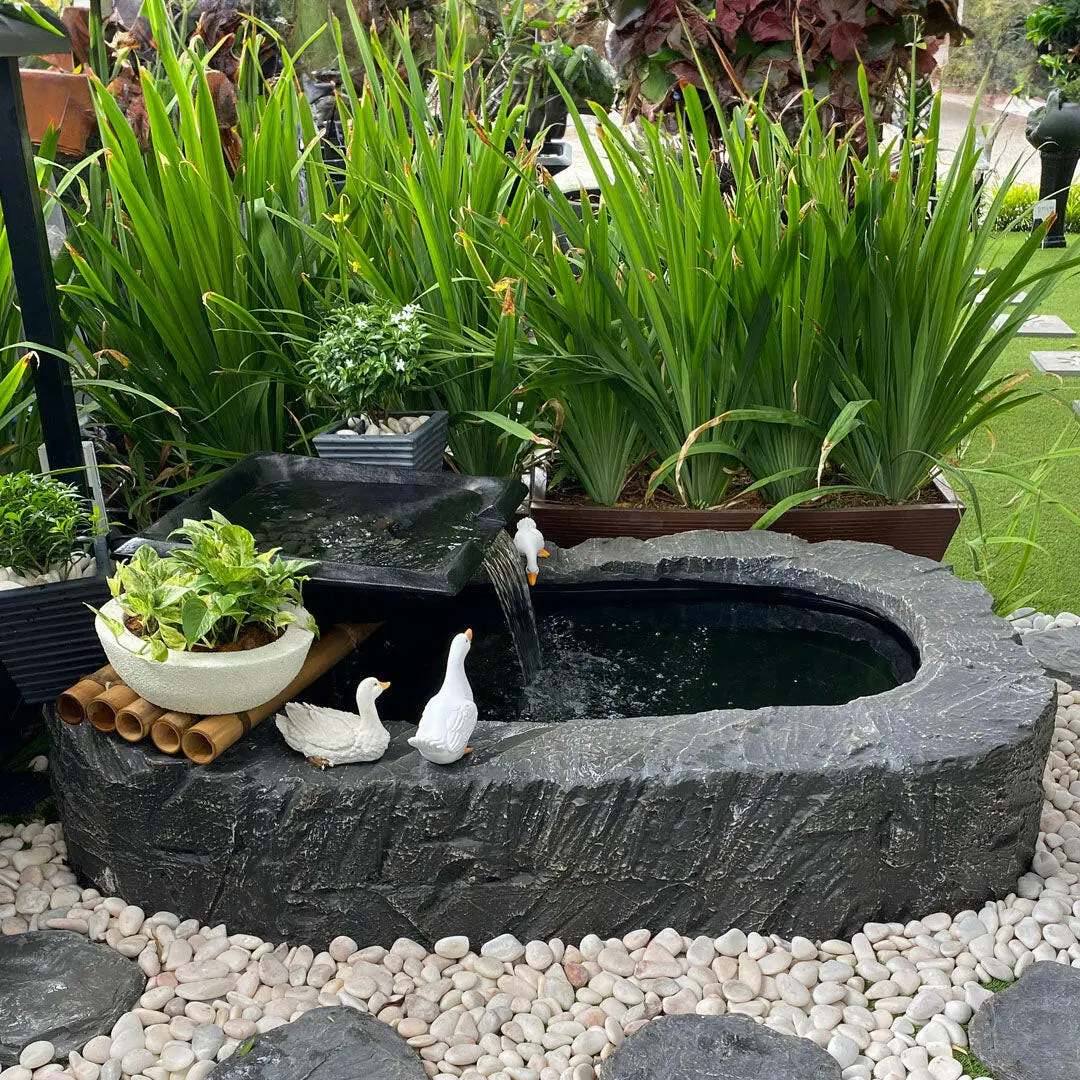
Konzept Garden supplies the pond as a complete package, so you do not source the pump, filter and stone separately. The Zen Bio Mini Natural Koi Pond, for example, includes a layer fountain, pump, UV light, canister filter, stepping stones, pebbles, starter bacteria and plants, with installation included. Transportation is not included. The Himalaya Rock Fish Pond Mini adds a planter box and needs no hacking of your floor.
Before anyone quotes, the team needs the area measurement, whether the pond is indoor or outdoor, sunlight exposure, drainage details, any tile or concrete hacking, and the plug points. You send photos and measurements, usually over WhatsApp. A site visit costs RM200, which is deducted from the final quotation if you proceed, and a proposal typically follows within 4 to 5 days.
Who it suits
This option suits owners who want one team accountable for design, filtration and installation.
- Finished homes where you do not want to cut the floor: the Himalaya Rock Fish Pond Mini requires no hacking.
- Owners who want a plant scheme included: the Zen Bio ponds come with a free landscape package.
- Buyers who care about warranty: koi ponds carry a 10-year original warranty against leaking plus a 5-year extension, while the submersible pump has 6 months.
Size, cost and trade-offs
Prices run from RM5,350 for the Himalaya Rock Fish Pond Mini (162 x 101 x 30 cm) to RM16,500 for the Zen Bio Koi Pond 1 (325 x 132 x 92 cm). The mini models are only 12 to 18 inches deep, which is shallow for adult koi, so treat them as homes for smaller or young fish. Hacking tiles and concrete for the Zen Bio models costs extra, and you need at least two 13A switched sockets nearby. The sizing section below compares every model side by side.
A package pond puts design, filtration and installation under one team, which is the easiest way to avoid mismatched parts.
2. Raised pond with a glass side
How it works
A raised pond sits above the floor inside a built wall, with one face made of toughened glass or acrylic. You watch the koi from the side like an aquarium, while the top stays open for feeding and filtration. The filter and pump hide in a cabinet or behind the wall.
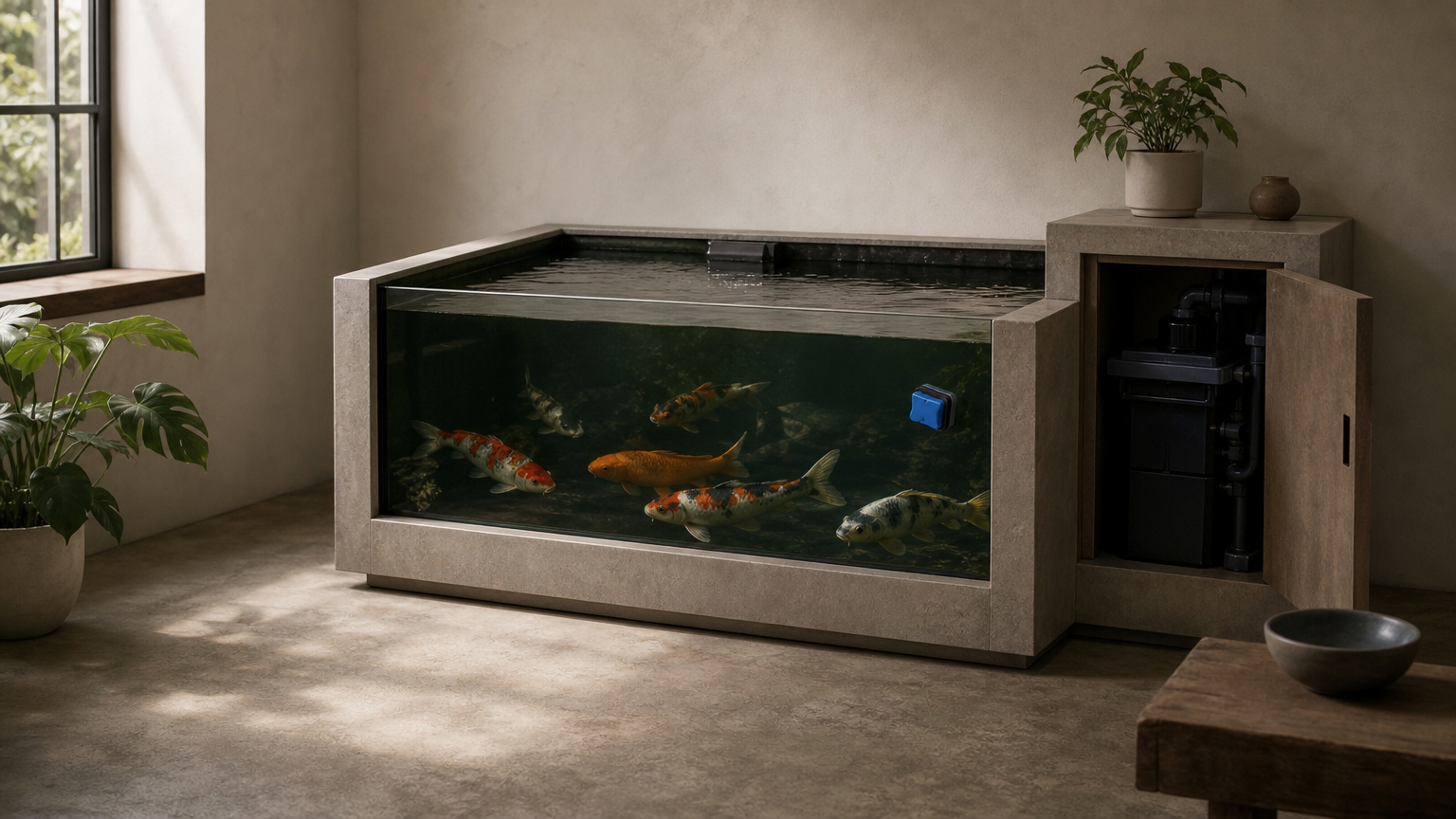
Glass thickness depends on the water depth and the panel length, so ask the builder for the engineered specification instead of guessing. Nothing is dug, so the floor slab stays intact and the build is quicker than a sunken pond. Eye-level viewing also shows color and body shape far better than looking down from above.
Who it suits
This design is the safest open-top option for homes with children or pets, because the water edge sits above a toddler's reach.
- Families with small children, cats or dogs.
- Renovations where cutting the slab is not an option.
- Owners who want a feature wall behind a sofa or dining area.
Size, cost and trade-offs
A raised pond can be 90 cm deep or more, which gives adult koi proper room. The cost is weight: 2,000 liters of water is about 2 tonnes, so keep it on a ground-floor slab. Seals around the glass are the weak point, so ask what the leak warranty covers. Algae film builds on the glass faster than people expect, so plan a magnetic scraper and a net or cover for cats.
Raised ponds give you depth without digging, but the glass seals decide how long the pond stays dry.
3. Sunken floor pond with a safety cover
How it works
A sunken pond is cut into the ground-floor slab and lined with waterproofed concrete or a heavy liner. The rim sits flush with the floor or a few centimeters above it. A toughened glass panel or stainless steel mesh covers the water when nobody is feeding the fish.
Because the water sits below floor level, it changes temperature slowly. That helps in a warm climate. You get the deepest pond of any indoor design, easily 90 cm or more, so full-grown koi are realistic.
Who it suits
Choose this design if the floor is already open for a new build or major renovation.
- Owners planning a large display with several adult koi.
- Homes with a quiet room, such as a study or sunroom, where the pond is a permanent feature.
- Anyone willing to pay for waterproofing done once and done properly.
Size, cost and trade-offs
This is the most expensive and least reversible design, since hacking tiles and concrete is a cost on its own. Waterproofing and an overflow route to a drain are not optional. If the pump fails or the pond leaks, the water goes into your slab. Without a cover, a sunken edge is a real drowning risk for toddlers.
A sunken pond is the right choice only when you are certain it stays forever and the cover is part of the design.
4. Courtyard pond seen through glass
How it works
Many Malaysian terrace homes have an air well or a small courtyard beside the living area. A pond built there, viewed through a floor-to-ceiling glass door or window, gives you indoor viewing with outdoor space for the water. The pond is covered or semi-covered, so it is not fully indoors, but you enjoy it as part of the room.
A glass panel in the pond wall or a sunken section close to the door lets you see the koi from your sofa. Add a low light in the pond for evening viewing.
Who it suits
This design suits terrace and semi-detached homeowners who do not want to give up interior floor space.
- Homes with an existing courtyard, air well or covered patio.
- Owners who want a deeper pond than a room can take.
- People who do not mind a little leaf litter and rain.
Size, cost and trade-offs
You can build to full koi depth because the pond sits on the ground outside the slab of the living area. The challenges are tropical downpours and afternoon sun. Heavy rain dilutes the water and can overflow, so fit a proper drain. Direct sun heats the water above 28°C and feeds algae, so aim for shade for most of the day. Keep the water moving, because stagnant corners breed mosquitoes.
A courtyard pond gives you the depth of an outdoor pond with an indoor view, as long as shade and drainage are solved first.
5. Narrow hallway or stair-base pond
How it works
This design turns dead space into a long, narrow pond, about 40 to 60 cm wide, along a hallway wall or under a staircase. Because the pond is narrow, the length does the work. Koi swim along it, and you see them as you walk past.
The filter usually sits at one end, hidden in a cabinet or under the stairs. A glass or mesh cover keeps people from stepping in, and a strip light makes it look intentional rather than leftover.
Who it suits
Choose this design if you have an unused corridor, a stair nook or a long blank wall.
- Homes that have no room for a wide pond.
- Owners keeping a few small koi or mixed ornamental fish.
- People who like a gallery feel more than a centerpiece.
Size, cost and trade-offs
A narrow channel limits stocking. Count its water volume, not its length, before deciding how many fish fit. Water noise and splash travel along a hallway, so keep the water level a few centimeters below the rim. Foot traffic and trip risk matter, so cover the pond fully. Under stairs, check ceiling height at the viewing point and plan access to the pump from the side.
A narrow pond suits a few young koi, and the volume of water, not the length, sets the limit.
6. Compact barrel or tub pond for young koi
How it works
A food-safe drum, a barrel with a pond liner or an old bathtub becomes a small pond with a pump and a basic filter. A 200-liter drum or a standard tub holds roughly 150 to 250 liters. That is enough for a couple of young koi for a few months, and not much more.
Check any container for rust, sharp edges and leftover chemicals before you fill it. Fill it, run it for a day, and look for leaks. Add a sponge filter or small pond filter and an air stone, because small volumes lose oxygen quickly.
Who it suits
This is the entry point for people testing the hobby or growing out small koi.
- Buyers on a tight budget.
- Apartments where a built pond is not allowed.
- Owners who plan to move the fish to a bigger pond later.
Size, cost and trade-offs
Small volumes swing in temperature and water quality fast. One overfeeding session can spike ammonia. Koi outgrow a barrel within months, so set a date to move them on. Never treat a barrel as the permanent home for koi you hope to keep for years.
A barrel pond is a nursery, not a home, and its biggest risk is leaving the fish there too long.
How big an indoor koi pond should be
Volume and depth rules of thumb
Plan for about 1,000 liters of water per adult koi, a floor of roughly 4,000 liters for a small group, and a depth of about 90 cm. These are common keeper guidelines, not hard laws. They exist because koi grow to 60 to 90 cm and need room to turn, and larger volumes stay stable when something goes wrong.
The table shows what Konzept Garden's pond sizes mean in those terms. Volume is an approximate figure from the outer dimensions, so real water volume is lower once you subtract wall thickness and leave room below the rim.
| Model | Size (cm) | Outer volume | Min. space without landscape | Price |
|---|---|---|---|---|
| Himalaya Rock Fish Pond Mini | 162 x 101 x 30 | about 490 L | 9 x 6.5 ft | RM5,350 |
| Zen Bio Mini Natural Koi Pond 1 | 213 x 122 x 46 | about 1,200 L | 9 x 6 ft | RM5,950 |
| Zen Bio Mini Koi Pond | 213 x 122 x 46 | about 1,200 L | 9 x 6 ft | RM6,650 |
| Zen Bio Natural Koi Pond 1 | 244 x 152 x 46 | about 1,700 L | 10 x 7 ft | RM6,950 |
| Zen Bio Koi Pond 1 | 325 x 132 x 92 | about 3,950 L | 12.6 x 6.3 ft | RM16,500 |
A worked example: you want three adult koi. At 1,000 liters each, you need about 3,000 liters of actual water. Only the Zen Bio Koi Pond 1 gets there, at roughly 3,300 liters once you allow for the water level. It also weighs nearly 4 tonnes when full, which is why it belongs on a ground-floor slab. The 7 x 4 ft minis hold roughly 1,000 liters of water, so they suit a handful of koi under about 20 cm, with a plan to upgrade.
Size the pond for the koi at full growth, not for the fish you bring home.
Floor space and layout clearance
The pond is only part of the footprint. Konzept Garden's published minimum for the 7 x 4 ft Zen Bio Mini is 9 x 6 ft without landscaping and 10 x 7 ft with it. That gives you about a foot of margin per side for stones, plants and access.
Add 60 cm of clear walkway on at least one side so you can net fish and service the pond. Keep the filter within arm's reach and the pond out of direct window sunlight. Put seating at a distance where you see the whole pond, because koi look best from two to three meters away.
Filtration, water quality and electrics
The three filter stages
Every indoor pond needs mechanical, biological and UV treatment, in that order. Skipping one is the most common reason indoor ponds turn green or smell.
- Mechanical: a skimmer, sponge or brush stage that catches solid waste before it breaks down.
- Biological: bio rings, ceramic media or a canister filter where bacteria convert ammonia to nitrite, then to nitrate.
- UV: a sterilizer that clears free-floating algae. It does not catch solids, so it never replaces the first two stages.
Mechanical removes the waste, biological removes the toxins, and UV only polishes the water.
Pump, aeration and water changes
Choose a pump that turns the whole pond volume at least once an hour. Add a fountain or air stone for oxygen, which drops fast in warm water. Warm water holds less oxygen, and in Malaysia indoor water can drift past 28°C, where koi stress rises. An air-conditioned room or shade helps.
A new pond needs about 4 to 6 weeks to build bacteria before you stock fully. Test for ammonia and nitrite, and wait until both read zero. Tap water contains chlorine, so treat it with a dechlorinator, and replace about 10% of the water weekly. Feed only what the koi finish in a few minutes. Overfeeding is the usual reason a small pond fails.
Electrics, humidity and safety
Plan at least two 13A switched sockets near the pond, as Konzept Garden requires for installations. Use RCD protection, keep sockets and plugs above splash height, and let a licensed electrician do the wiring. Water and mains power are a combination to take seriously.
Open water adds humidity, so ventilate the room, and expect to top up the water as it evaporates. Cover the pond with a mesh if children or pets are around.
Choosing your indoor koi pond design
The right design depends on your floor and your fish. Ready-built packages and raised glass ponds reduce risk. Sunken and courtyard ponds give the most depth. Hallway ponds and barrels suit only a few young fish. In every case, size for adult koi, build three-stage filtration, and put electrics and safety covers in the plan from day one.
If you want a team to check your space, measurements and plug points before you commit, talk to Konzept Garden about your indoor koi pond. Send photos of the area with measurements, and we will tell you which of these designs fits.