
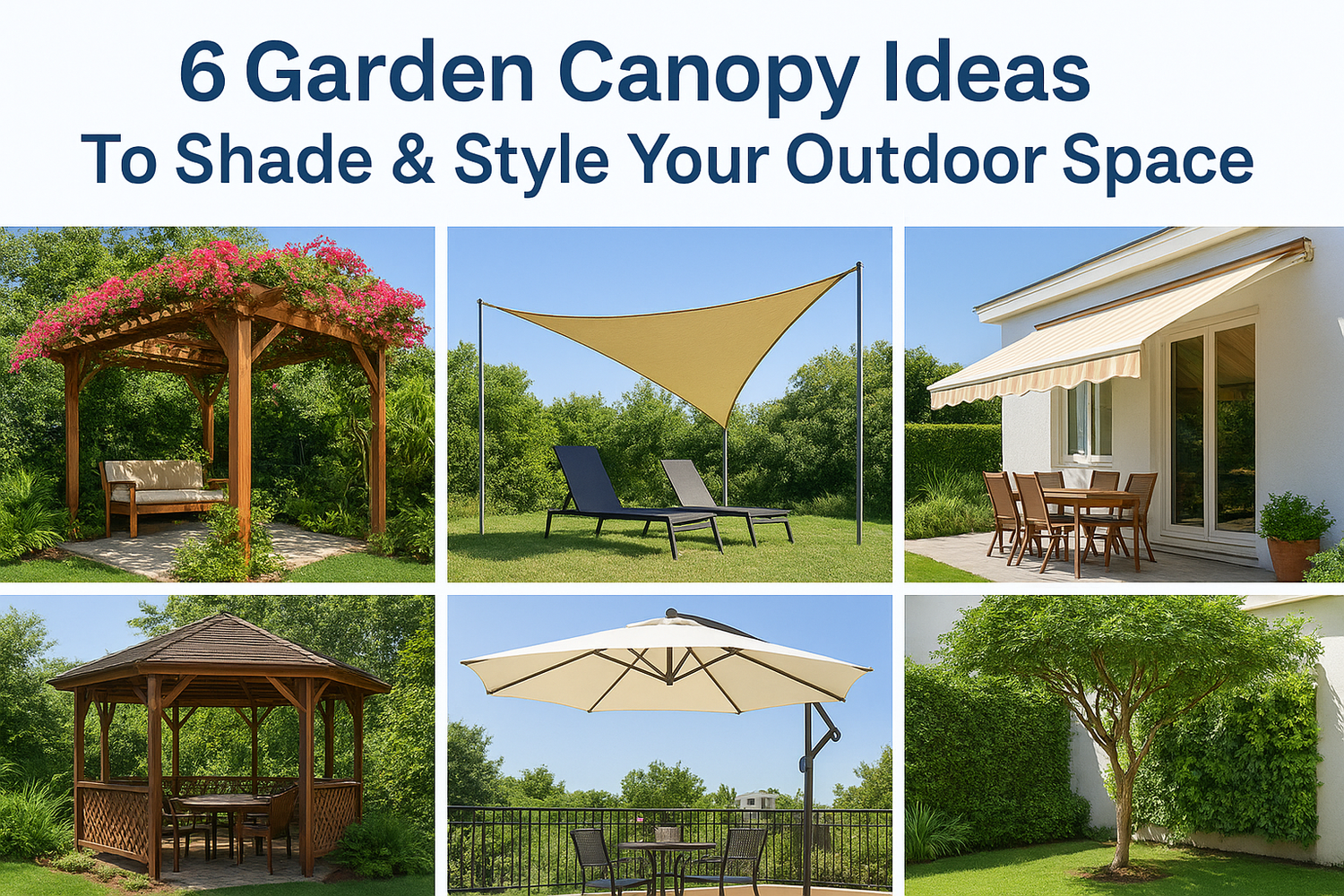
Malaysia's sun doesn't ease up, and by midday most gardens turn into spaces nobody wants to sit in. If you've been searching for garden canopy ideas that actually hold up in tropical heat and downpours, you already know that a flimsy umbrella or a store-bought gazebo rarely lasts a season. The real question is which structure suits your space, your budget, and how you use your garden.
This list answers that directly. We cover six proven options, from timber pergolas with climbing vines to sleek shade sails, retractable awnings, and freestanding parasols, plus a couple of DIY builds for hands-on homeowners. Each idea includes what it costs to run, how much upkeep it needs, and which garden layouts it works best in.
We've built enough koi ponds, decks, and shaded seating areas across Malaysian homes to know what survives monsoon season and what falls apart after a year. So as you go through these canopy options, you'll get practical, tested advice rather than generic inspiration, helping you pick a design that shades your outdoor space and gives it real character.
1. Custom-built pergola with climbing plants
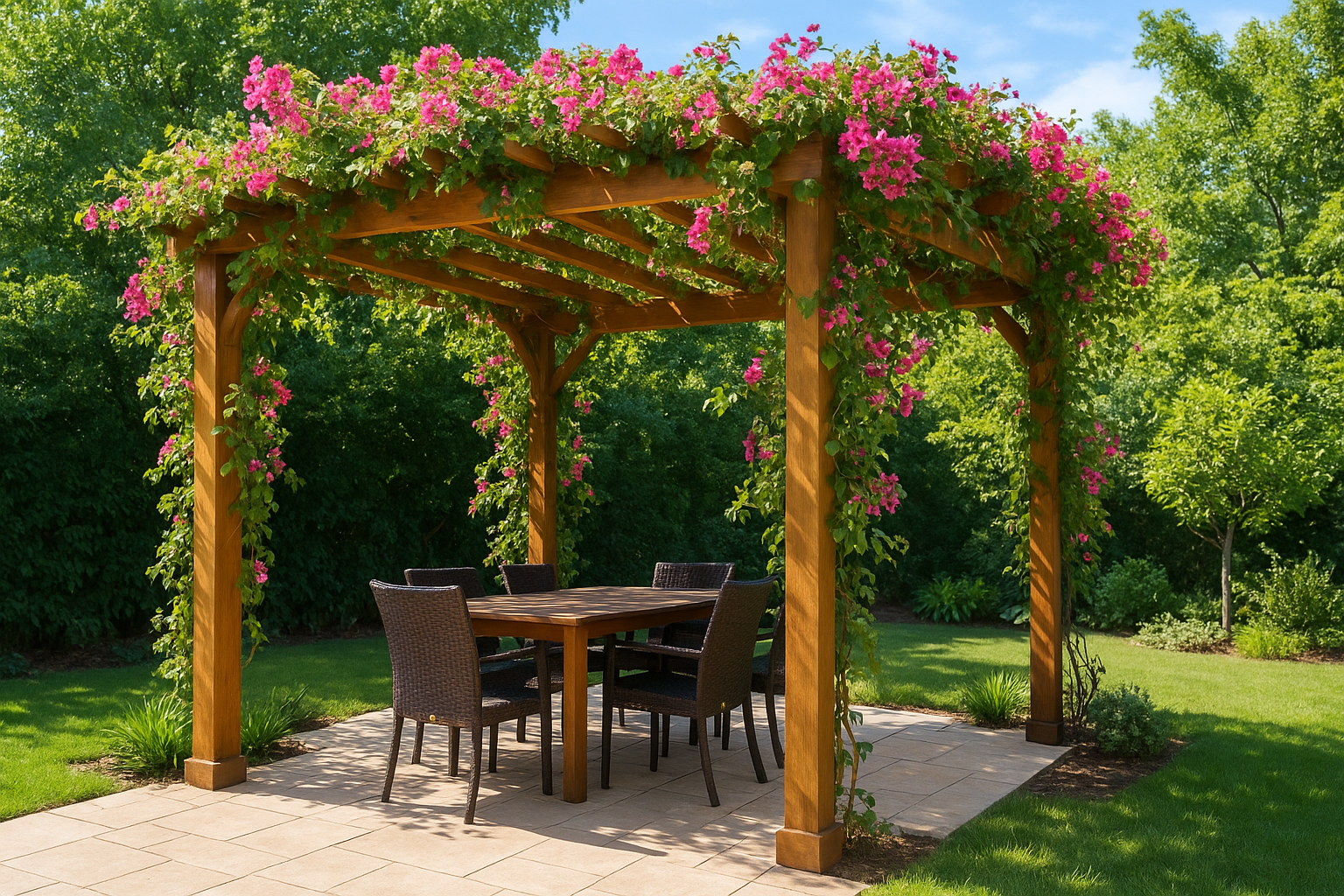
A pergola remains the gold standard among garden canopy ideas because it does two jobs at once: it frames a space and it grows shadier every year. Unlike a fixed roof, a pergola starts as an open timber or aluminum frame, then fills in as climbers like bougainvillea, jasmine, or thunbergia weave through the crossbeams. Give it two to three growing seasons and you get a living roof that filters harsh midday sun while still letting air move through, which matters a lot in Malaysia's humidity.
How it works
The structure sits on four to six posts anchored into footings, topped with horizontal rafters spaced to support plant growth and, if you want more coverage, a secondary layer of bamboo or lattice. Climbing plants need a trellis wire or mesh run along the beams so they grip and spread rather than sag. Most of our clients pair the pergola with a paved or decked base underneath, turning it into a proper outdoor room rather than just a shaded patch of lawn.
A pergola is the only canopy option that gets better looking and more effective every year you own it.
Best for
This option suits homeowners who want a permanent garden feature, not a seasonal fix. It works best over dining areas, entertaining decks, or as a transition piece between the house and a larger garden. If you like the idea of layering in fairy lights, hanging planters, or an outdoor kitchen later, a pergola gives you the structure to build around.
Cost range in Malaysia
Pricing depends heavily on materials and size, but here's what we typically quote:
| Pergola type | Typical size | Cost range (RM) |
|---|---|---|
| Treated timber, basic frame | 3m x 3m | 4,000 - 7,000 |
| Aluminum frame, powder-coated | 3m x 4m | 7,000 - 12,000 |
| Custom hardwood with integrated lighting | 4m x 5m | 15,000 - 25,000 |
Expect to add RM 500 to RM 1,500 for climbing plants, trellis wiring, and irrigation lines if you want the greenery low-maintenance from day one.
2. Tensioned shade sail
A shade sail is a stretched piece of fabric pulled taut between three or more anchor points, angled to cut glare without boxing in the space. It's the fastest way to shade a patio, pool deck, or play area without committing to posts and footings everywhere. Where a pergola takes weeks to build, a shade sail installation usually wraps up in a day or two once the anchors are set.
How it works
Installers fix steel turnbuckles to existing walls, fence posts, or dedicated poles, then stretch a triangular or square sail of knitted polyethylene fabric between them. The fabric blocks 90 to 95 percent of UV rays while still letting rain and breeze pass through the weave, so you don't get that stuffy, trapped-heat feeling you get under solid roofing.
A shade sail gives you serious UV protection with none of the visual bulk of a hard roof.
Best for
This suits homeowners who want quick, budget-friendly shade over a pool, play area, or side patio without altering the garden's structure. It also works well for rental properties or anyone who wants shade now and a permanent structure later.
Cost range in Malaysia
| Sail size | Fabric grade | Cost range (RM) |
|---|---|---|
| 3m x 3m | Standard knitted HDPE | 800 - 1,500 |
| 4m x 5m | Marine-grade, UV-stabilized | 2,000 - 3,500 |
| Custom multi-sail layout | Premium shade cloth | 4,000 - 7,000 |
Replace the fabric every five to eight years depending on sun exposure.
3. Retractable awning
A retractable awning gives you control that fixed structures can't match. Roll it out when the afternoon sun hits your patio, then pull it back in when you want open sky or when a storm rolls through. For homeowners who use their outdoor space differently depending on the weather or time of day, this flexibility makes it one of the more practical garden canopy ideas on this list.
How it works
The awning fixes to your house wall or a freestanding frame, with a fabric sheet that extends on folding arms or a cassette system. Motorized versions run on a wall switch or remote, while manual ones use a hand crank. Either way, sensors or a quick manual pull retract the fabric before wind or rain damages it, which matters during Malaysia's sudden downpours.
An awning is the only canopy here you can open and close on demand, which makes it the most weather-responsive option.
Best for
This suits homeowners with a patio or deck attached directly to the house, especially where you want shade some days and open sun on others. It also fits smaller gardens where a fixed structure would feel too heavy or permanent.
Cost range in Malaysia
| Awning type | Coverage | Cost range (RM) |
|---|---|---|
| Manual retractable | 3m x 2.5m | 2,500 - 4,500 |
| Motorized retractable | 4m x 3m | 6,000 - 10,000 |
| Motorized with wind sensor | 5m x 3.5m | 11,000 - 16,000 |
Budget for fabric replacement every six to ten years, sooner if it's mounted facing direct afternoon sun.
4. Garden gazebo
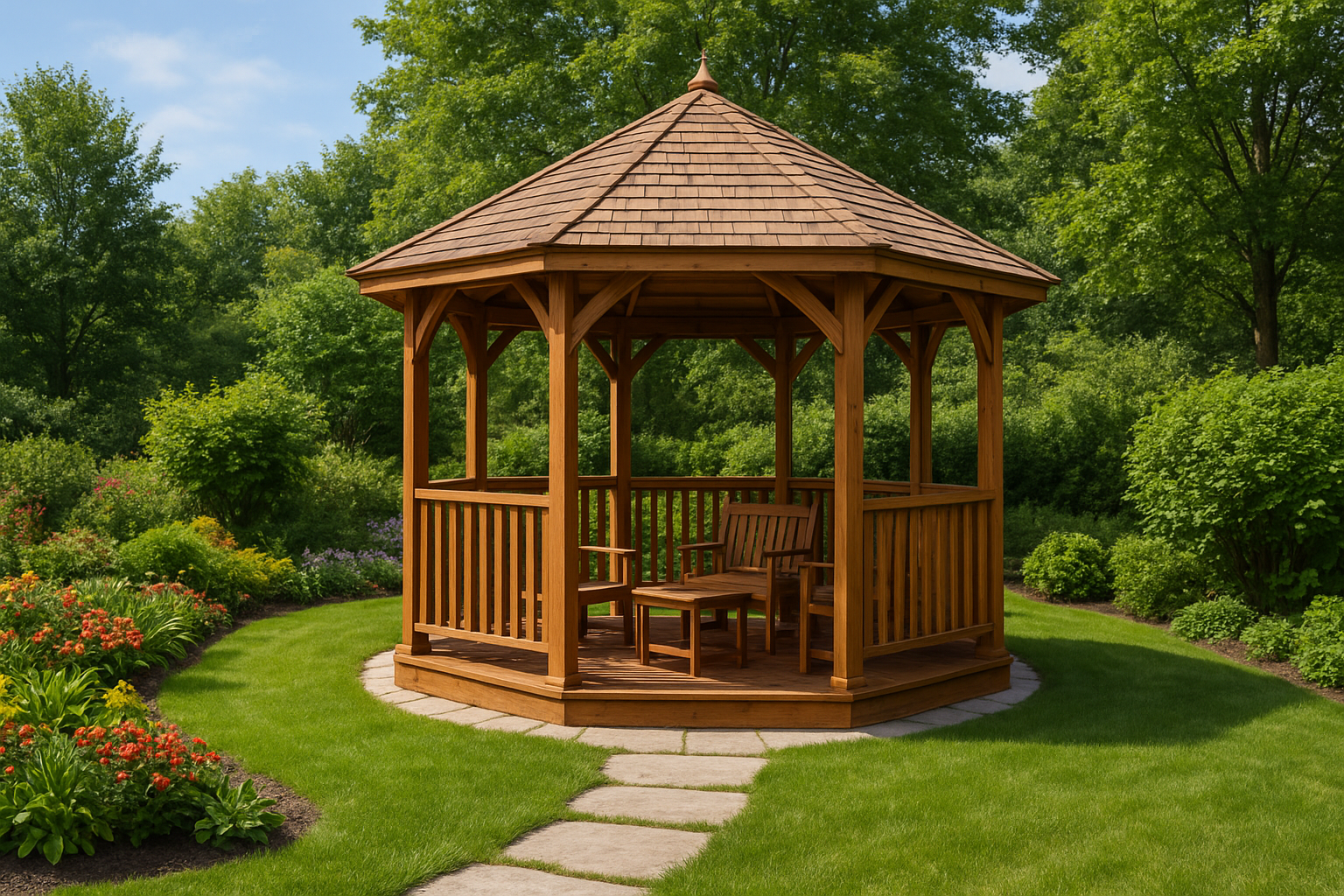
A gazebo gives you a fully enclosed roof structure, usually hexagonal or octagonal, standing on its own posts rather than attached to your house. Among garden canopy ideas, it's the closest thing to adding a small outdoor room, complete with a peaked roof that sheds rain properly instead of just filtering sun. If you want a defined gathering spot that reads as a destination in the garden rather than an extension of the patio, a gazebo does that job better than any of the flatter canopy styles.
How it works
Builders set six to eight posts into concrete footings, then frame a peaked or domed roof clad in shingles, metal sheeting, or thatch depending on the look you want. Screens or half-walls between the posts are optional, but they turn the gazebo into a bug-free space you can use at dusk without citronella candles doing all the work.
A gazebo is the only structure on this list that functions as a standalone room rather than a shade layer over existing space.
Best for
This suits larger gardens with room to dedicate a corner to seating, a hot tub, or an outdoor bar. It also works well for households that entertain often and want a fixed focal point guests gravitate toward.
Cost range in Malaysia
| Gazebo type | Size | Cost range (RM) |
|---|---|---|
| Timber, open-sided | 3m diameter | 6,000 - 9,000 |
| Metal roof with screens | 3.5m diameter | 10,000 - 15,000 |
| Custom hardwood, thatched roof | 4m diameter | 18,000 - 28,000 |
Factor in annual roof and screen maintenance, especially after heavy monsoon seasons.
5. Garden parasol or cantilever umbrella
A parasol is the simplest of all the garden canopy ideas here, and sometimes that's exactly what a small patio or balcony needs. Instead of posts sunk into footings, a cantilever umbrella holds its pole off to the side, so the canopy swings out over a table or lounge chair without a center pole getting in the way. It's the option you reach for when you want shade today, not shade after a construction crew finishes a project.
How it works
Cantilever models sit on a weighted or bolted-down base, with an arm extending the canopy outward and a crank or pulley system to open and tilt it toward the sun. Centre-pole parasols are simpler still, just a pole through a table or a freestanding base, with a push-up or crank mechanism. Both fold down fast when wind picks up, which matters given how quickly Malaysian afternoon storms roll in.
A parasol gives you shade you can move, tilt, and pack away in minutes, which no fixed structure can match.
Best for
This suits balconies, small patios, and anyone renting or not ready to commit to a permanent structure. It also works well as a second shade source next to a pergola or gazebo, covering spots the main structure misses.
Cost range in Malaysia
| Parasol type | Size | Cost range (RM) |
|---|---|---|
| Basic center-pole | 2.5m diameter | 200 - 500 |
| Cantilever, manual tilt | 3m diameter | 800 - 1,800 |
| Cantilever, crank with LED lighting | 3.5m diameter | 2,000 - 3,500 |
Replace the canopy fabric every three to five years if it stays outdoors year-round.
6. Living green canopy of trees and vertical gardens
A living canopy skips built structures altogether and uses trees, climbers, or vertical planting to do the shading work. Among garden canopy ideas, this is the slowest to establish but the most rewarding long-term, since it cools the whole garden rather than one patch of it and keeps improving as roots and foliage mature. If you already lean toward sustainable landscaping, this option fits that goal better than anything built from timber or fabric.
How it works
You plant fast-growing, broad-canopy trees like angsana, rain trees, or frangipani in spots that shade seating areas without blocking airflow, or you install a vertical garden system like EcoWall against a fence or wall to add shade and greenery in a tighter footprint. Spacing matters here. Trees need root room and distance from foundations, while vertical panels need irrigation lines built in from the start so they don't dry out in Malaysia's heat.
A living canopy is the only option that actively cools your garden's microclimate instead of just blocking the sun.
Best for
This suits homeowners with a long-term view of their garden and enough space for tree root systems, or anyone with a narrow plot who wants vertical greenery instead of horizontal shade. It also pairs well with a pergola, giving climbers something to eventually take over.
Cost range in Malaysia
| Green canopy type | Setup | Cost range (RM) |
|---|---|---|
| Shade tree, semi-mature | Single tree, planted | 300 - 1,200 |
| Vertical garden panel system | 3m x 2m wall | 3,500 - 6,500 |
| Full living wall with irrigation | 5m x 2.5m wall | 8,000 - 14,000 |
Budget for pruning and irrigation upkeep every season, since living canopies need ongoing care that built structures don't.
Choosing the right canopy for your garden
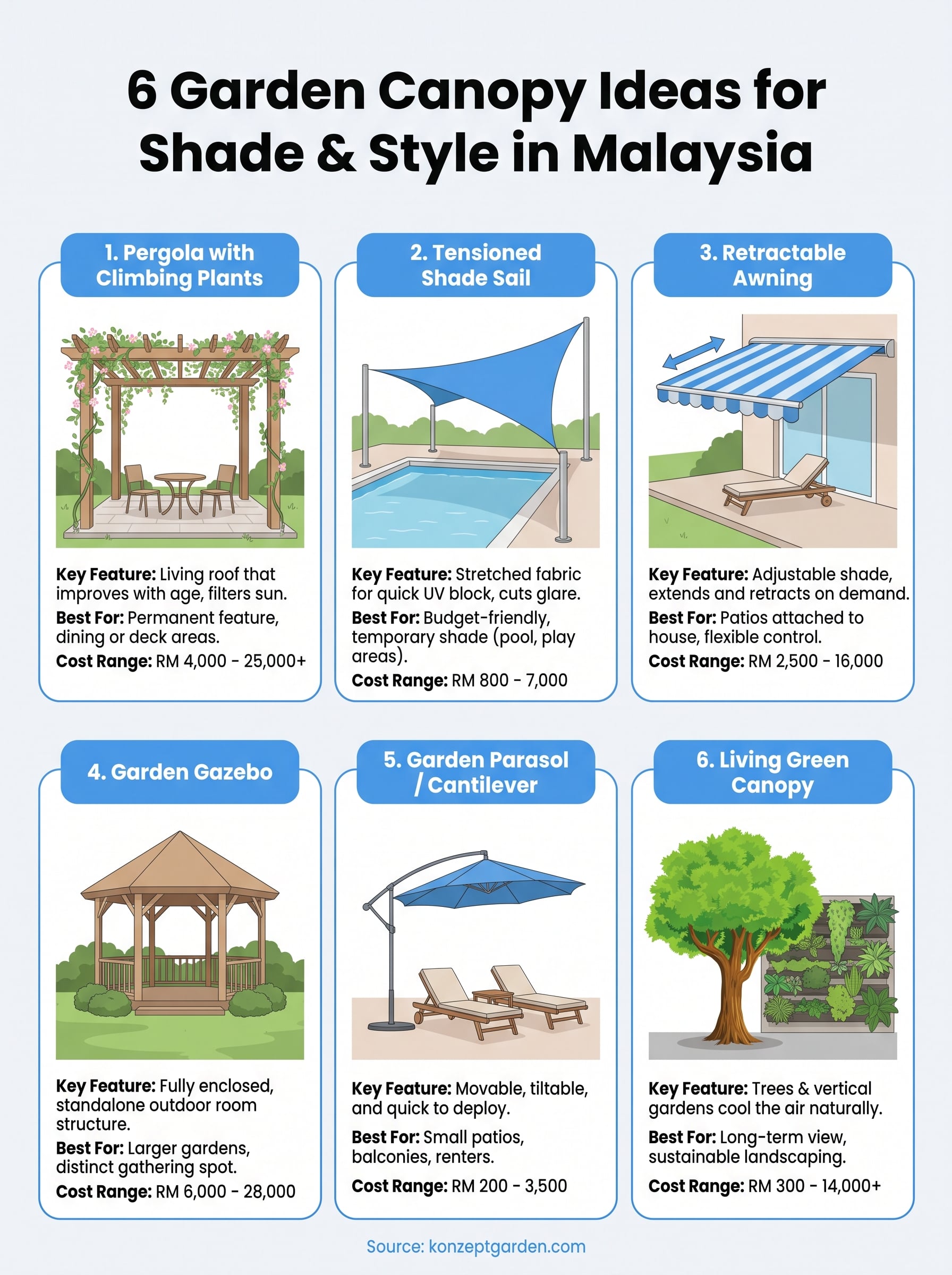
None of these six options is universally "best." A pergola with climbing plants rewards patience and gives you a structure that only gets better with age, while a shade sail or parasol solves the problem this weekend. Gazebos suit gardens with room to spare, awnings suit homeowners who want control, and living canopies suit anyone thinking decades ahead rather than one dry season. Match the choice to how you actually use your garden, not just what looks good in photos.
Whatever you land on, the details matter more than the concept: footing depth, fabric grade, plant spacing, drainage. Getting those wrong is why so many canopies fail within a year. If you'd rather skip the guesswork, talk to our design team about which structure fits your space, your budget, and Malaysia's weather, and we'll walk you through it properly before you spend a ringgit.