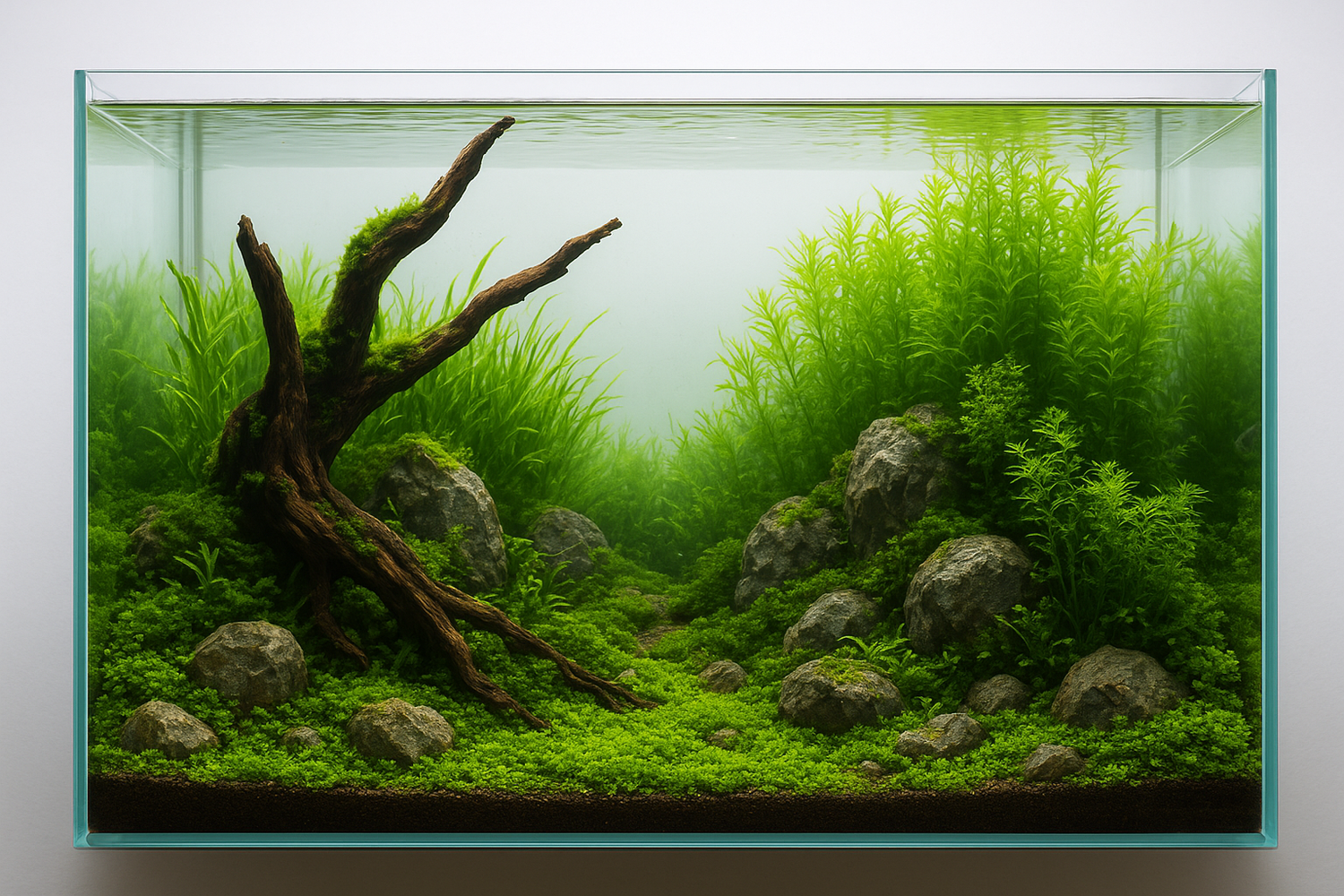
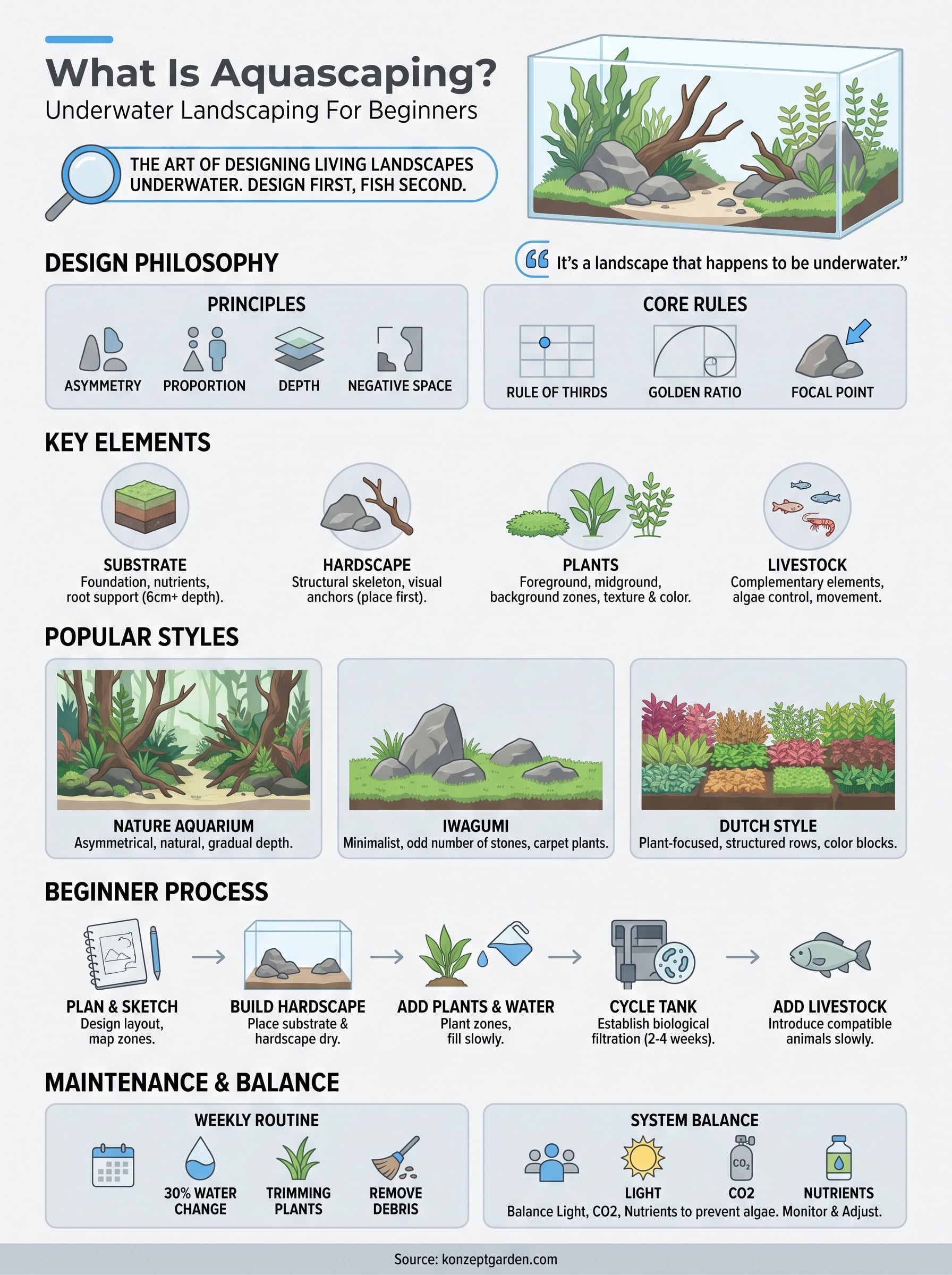
Picture a lush garden, layered with rocks, driftwood, and carefully placed greenery, except it's entirely submerged underwater. That's the simplest way to answer what is aquascaping. It's the art of designing living landscapes inside an aquarium, using aquatic plants, stones, and wood to create scenes that range from dense jungle floors to minimalist mountain ridges.
Unlike traditional fishkeeping, where the tank exists to house fish, aquascaping flips the priority. The layout, the plants, and the hardscape materials come first. Fish, shrimp, or snails are added later as complementary elements, almost like wildlife moving through a finished garden. The practice borrows heavily from landscape design principles: proportion, depth, focal points, and negative space all play a role. If you've ever admired a well-designed outdoor space and wondered how those same ideas could work on a smaller, more contained scale, aquascaping is exactly that bridge.
At Konzept Garden, we design landscapes above water, from residential gardens to custom koi ponds, so we understand the pull of shaping a natural environment from scratch. Aquascaping shares that same creative DNA. This guide breaks down how the hobby started, what materials you need, the major styles, and how it differs from simply keeping fish. Whether you're considering your first planted tank or just curious about the craft, you'll walk away with a solid foundation to decide if aquascaping is for you.
Why aquascaping is more than a decorated fish tank
Most people who set up a fish tank focus on the fish. They choose a tank, fill it with water, drop in a plastic ornament, and call it done. Aquascaping starts from the opposite direction. You begin with the landscape itself, treating the underwater space as a canvas where every rock placement, every root angle, and every plant species contributes to a unified composition. The fish, if you add any at all, are almost secondary to the environment you've built around them.
The design philosophy behind the water
Aquascaping borrows its core logic from terrestrial landscape design principles that have existed for centuries. Japanese garden design, for example, emphasizes asymmetry, natural proportion, and the deliberate use of empty space. An aquascape applies exactly that kind of thinking underwater: where does your eye land first, how does it travel through the scene, and what anchors the composition at its center? When someone asks what is aquascaping, the honest answer involves as much design theory as it does biology.
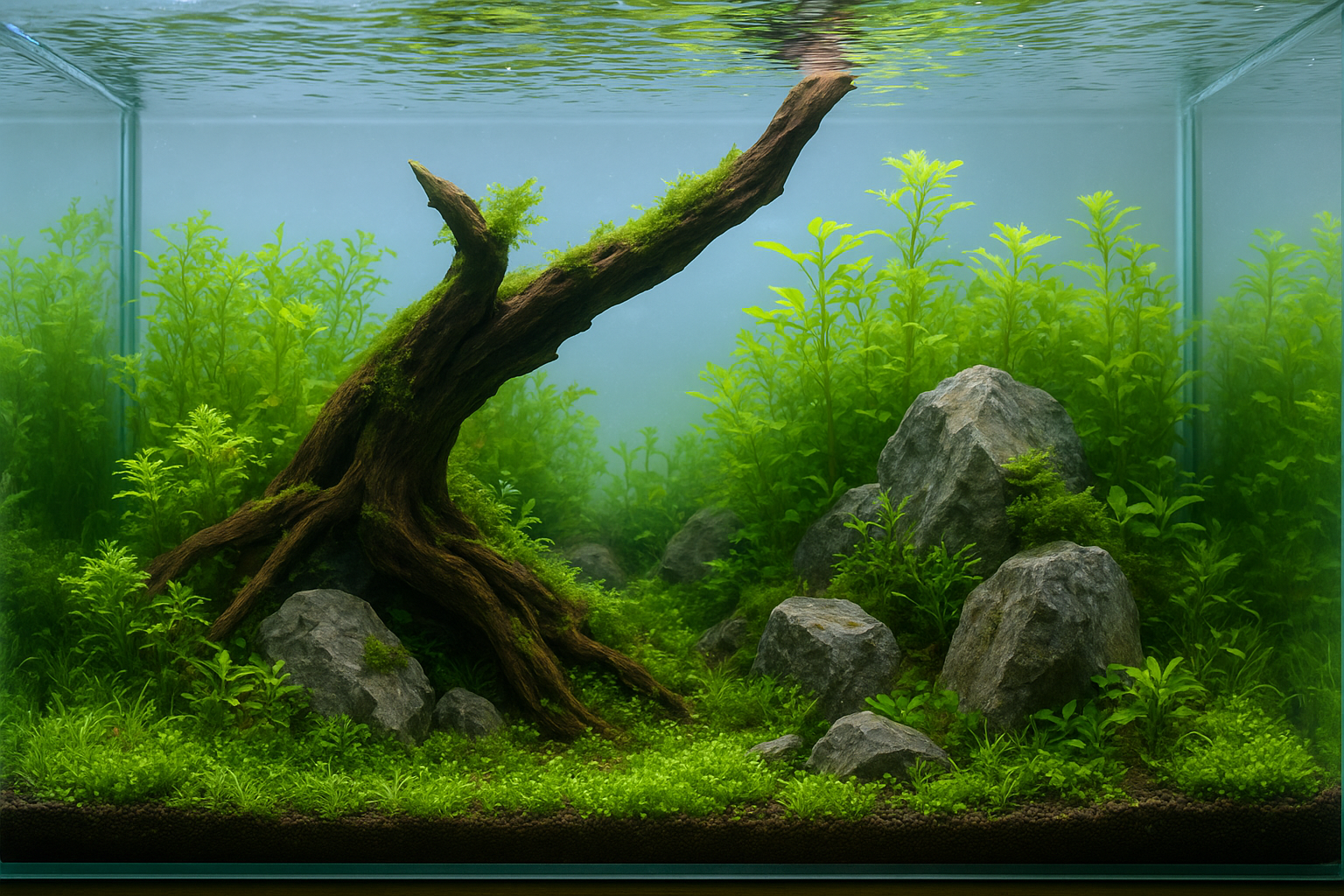
A well-built aquascape isn't a tank with plants in it. It's a landscape that happens to be underwater.
Experienced aquascapers think more like gardeners or architects than hobbyist fishkeepers. They sketch layouts before buying a single stone. They map out foreground, midground, and background plant zones the way a garden designer maps planting beds. That level of intentional planning is what separates a thoughtful aquascape from a tank that simply has some greenery dropped into it.
A living system, not a static display
One thing that separates aquascaping from interior decoration is that your aquascape is alive and constantly changing. Plants grow, spread, and compete for light. Shrimp graze algae from leaf surfaces. Roots push deeper into the substrate. What you set up on day one will look noticeably different after six months, and that biological progression is part of the appeal. You're not arranging objects; you're establishing conditions for a living system to develop on its own terms.
This dynamic quality demands a basic understanding of ecology. Lighting intensity determines which plants thrive. CO2 levels influence plant growth rates. The balance between nutrients, light, and carbon dioxide either produces healthy plant growth or triggers algae outbreaks. A decorated fish tank can survive a lot of neglect. A well-maintained aquascape requires you to monitor and adjust those conditions on a regular schedule, more like tending a garden bed than maintaining an appliance.
Why the discipline attracts designers and gardeners
People with backgrounds in graphic design, architecture, or landscape gardening tend to take to aquascaping quickly, precisely because the underlying principles feel familiar. Composition, scale, texture contrast, color gradation from foreground to background: these are the same tools you'd use to design a planted courtyard or a layered rockery. The water surface simply acts as a frame, cutting the scene into a clearly defined picture plane that rewards careful placement of every element.
That fixed frame is part of what makes aquascaping so visually distinct from outdoor gardening. Unlike a garden, where the view shifts depending on where you stand, an aquascape presents one composed view through the front glass. Every element either strengthens or weakens that single perspective, which raises the design stakes considerably. For anyone who enjoys shaping space with intention, whether above ground or below the waterline, that constraint turns a hobby into a genuine creative discipline worth taking seriously.
What counts as aquascaping and what doesn't
The term gets stretched in casual conversation, so it helps to draw a clear line. Aquascaping refers specifically to the intentional design of an underwater landscape, where the arrangement of plants, hardscape materials, and the biological system all serve a deliberate visual and ecological goal. If you've searched what is aquascaping and landed on images that look more like nature scenes than pet store tanks, that precision in design is exactly what defines it.
What qualifies as a true aquascape
A tank qualifies as an aquascape when design intent drives every decision. That means you've chosen a specific layout style, selected substrate depth and composition to support plant roots, and arranged hardscape materials like stones or driftwood according to a planned composition. Plants aren't dropped in at random; each species occupies a deliberate position based on its mature size, color, and growth rate. Even the choice of fish or shrimp reflects the overall visual concept rather than personal preference alone.
The clearest test: if you removed all the plants and hardscape, the remaining structure should still reflect deliberate planning rather than random placement.
Simply adding a few stems to a community fish setup doesn't fully meet that bar. The plants may be a welcome addition to the tank, but if the fish remain the primary focus and the layout serves the fish rather than the composition, the design intent isn't actually driving the project, which keeps it in planted-tank territory rather than true aquascaping.
What falls outside the definition
Several common setups look similar but sit outside the scope of aquascaping. A fish-only tank with plastic decorations doesn't qualify, regardless of how elaborate those decorations are. A biotope tank, which replicates the exact natural habitat of a specific species, comes close but prioritizes ecological accuracy over visual composition, making it a separate category with its own community and standards.
Paludariums, which combine above-water and below-water planting in a single tank, occupy a related but distinct space. You can apply aquascaping principles to the submerged section, but the above-water element follows terrestrial planting logic rather than underwater composition rules. Terrariums, outdoor water gardens, and moss walls share some aesthetic overlap with aquascaping but belong to entirely separate disciplines with their own tools, materials, and skill sets.
Key elements of an aquascape
Every aquascape is built from the same core components, and understanding what each one does helps you see why successful tanks look the way they do. When people dig into what is aquascaping beyond the surface definition, they quickly realize that the finished result depends on how well these elements work together, not just on which species or stones you choose.
Substrate: the foundation everything grows from
Substrate refers to the material that covers the tank floor, and it does far more than look natural. In a planted aquascape, the substrate holds plant roots, stores nutrients, and influences water chemistry over time. Basic gravel works for simple setups, but most planted tanks use a specialized nutrient-rich substrate like aquasoil, which actively supports root development and buffers pH to a range that most aquatic plants prefer. Depth matters too: a minimum of 6 cm gives roots enough space to anchor and spread without becoming root-bound against the glass bottom.
Hardscape: rocks and wood as structural anchors
Hardscape materials form the skeleton of your layout. Stones and driftwood define the visual structure before a single plant goes in, so your placement decisions here carry the most weight. Common choices include Seiryu stone for sharp, layered ridges and spiderwood or manzanita branches for organic, root-like forms. Each piece should serve the composition: larger elements sit toward the back and center, smaller pieces echo those shapes toward the edges and front. Avoid symmetrical arrangements; natural landscapes almost never mirror themselves, and your aquascape will look more convincing for the same reason.
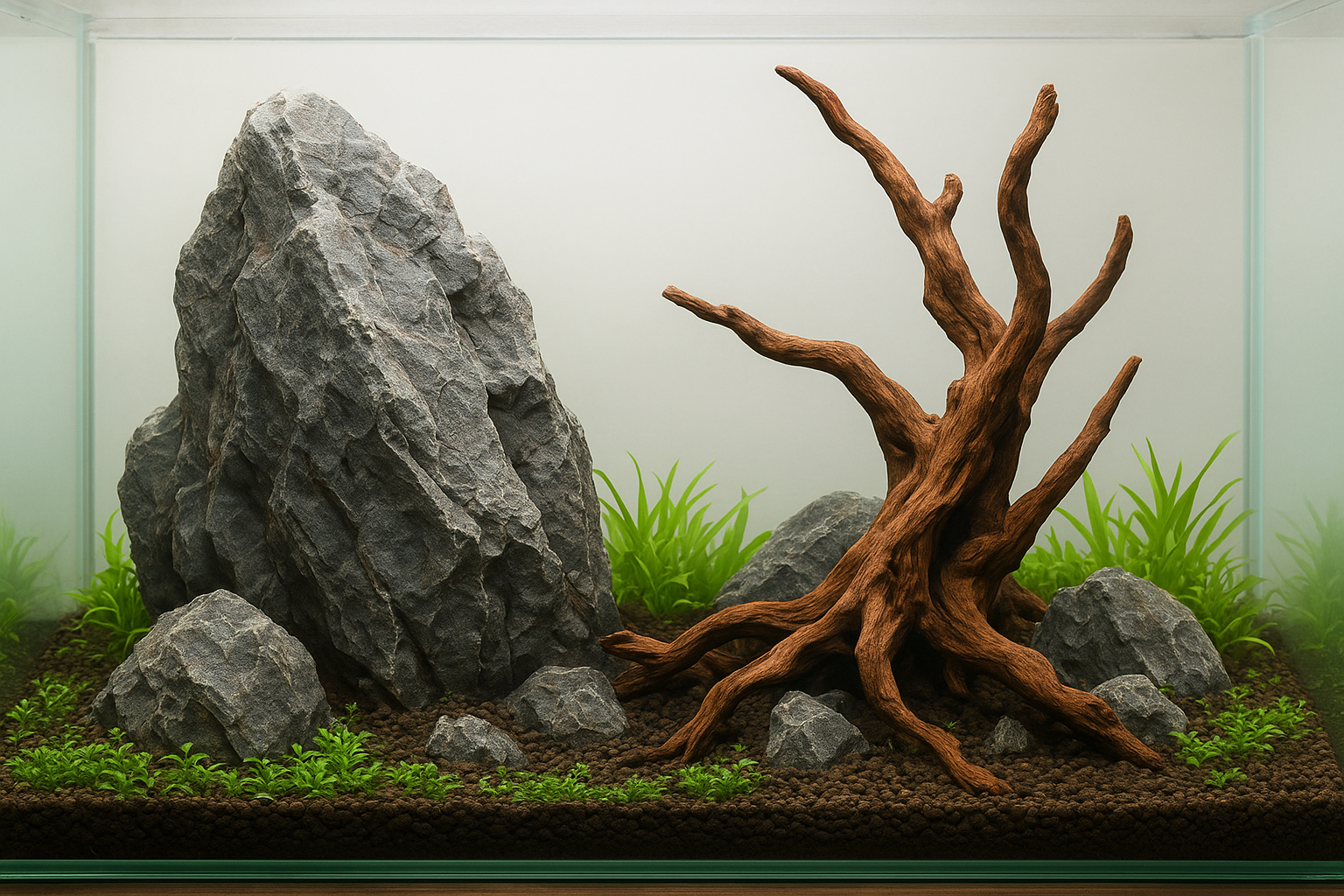
Place your largest hardscape piece first, then build the rest of the composition around it rather than trying to adjust everything simultaneously.
Plants: the living layer that ties it together
Aquatic plants fill the three spatial zones of the tank: foreground, midground, and background. Low, carpeting species like Hemianthus callitrichoides cover the substrate in the foreground. Mid-height plants such as Cryptocoryne or Anubias create visual transitions in the middle zone. Tall stem plants like Rotala or Vallisneria fill the back and create depth. Choosing species with contrasting leaf shapes and shades of green adds texture that makes the layout read as a natural scene rather than a monoculture.
Livestock: completing the living system
Fish and invertebrates serve both visual and functional roles. Small schooling fish like rasboras or tetras add movement without dominating the composition. Amano shrimp and Otocinclus catfish graze algae from plant surfaces, keeping the tank cleaner between maintenance sessions. Choose livestock that stays appropriately sized for your tank volume so the animals complement the landscape rather than crowd it.
Core design rules that make a tank look natural
Knowing what materials to use is one thing; knowing how to arrange them is another. Design rules give your aquascape a coherent structure, and the best ones draw directly from principles that landscape architects and visual artists have used for centuries. When someone digs into what is aquascaping at a deeper level, these rules explain why certain tanks look immediately convincing while others feel cluttered or flat despite using the exact same plants and stones.
The rule of thirds and the golden ratio
These two principles govern where your focal point sits inside the frame. The rule of thirds divides the tank into a 3x3 grid, and the strongest focal points land on the intersection lines rather than dead center. Centering your main hardscape piece produces a static, symmetrical result that reads as artificial. Shifting it to one of the intersecting grid points creates tension and movement, which is exactly how natural environments actually look.
Placing your tallest or most striking element at a rule-of-thirds intersection is the single fastest upgrade you can make to an average-looking layout.
The golden ratio takes the same logic further. It describes a naturally occurring spiral proportion found in shells, fern fronds, and river bends, and aquascapers use it to decide where rocks taper toward the substrate or where a wood branch curves into the background. You don't need to measure precisely; studying a few reference layouts built around this proportion trains your eye quickly to recognize when placement feels right and when something is off.
Scale, proportion, and negative space
Scale refers to the size relationship between elements: a massive stone paired with fine-leafed carpeting plants reads as dramatic; similarly sized pieces grouped together read as monotonous. Vary the scale of every element deliberately, from the largest background stone down to the smallest foreground plant, so the eye has a clear visual hierarchy to follow through the composition.
Proportion applies the same logic to the overall ratio of planted area to open space. Leaving some areas of bare substrate, called negative space, lets your plants and hardscape breathe visually. Cramming every centimeter with greenery removes that breathing room and makes the layout feel chaotic rather than natural. Natural underwater environments carry open corridors of substrate between plant clusters, and your aquascape will look far more convincing the moment you stop filling every gap and start treating empty areas as intentional design choices rather than problems to solve.
Popular aquascaping styles and layouts
Understanding the major aquascaping styles gives you a clearer picture of where to direct your energy as a beginner. Each style carries its own rules around plant selection, hardscape arrangement, and layout proportion, so choosing one before you start prevents the scattered look that comes from mixing incompatible approaches. When someone researches what is aquascaping and browses examples online, these are the categories most of those images fall into.
Picking a style before buying your first plant saves you from building a tank that tries to be everything at once.
Nature Aquarium style
The Nature Aquarium style was developed by Japanese photographer and aquarist Takashi Amano in the 1990s and remains the most influential approach in the hobby. It draws directly from Japanese garden aesthetics, using asymmetrical hardscape arrangements, gradual depth, and contrasting plant textures to recreate miniature versions of natural landscapes like forest floors or riverbeds.
Your focal point sits off-center, your plants transition from low foreground carpets to tall background stems, and open substrate corridors create breathing room throughout the composition. Amano's approach prioritizes visual harmony over plant variety, so a modest selection of two or three species arranged with care will outperform a crowded mix placed without intention.
Iwagumi style
Iwagumi is a minimalist subset of the Nature Aquarium approach, built almost entirely around stone arrangements and low carpeting plants. You work with an odd number of stones, typically three, five, or seven, placed according to golden ratio proportions, with one dominant stone called the oyaishi anchoring the composition at a rule-of-thirds intersection.
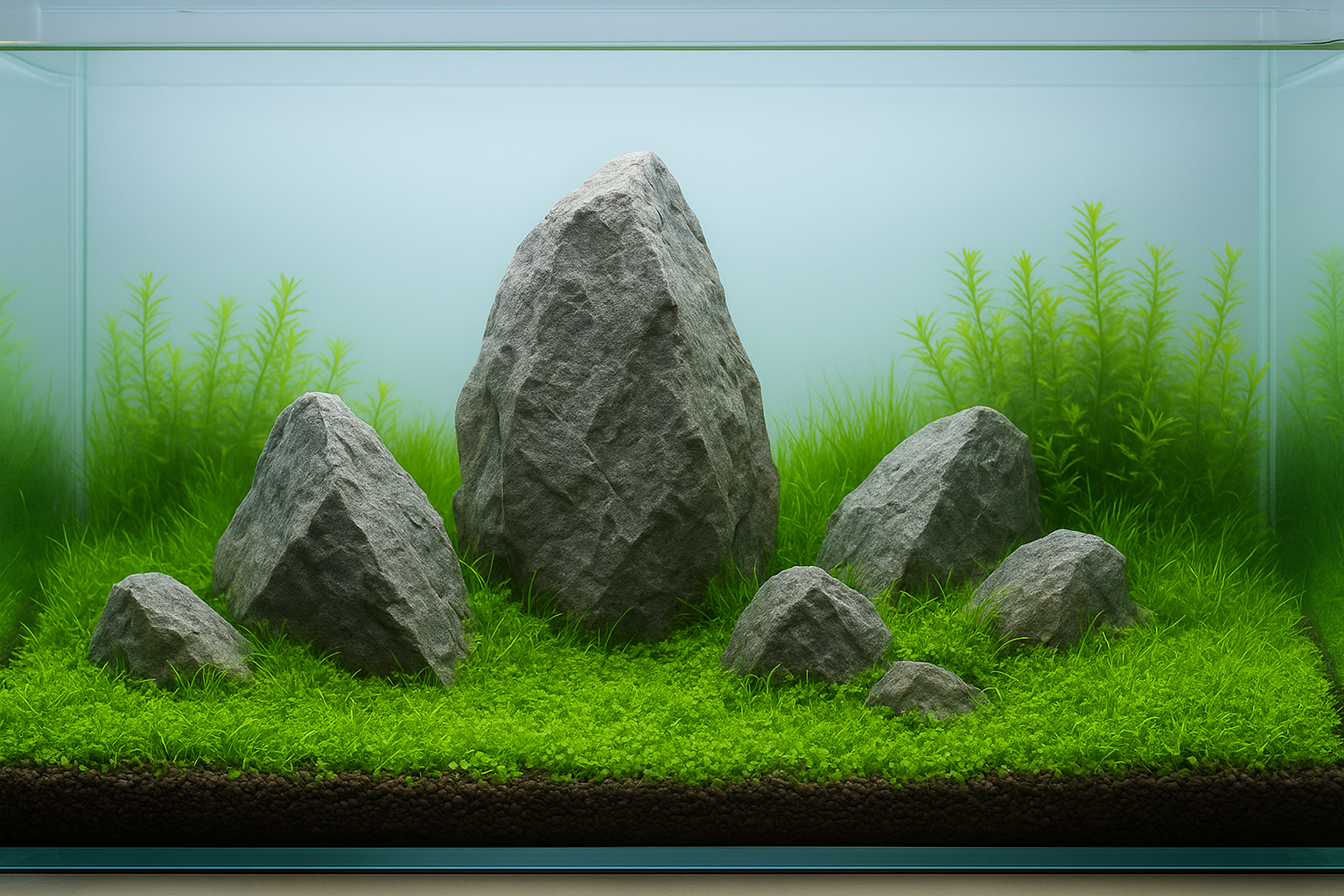
The challenge with Iwagumi is that its simplicity removes all visual distractions, so every stone angle and every patch of carpet plant must be precisely placed. This style rewards patience and disciplined trimming more than almost any other, making it difficult for beginners but deeply satisfying once the carpet fills in evenly across the substrate.
Dutch style
The Dutch style originated in the Netherlands during the 1930s and takes a completely different direction: it relies entirely on plants, with no exposed hardscape materials and no attempt to replicate a natural outdoor scene. Instead, it uses structured rows and color blocks of different plant species to create a formal, garden-like display that reads more like a planted flower bed than a landscape.
You arrange taller, contrasting species in deliberate groups separated by distinct color and leaf shape, creating visual lanes that draw the eye toward the back of the tank. Dutch aquascaping demands solid knowledge of plant growth rates and compatibility because the entire effect depends on keeping each species precisely within its designated space.
The basic aquascaping process for beginners
Starting your first aquascape feels overwhelming only when you skip the planning stage and buy materials without a direction. Following a clear sequence, from sketching the layout to cycling the water, keeps each step manageable and prevents the most common beginner mistakes. Understanding this order is just as central to understanding what is aquascaping as knowing which plants or stones to use, because the process shapes the outcome as much as the materials do.
Plan your layout before you purchase anything
Before you spend money on a single stone or plant, sketch your intended composition on paper. Decide which style you're working in, identify where the focal point will sit, and map out your three planting zones. Planning on paper forces you to commit to a design direction before purchase decisions lock you into materials that don't fit together. A simple pencil sketch with rough dimensions and labeled zones takes under an hour and saves you from buying pieces that conflict with the layout you had in mind.
Once you have a usable sketch, build a sequenced shopping list organized by category: substrate first, then hardscape, then plants, then equipment. Working from a list rather than browsing at random prevents impulse purchases and keeps your budget aligned with the actual requirements of your planned composition.
Build the tank from the bottom up
Set up the tank completely dry before adding any water. Start with the substrate layer at a depth of at least 6 cm, then position every piece of hardscape before a single plant goes in. Arranging stones and wood in a dry tank lets you shift angles and proportions freely without disturbing anything else. Once the hardscape feels right, photograph the front panel at eye level to check the composition from the exact perspective your viewer will see it from.
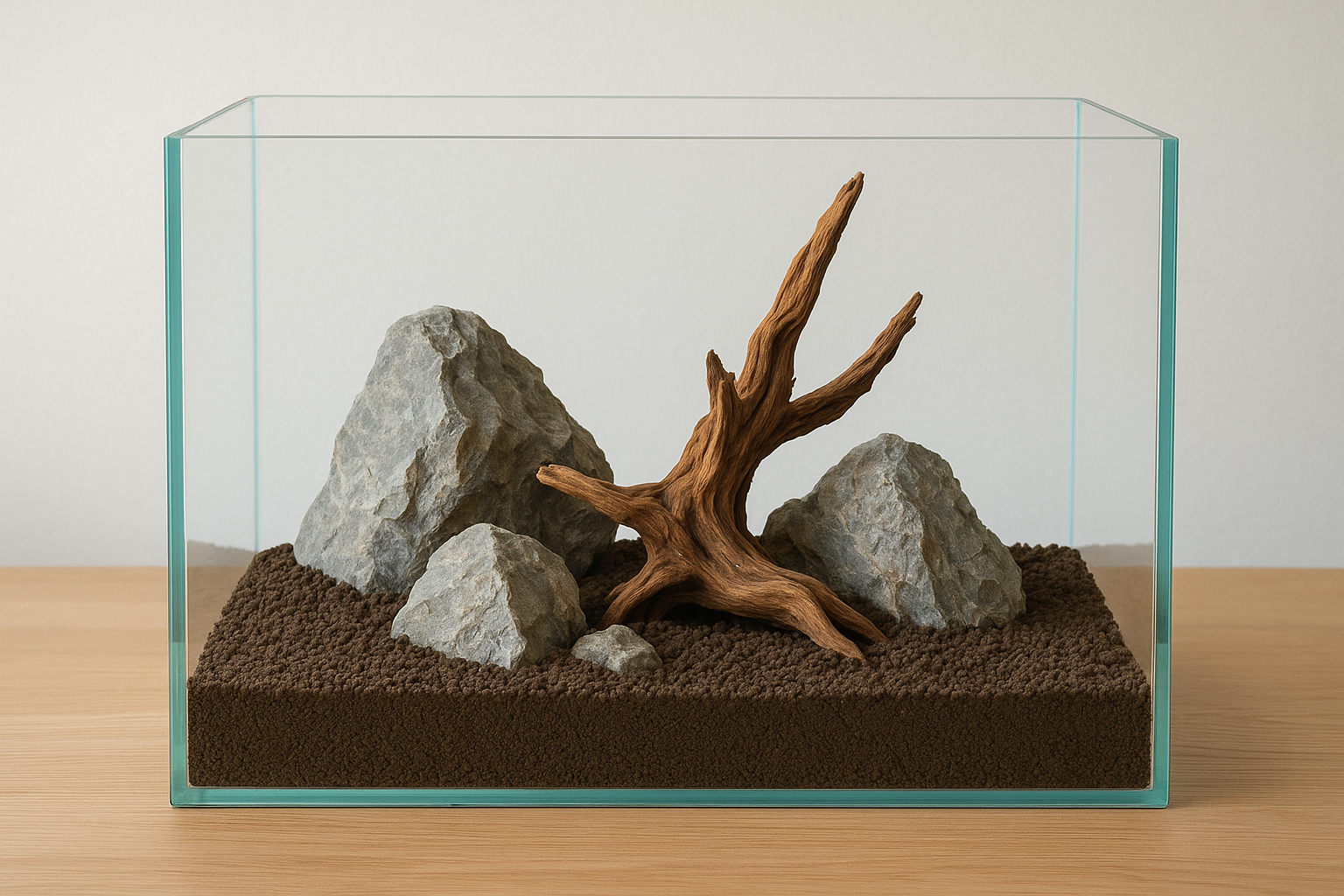
Getting the hardscape right before adding water is the step most beginners skip and later wish they hadn't.
Add plants, fill with water, and cycle before adding fish
Plant each species in its designated zone, starting at the background and working toward the foreground so you don't trample freshly placed carpeting plants while reaching toward the back. After planting, add water slowly by pouring it over a plate or plastic bag resting on the substrate. This simple step prevents the water current from disturbing your substrate layer and shifting your hardscape out of position during the fill.
Run the filter after filling and allow the tank to complete the nitrogen cycle before you add any fish or shrimp. This process typically takes two to four weeks and establishes beneficial bacteria that process waste compounds into less harmful forms. Adding livestock before that cycle finishes stresses the animals and can destabilize the biological system you've spent weeks building.
Equipment basics: light, filtration, CO2, fertilizer
Anyone researching what is aquascaping quickly discovers that the plants and hardscape get most of the attention, but the equipment running behind the scenes determines whether those plants actually survive. Four systems carry the most weight: lighting, filtration, carbon dioxide injection, and liquid fertilizers. Getting each one right from the start prevents the algae problems and slow plant growth that frustrate most beginners in their first few months.
Lighting: matching intensity to your plant selection
Light drives photosynthesis, which means your plant choices must match the intensity your light produces. Low-light species like Anubias and Java fern tolerate basic LED fixtures without issue. High-light carpeting plants such as Hemianthus callitrichoides need a full-spectrum LED capable of producing at least 50 micromoles of PAR at the substrate level. Running a light that's too weak for your plants produces pale, leggy growth. Running one that's too strong without adequate CO2 and nutrients triggers algae outbreaks instead of plant growth. A simple programmable timer set to eight to ten hours per day prevents the inconsistent photoperiods that destabilize a new tank.
Filtration: keeping water clear without disturbing the layout
Your filter handles two jobs: mechanical removal of debris and biological processing of waste compounds through beneficial bacteria colonies. A canister filter works best for planted tanks because it sits outside the aquarium entirely, leaving the interior clean and uncluttered. Adjust the spray bar or outlet so the current moves horizontally across the surface rather than blasting downward into your substrate, which would uproot carpeting plants and scatter your foreground planting zones.
A canister filter sized for twice your actual tank volume gives you biological capacity to handle feeding waste without weekly media changes.
CO2 and fertilizers: fueling plant growth
Carbon dioxide injection is the single biggest upgrade you can make to a planted aquascape. Plants absorb CO2 during photosynthesis, and the natural concentration dissolved in tap water isn't enough to support rapid, healthy growth. A pressurized CO2 system delivers a steady supply through a diffuser, and the difference in plant growth rate is visible within two weeks of starting injection. Run CO2 during your photoperiod only; running it overnight wastes gas and drops pH unnecessarily while the lights are off.
Liquid fertilizers cover the macro and micronutrients that substrate alone can't provide as the tank matures. Dose according to your plant density and adjust based on what you observe: pale leaves signal a nutrient deficiency, while excessive algae alongside healthy plants often points to a lighting or CO2 imbalance rather than a fertilizer problem.
Plants and livestock that work well together
Choosing plants and livestock without a plan produces a tank where species compete rather than complement each other. Pairing the right plant species with compatible animals is one of the most practical sides of understanding what is aquascaping, because the biology behind your layout either holds the system together or slowly pulls it apart. Your goal is to build combinations where each species fills a role: covering a spatial zone, controlling algae, adding movement, or stabilizing water chemistry.
Plants that suit different tank zones
Foreground carpeting plants like Hemianthus callitrichoides and Glossostigma elatinoides spread low across the substrate and create the dense, lawn-like base that defines many classic layouts. Both species demand high light and consistent CO2, so pair them with a reliable injection system from the start. For beginners who want a carpeting effect without those intensive requirements, Marsilea hirsuta grows slowly but tolerates lower light and still produces a compact, ground-covering result over time.
Mid and background zones reward variety in leaf shape and height. Cryptocoryne species handle a wide range of water conditions and add broad, textured leaves that contrast well against fine-stemmed plants. Rotala rotundifolia provides tall, reddish stem growth at the back that draws the eye upward and adds warm color without crowding lower foreground plants. Mixing narrow and wide leaf shapes across zones gives the composition visual depth that a single species scattered throughout the tank simply cannot achieve.
Selecting one dominant species per zone and one accent species keeps the layout readable without turning into a plant catalogue.
Livestock that supports the ecosystem
Amano shrimp are the most effective algae-grazing invertebrates available to aquascapers. A group of ten to fifteen in a standard 60-liter tank keeps hair algae and biofilm under control between water changes without disturbing plant roots or uprooting foreground carpets. Otocinclus catfish perform a similar role on leaf surfaces, grazing the thin green film algae that coats broad-leaved plants like Anubias and Echinodorus if light levels run slightly high.
For fish, small schooling species add movement without overpowering the composition. Ember tetras, chili rasboras, and rummy-nose tetras stay compact and shoal tightly, which creates natural-looking movement through the midwater column without competing visually with your hardscape or plants. Avoid cichlids or large barbs in a planted layout; those species dig substrate, uproot stems, and disrupt the carpet layer within days of introduction, which undoes weeks of careful planting work.
Maintenance, algae control, and common mistakes
A finished aquascape doesn't run itself. Regular maintenance keeps your plants healthy, your water chemistry stable, and your layout looking intentional rather than overgrown. Most aquascapers settle into a weekly schedule that covers the same core tasks, and building that habit early prevents the small problems that compound into major setbacks over time.
Building a weekly maintenance routine
A 30% water change performed once per week removes dissolved waste compounds, replenishes minerals, and resets nutrient levels before they drift out of range. During each water change, use trimming scissors to cut back any stems or carpeting plants that have grown past their assigned zone. Consistent trimming trains plants to grow dense and compact rather than tall and leggy, which strengthens the composition over months rather than weakening it through overgrowth.
After trimming, remove all cut plant material before it sinks and decomposes in the substrate. Decomposing plant matter raises nutrient levels rapidly and unevenly, which fuels algae rather than your plants and can destabilize water chemistry between water changes.
Algae: reading the signs and fixing the cause
Algae appears in every planted tank at some point, and understanding what is aquascaping includes understanding how to read algae as a diagnostic signal rather than treating it as random bad luck. Green spot algae on the glass usually points to low phosphate levels, while thread algae growing on plant leaves typically indicates inconsistent CO2 delivery. Fixing the root cause clears the problem; scrubbing the glass without adjusting your system only delays the next outbreak.
Algae is almost always a symptom of an imbalance between light, CO2, and nutrients rather than a problem you can clean your way out of.
Reducing your photoperiod by one hour is the fastest adjustment you can make when algae appears suddenly in a previously stable tank. Cutting light duration buys time to diagnose whether CO2 delivery, fertilizer dosing, or a recent change in plant density triggered the imbalance before it spreads further.
Mistakes that set beginners back
Overstocking fish too early is the most common mistake that destabilizes a new planted tank. A high fish load produces more waste than a young biological filter can process, which spikes ammonia and triggers algae outbreaks before your plants have established strong root systems. Wait until your tank has cycled fully and your plants show active growth before adding any livestock.
Skipping the planning stage produces the second most predictable failure: a tank full of plants and stones with no coherent focal point, no defined zones, and no style guiding future decisions. Committing to a layout sketch before purchasing a single item prevents that outcome entirely.
Next steps for your first aquascape
Now that you understand what is aquascaping and how every element connects, the most productive next step is to pick one style, sketch a simple layout, and start sourcing your materials in the right order: substrate first, then hardscape, then plants, then equipment. Resist the urge to buy everything at once. A focused beginner tank with three plant species and a clear focal point will outperform an overstocked layout built without a plan every single time.
Water features don't stop at the aquarium glass. If you enjoy the idea of shaping a living water environment and want to take that interest outside, a custom koi pond brings the same design thinking to your garden on a much larger scale. Konzept Garden builds both naturalistic and contemporary pond designs across Malaysia, so explore the Zen Bio Koi Pond to see what a professionally designed water feature looks like in a real outdoor space.