


A Japanese garden isn't just a collection of rocks, water, and plants arranged to look pretty. It's a deliberate practice, every stone placed with intention, every empty space left purposefully bare. Understanding japanese garden design principles means recognizing that these gardens function as living expressions of philosophy, where nature and human craft meet on equal terms.
Whether you're drawn to the raked gravel of a Zen courtyard or the mossy stillness of a tea garden, these principles offer something practical: a framework for creating outdoor spaces that feel calm, balanced, and deeply considered. For homeowners and property developers in Malaysia, where tropical greenery already thrives, Japanese design thinking can shape gardens that feel purposeful rather than overgrown, and serene rather than simply decorated. At Konzept Garden, we've applied these philosophies across residential and commercial projects, adapting them to our local climate and plant palette.
This article breaks down the core elements, the Zen Buddhist roots, and the Wabi-Sabi aesthetic that together define authentic Japanese garden design. You'll learn what each principle actually means, how they work together, and how to apply them to your own outdoor space, no matter its size.
Why Japanese garden principles still work today
Most garden trends burn bright and fade quickly. A style saturates the market, shows up in every new development, and within a few years it looks dated. Japanese garden design principles have followed a completely different trajectory. Originating over a thousand years ago, they've been refined, documented, and applied across wildly different cultures and climates. The reason they stay relevant isn't nostalgia. It's that the problems they were built to solve are permanent.
They address the problem of visual noise
Modern life generates a relentless amount of input. Screens, traffic, and urban density all compete for your attention. Your outdoor space has a real opportunity to work against that pressure rather than add to it. Japanese garden design responds to this directly, using deliberate restraint to lower stimulation rather than raise it. Every element earns its place, and what gets left out is just as considered as what stays in.
A garden built on restraint doesn't just look calm. It functions as a physical counterweight to the noise of everyday life.
Central to this is the concept of ma, or negative space. Empty areas in a Japanese garden aren't voids waiting to be filled. They're active parts of the composition that give your eye somewhere to rest. This is increasingly valuable in dense urban settings, where most gardens are small and the temptation is to pack in as much as possible.
They work at any scale and in any climate
One reason Japanese design thinking has spread globally is that its principles operate independently of plant species and plot size. A 30-square-meter courtyard in Kuala Lumpur can apply the same compositional logic as a traditional stroll garden in Kyoto. You don't need Japanese maples or raked gravel to achieve the underlying structure. Local tropical plants, volcanic stone, and gravel alternatives all carry the same visual weight when placed according to the same rules.
Adapting these principles in Malaysia is more straightforward than most people expect. Moss, which features heavily in traditional Japanese gardens, has direct tropical equivalents. Bamboo grows faster here than almost anywhere else. Water features benefit from Malaysia's consistent rainfall, and the year-round warmth supports the kind of lush, textured planting that defines the Japanese aesthetic. The underlying geometry translates even when the specific plant palette changes entirely.
They give your garden a consistent design language
Without a unifying philosophy, garden projects tend to accumulate features that don't relate to each other. You end up with a water feature on one side, a pergola on the other, and planting that fills gaps rather than creates meaning. Japanese design principles prevent this by establishing a clear hierarchy for every decision you make, from the largest structural stone down to the placement of a single ground cover plant.
When you understand what each element is meant to do and how it relates to everything around it, every choice becomes more intentional. That consistency is what separates a garden that looks professionally designed from one that looks assembled. Japanese-inspired spaces age well precisely because they don't rely on seasonal color or fashionable materials. They rely on proportion, texture, and balance, which hold up regardless of the year.
Core Japanese garden design principles
Japanese garden design isn't guided by a single rule but by a set of interlocking ideas that together create visual harmony. Each principle reinforces the others, and once you understand how they connect, you can apply them to any outdoor space, from a compact urban courtyard to a sprawling residential property. These ideas have been formalized in Japanese aesthetics under specific terms, but their practical meaning is straightforward and entirely transferable to a Malaysian context.
Fukinsei: asymmetry over symmetry
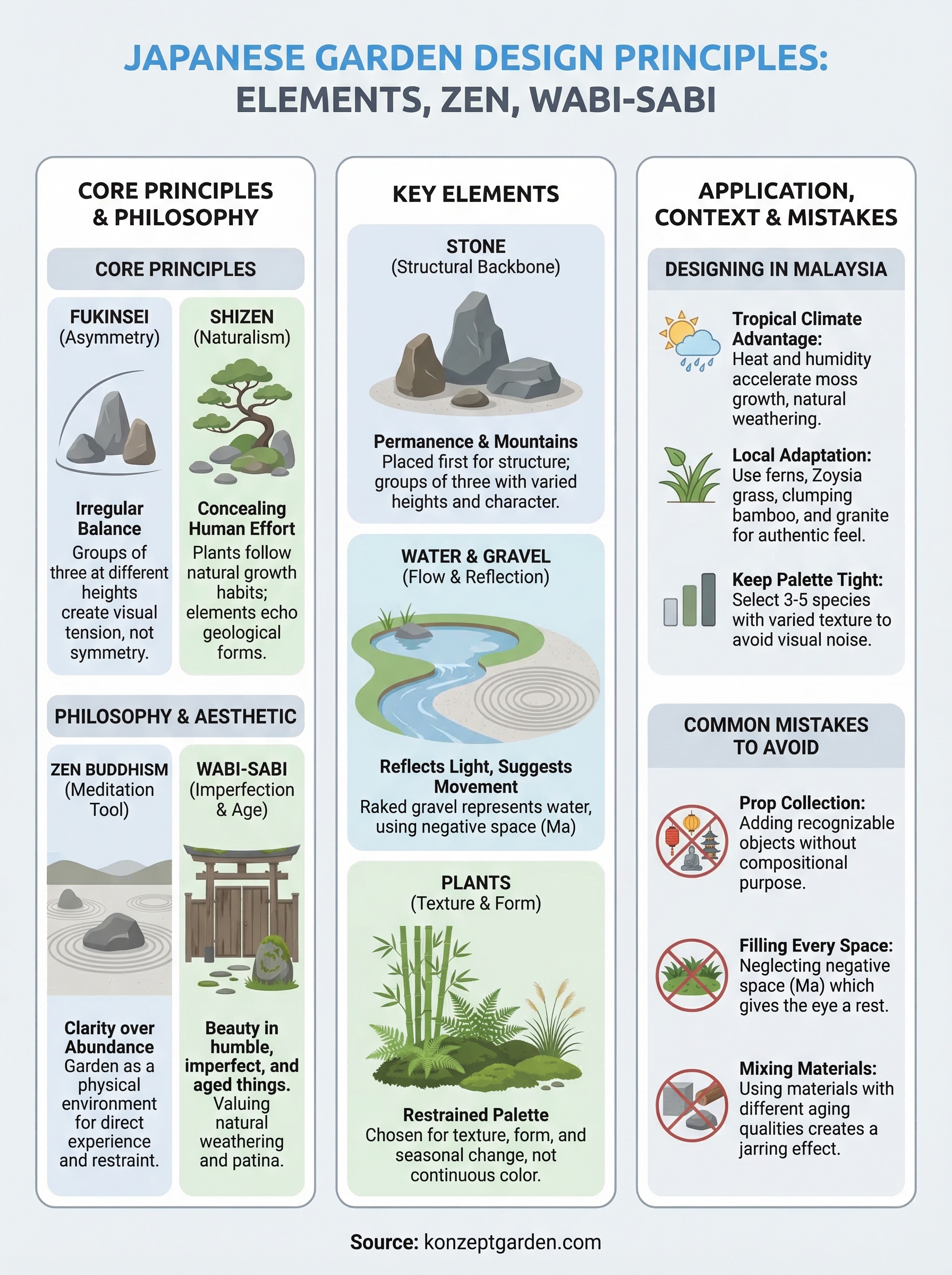
Western formal gardens often rely on mirror symmetry, with matching beds on each side of a central axis. Japanese design deliberately avoids this, favoring compositions that feel balanced without being identical. This is fukinsei, the principle of irregular balance. A group of three stones placed at different heights creates more visual tension and interest than two matching stones placed side by side, because the eye has to work slightly to find equilibrium. That small effort produces a sense of discovery rather than instant resolution.
Applying fukinsei means resisting the urge to pair things. Instead of two identical planters flanking an entrance, consider three elements of different sizes arranged at varied distances. The result feels natural rather than constructed, which is precisely the effect that authentic japanese garden design principles aim for.
Shizen: embracing naturalism
Shizen translates roughly as naturalness, but in practice it means something more specific: concealing human effort so the garden appears to have emerged on its own rather than been imposed on the land. Clipped hedges and symmetrical borders work against shizen. Plants trained to follow their natural growth habit, stones that echo geological formations, and paths that curve rather than run straight all work with it.
The goal isn't to copy nature directly, but to distill it into something that feels genuine.
This principle carries direct relevance in Malaysia, where the tropical landscape already offers rich texture, layered canopies, and organic form. You're working with natural abundance rather than against it, which makes shizen considerably easier to achieve here than in temperate climates where gardens have to work harder to look alive and dynamic year-round.
Zen and Wabi-Sabi in garden design
Two philosophical traditions sit at the core of authentic Japanese garden design: Zen Buddhism and the aesthetic of Wabi-Sabi. Neither is purely decorative. Both provide a specific lens for making design decisions, and understanding them helps you see why certain gardens produce a sense of stillness that well-planted but philosophy-free spaces never achieve.
Zen Buddhism and the garden as a meditation tool
Zen Buddhism arrived in Japan from China in the 12th century, and its influence on garden design was immediate. Zen practice centers on direct experience rather than intellectual knowledge, and the garden became a physical environment for that kind of attention. Traditional Zen gardens, called karesansui or dry landscape gardens, strip everything back to stone, gravel, and sand. The raked patterns represent water without using any. The stones represent mountains, islands, or natural forms without imitating them literally.
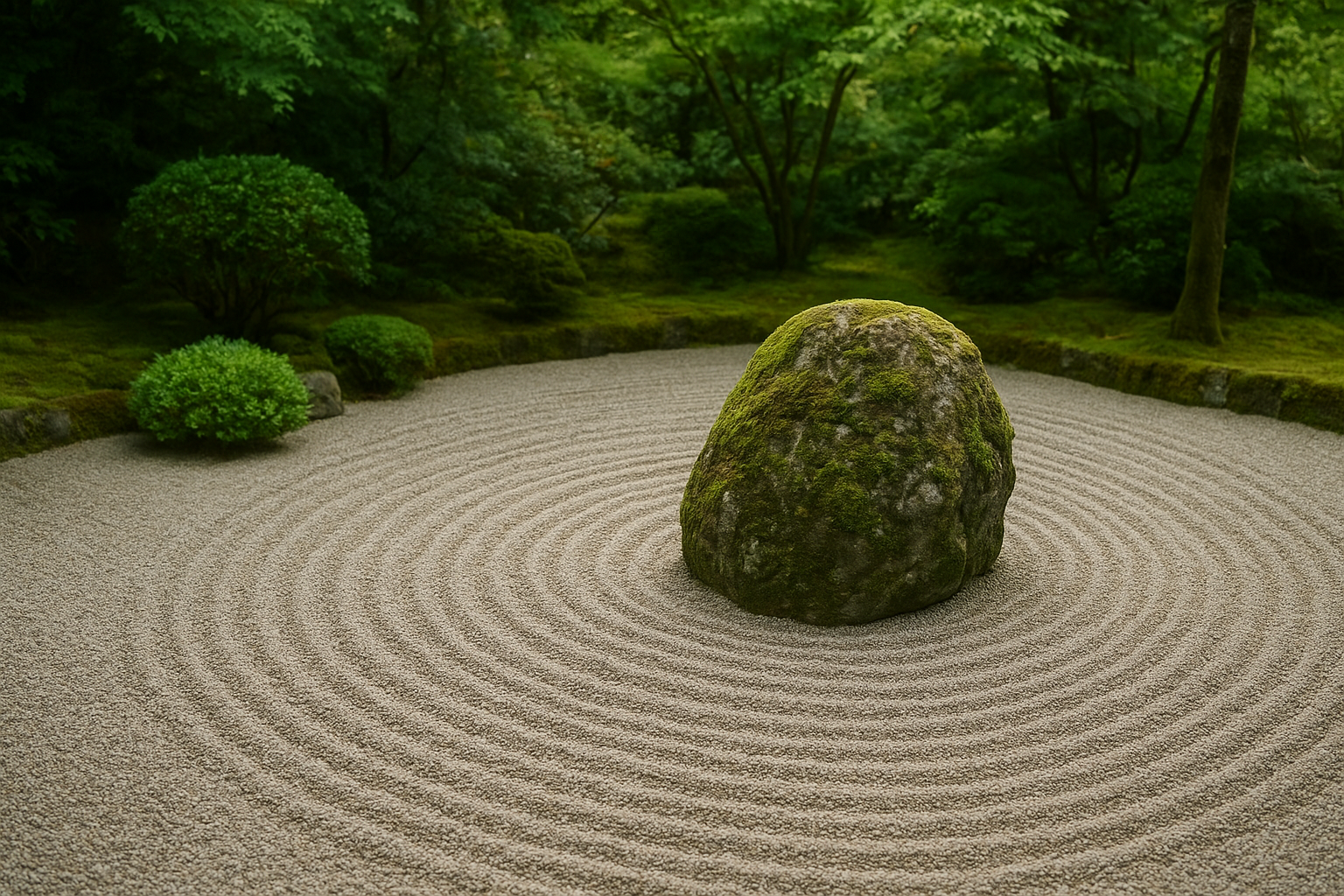
The garden doesn't explain itself. It asks you to sit with it until it becomes clear.
What this means in practical design terms is that Zen-influenced spaces prioritize clarity over abundance. A single well-placed stone says more than five competing focal points. Applying japanese garden design principles in a Zen context means actively removing elements that serve no compositional purpose, even if they're attractive on their own.
Wabi-Sabi: finding beauty in imperfection
Wabi-Sabi is harder to translate but easier to recognize. Wabi refers to simplicity and the beauty found in humble, imperfect things. Sabi refers to the beauty that emerges through age, wear, and the passage of time. Together, they describe an aesthetic that values a moss-covered stone over a polished one, and a weathered timber gate over a freshly painted surface.
In a garden context, Wabi-Sabi means choosing materials that age gracefully, planting groundcovers that fill gaps organically, and resisting the urge to keep everything looking pristine. A garden that shows its age honestly carries more character than one maintained to look perpetually new. In Malaysia's humid climate, moss appears naturally on stone surfaces and timber weathers quickly, which means Wabi-Sabi is, in many ways, the easiest philosophy to express here without forcing it.
Key elements of an authentic Japanese garden
Understanding the philosophy is one thing. Translating it into a physical space requires knowing which specific materials and features carry the most weight in japanese garden design principles, and how each one functions both practically and symbolically. These aren't decorative accessories chosen for visual appeal alone. Every element has a defined role in the composition, and learning that role helps you use it correctly rather than just recognizably.
Stone
Stone is the structural backbone of any authentic Japanese garden. Rocks represent permanence, mountains, and the enduring forces of nature, which is why they're placed first before any other element is introduced. The Japanese practice of ishigumi, or stone setting, treats each rock as an individual with a front, back, and dominant axis. You position stones to face a viewpoint, not scatter them arbitrarily across the ground.
The most important stone in a composition is usually the one you place last, because it resolves the tension created by everything else.
Groups of three stones at varying heights are the most common arrangement, reflecting the asymmetrical balance principle of fukinsei. Avoid round, uniform stones. Irregular forms with distinct character create far more visual interest and feel genuinely embedded in the landscape rather than placed on top of it.
Water and gravel
Water appears in Japanese gardens as ponds, streams, or symbolic representations in dry gravel. Still water reflects light and sky, creating a sense of depth that extends the garden visually beyond its physical boundaries. Moving water introduces sound, which masks urban noise and reinforces the feeling of a separate, contained world.
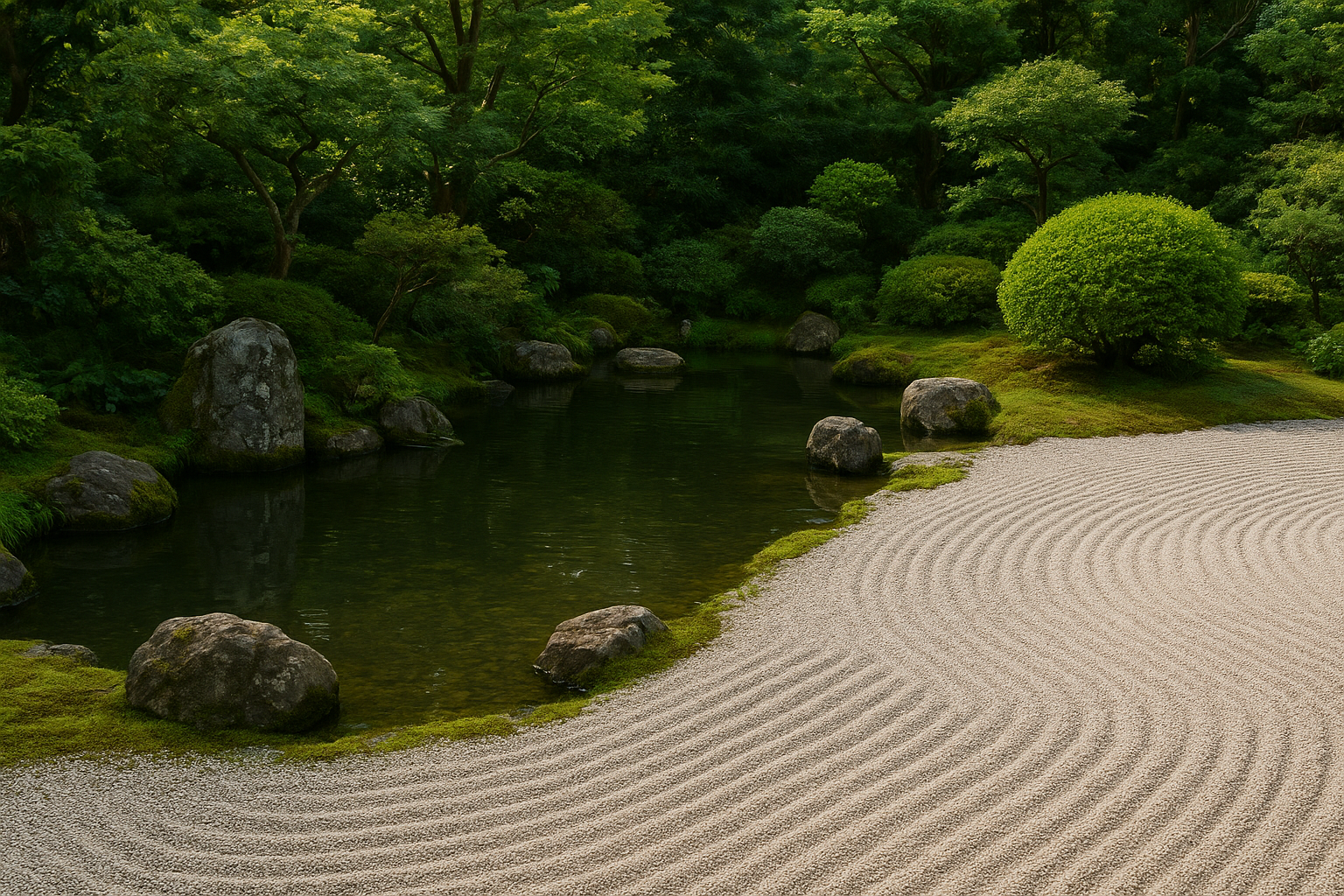
Where actual water isn't practical, raked gravel or sand performs the same compositional role. Raked patterns suggest flow and movement without requiring plumbing or ongoing maintenance, making this approach especially useful for compact courtyard spaces.
Plants
Japanese gardens use a restrained plant palette chosen for texture, form, and seasonal change rather than continuous color. Moss, bamboo, pine, and ornamental grasses are common because they contribute structure without demanding constant attention. In Malaysia, tropical alternatives like ferns, Zoysia grass, and clumping bamboo fill the same roles effectively, giving you access to the same layered, textured aesthetic within a climate that supports year-round growth.
How to design a Japanese-inspired garden in Malaysia
Malaysia's tropical climate creates conditions that support authentic Japanese-inspired design more readily than most people realize. The heat, humidity, and year-round rainfall that make maintenance challenging in some garden styles actually accelerate the processes that japanese garden design principles depend on: moss establishing quickly, stone weathering naturally, and bamboo filling in fast. The starting point isn't finding the right plants. It's working out the underlying structure first.
Start with the bones, not the plants
Before you select a single plant, map out the fixed elements: where the stones go, where the path runs, and where the empty ground stays empty. These structural decisions determine whether your garden feels considered or cluttered. Placing three stones of varying height and mass gives you a focal point that anchors everything else around it.
Planting decisions become far easier once the stone and ground plane are settled, because you're filling in a framework rather than building from scratch.
Resist the urge to fill every gap immediately. Negative space does real compositional work, and leaving ground bare or covered with gravel is a deliberate choice, not a placeholder.
Choose materials that age in the tropics
Locally sourced stone weathers well in Malaysia's humidity and develops the surface texture that Wabi-Sabi values over time. Granite and laterite both take on character quickly. Timber elements like posts, stepping stones, and low borders work best when you choose species with natural oils that resist moisture without requiring constant resealing.
Concrete and ceramic tiles age poorly in the tropics and tend to look worn rather than weathered, which misses the distinction Wabi-Sabi draws between dignified age and simple deterioration. Choose materials that improve with time rather than just survive it.
Keep the plant palette tight
Malaysian gardens often include too many competing species, which produces visual noise rather than calm. Select three to five plants that vary in texture and height, then repeat them throughout the space to create rhythm. Ferns, clumping bamboo, and low-growing Zoysia grass cover most of what you need structurally. Restraint in the plant palette is one of the fastest ways to push any garden toward the focused, deliberate quality that defines this design tradition.
Common mistakes that make gardens look cliché
Even when you understand japanese garden design principles at a conceptual level, execution is where most projects go wrong. The mistakes aren't usually dramatic. They tend to be small decisions that accumulate into a garden that reads as a themed recreation rather than a considered space. Knowing what to avoid is just as useful as knowing what to include.
Treating it as a prop collection
The most common mistake is buying recognizable Japanese garden objects without thinking about how they relate to each other or to the rest of the space. Stone lanterns, bamboo fences, and Buddha statues placed without compositional logic produce a garden that looks like a shopping cart rather than a design. Each object becomes a prop, and the overall effect is theatrical rather than calm.
One well-placed stone lantern positioned to light a path at night carries more weight than five lanterns scattered across a garden for decoration.
Remove anything that doesn't serve a specific function in the composition: directing movement, defining a boundary, or anchoring a focal point. If you can't explain why an object sits where it does, it probably shouldn't be there.
Filling every space out of habit
Negative space makes Japanese gardens work, and most people are uncomfortable leaving it intact. The instinct to plant groundcover in every gap, place stepping stones across every bare patch, and fill corners with ornamental grasses is understandable, but it works directly against the principles of ma and Zen restraint. Empty ground, bare gravel, and open water surfaces all do active compositional work by giving your eye somewhere to rest.
Mixing materials without considering age
Using a combination of concrete pavers, treated timber, and polished granite in the same space creates a jarring surface palette, because each material ages at a different rate and in a different direction. Polished surfaces look worse over time in tropical humidity, while rough-cut stone and naturally oiled timber improve. Stick to two or three materials that share a similar aging quality, and your garden will look more coherent in five years than it does on the day it's completed.
Final thoughts
Japanese garden design principles give you something most garden styles can't: a complete framework for making decisions, from the largest stone placement down to the choice of ground cover. Every principle covered in this article, from fukinsei and shizen to Wabi-Sabi and Zen restraint, points toward the same outcome: a space that feels intentional, calm, and genuinely connected to the natural world around it.
Applying these ideas in Malaysia is entirely achievable. Your tropical climate accelerates the natural aging, moss growth, and material weathering that these principles actually depend on, which means you're starting with real advantages. The key is getting the structure right before you think about plants or features, and avoiding the temptation to fill every gap or add recognizable objects without purpose.
If you want to bring a water feature into your design, explore what a Zen Bio Koi Pond can do for your outdoor space.


