

Every garden starts below the surface. Before a single plant goes into the ground, the soil determines what thrives, what struggles, and what fails entirely. So what is soil science, and why should anyone designing or building a garden care about it? At its core, it's the study of soil as a natural resource, its formation, classification, physical and chemical properties, and biological activity. For homeowners and property developers in Malaysia, understanding even the basics can mean the difference between a lush, lasting garden and one that deteriorates within a few seasons.
At Konzept Garden, we've seen firsthand how soil conditions shape every design decision we make, from plant selection and drainage planning to long-term maintenance requirements. Our botanist consultations and landscape designs are grounded (literally) in understanding what's happening beneath the topsoil. It's not something we treat as an afterthought; soil assessment is built into our process from the very first site visit.
This article breaks down the branches of soil science, the key components that make up soil, and the practical reasons it all matters, whether you're planning a residential garden, a commercial landscape, or simply trying to keep your plants alive. You don't need a degree in earth sciences to benefit from this knowledge. You just need a clear starting point, and that's exactly what we'll provide here.
Soil science explained, scope, and key terms
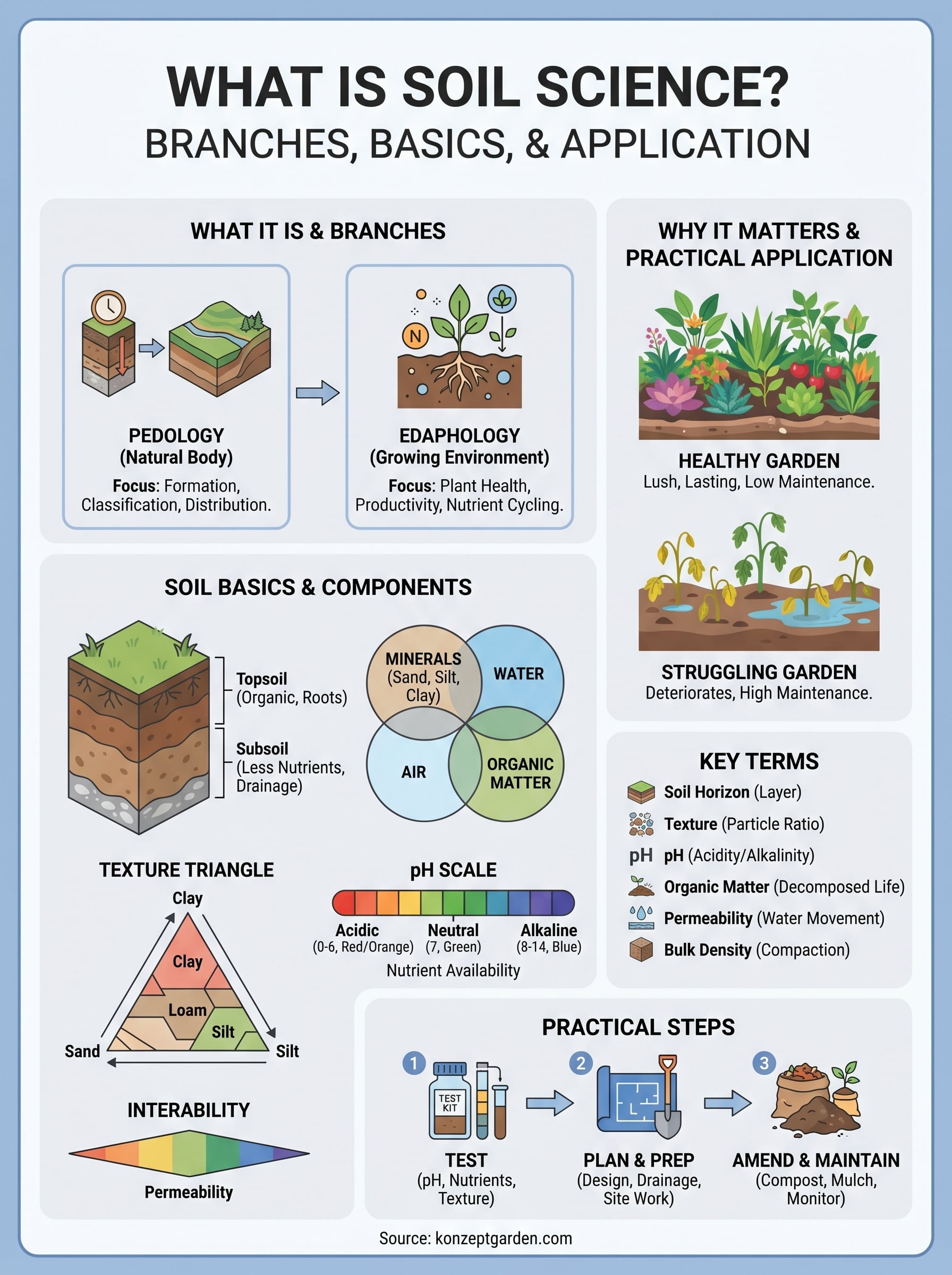
When you ask what is soil science, the simplest answer is this: it's the scientific study of soil as a natural resource on the surface of the Earth. That covers everything from how soil forms over thousands of years to how it functions today in supporting plant life, filtering water, and cycling nutrients. Soil scientists examine the physical structure, chemical composition, biological activity, and geographic distribution of soils, making it one of the most multidisciplinary fields in earth science. For anyone working with land, whether at a large agricultural scale or a single residential garden, the principles are equally relevant.
What soil science actually covers
Soil science isn't a narrow field. It pulls from geology, chemistry, biology, and environmental science to give you a complete picture of what's happening underground. In practical terms, it helps you understand why one patch of land grows lush vegetation while another, just meters away, produces stunted plants with yellowing leaves. The scope extends far beyond farms and research labs. It applies directly to residential and commercial garden design, construction site planning, and environmental remediation.
The health of any outdoor space, whether a backyard garden or a commercial landscape, ultimately depends on what's happening in the first 30 to 60 centimeters of soil beneath your feet.
Malaysian soils in particular present a distinct set of challenges and characteristics. The country's tropical climate, high rainfall, and naturally acidic soils mean that understanding soil science is especially relevant here. Laterite soils and peat soils, both common across Malaysia, behave very differently from the loamy soils typically used as default examples in general textbooks. Recognizing these regional differences early saves you from making costly planting and design mistakes later.
Key terms you need to know
Before you can make sense of soil science literature or conversations with landscape professionals, a few core terms will come up consistently. Understanding this vocabulary lets you work more productively with landscape designers, botanists, and garden contractors rather than relying entirely on their interpretation.
| Term | What it means |
|---|---|
| Soil horizon | A distinct layer within a soil profile, each with different composition and properties |
| Texture | The proportion of sand, silt, and clay particles in a soil sample |
| pH | A measure of soil acidity or alkalinity, which directly controls nutrient availability |
| Organic matter | Decomposed plant and animal material that improves soil structure and fertility |
| Permeability | How quickly water moves through a soil, directly affecting drainage and root health |
| Bulk density | The mass of soil per unit volume, used as an indicator of compaction |
Each of these terms connects directly to decisions you make in a garden or landscape project. A soil with poor permeability, for example, needs a specific drainage strategy before any planting takes place. High bulk density tells you the soil is compacted, which restricts root growth and typically requires physical amendment or aeration before the site is ready for planting. Getting familiar with these basics means you can ask better questions and evaluate the advice you receive with more confidence.
Soil basics every beginner should know
Before diving into what is soil science as a formal discipline, it helps to understand the foundational building blocks that every soil scientist works with. Soil isn't just dirt. It's a living system made up of mineral particles, water, air, and organic matter, and the balance between these components determines how well your plants grow. Getting a basic grasp of these elements sets you up to make smarter decisions, whether you're planning a new garden bed or troubleshooting why your plants are struggling.
The layers that make up a soil profile
Soil forms in distinct horizontal layers called horizons, and each layer plays a different role in supporting plant life. The topsoil layer holds the most organic matter and biological activity, and it's where roots feed and most of your planting work takes place. Below that sits the subsoil layer, which contains fewer nutrients but still influences drainage and root depth. In Malaysia, the transition to nutrient-poor, reddish laterite subsoil can be abrupt, and that directly affects how deeply your plants can establish roots.
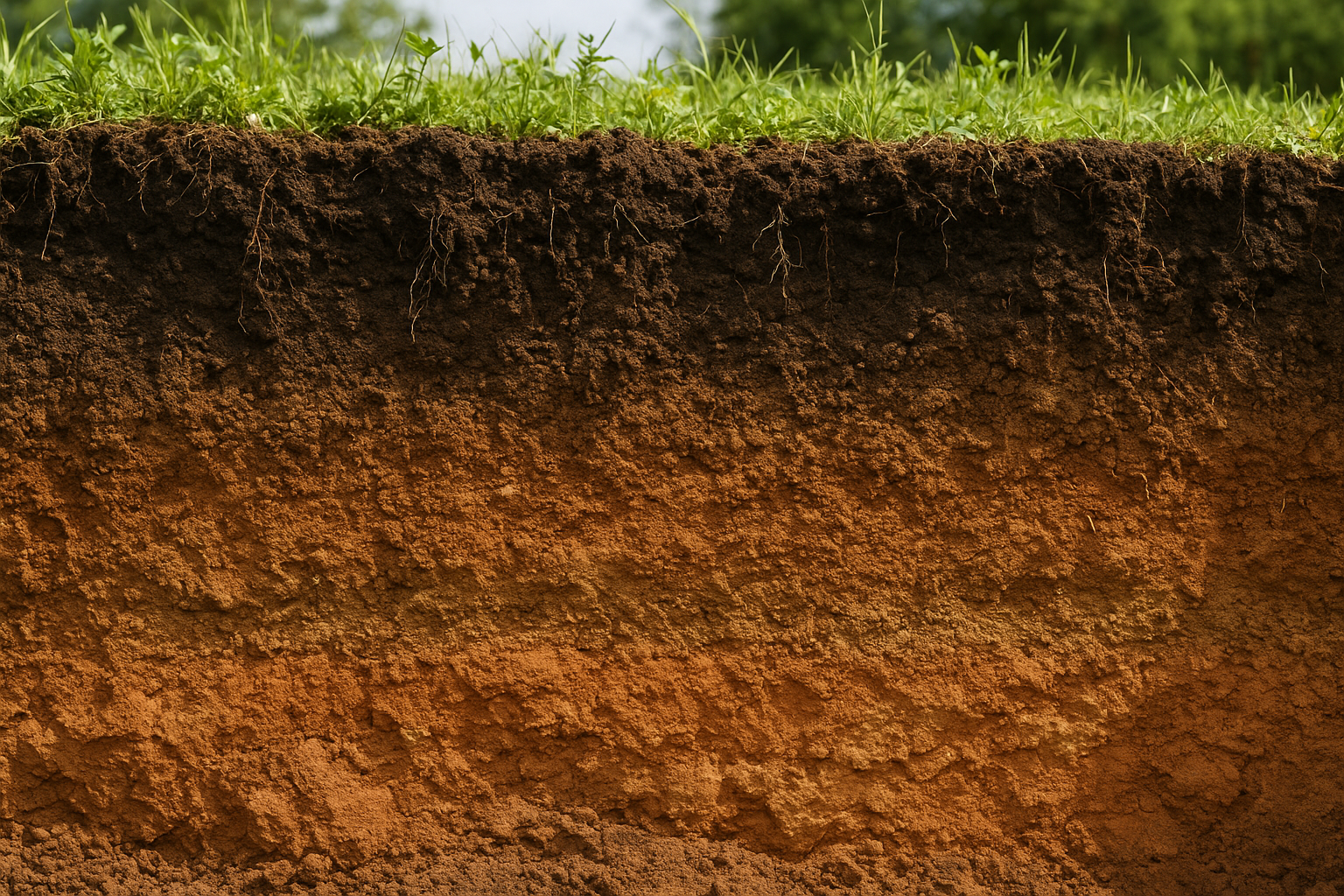
Understanding your soil profile before any planting begins can save you from years of unexplained plant failure.
The depth of usable topsoil on a site matters more than most people realize. On new construction sites in particular, topsoil is often scraped away or buried during building work, leaving you working with compacted subsoil that performs poorly without significant amendment and preparation.
Texture, pH, and organic matter
Soil texture refers to the ratio of sand, silt, and clay in a given sample, and it shapes nearly everything else about how your soil behaves. Sandy soils drain fast but struggle to hold nutrients. Clay soils retain water and nutrients well but can become waterlogged and compacted. Most productive garden soils sit in the loam range, balancing drainage and nutrient retention. Measuring your soil's pH tells you whether nutrients are actually available to your plants, regardless of how much fertilizer you apply.
Organic matter ties everything together. It improves aeration in clay soils, boosts water retention in sandy soils, and feeds the microbial communities that convert nutrients into forms your plants can absorb.
The main branches of soil science
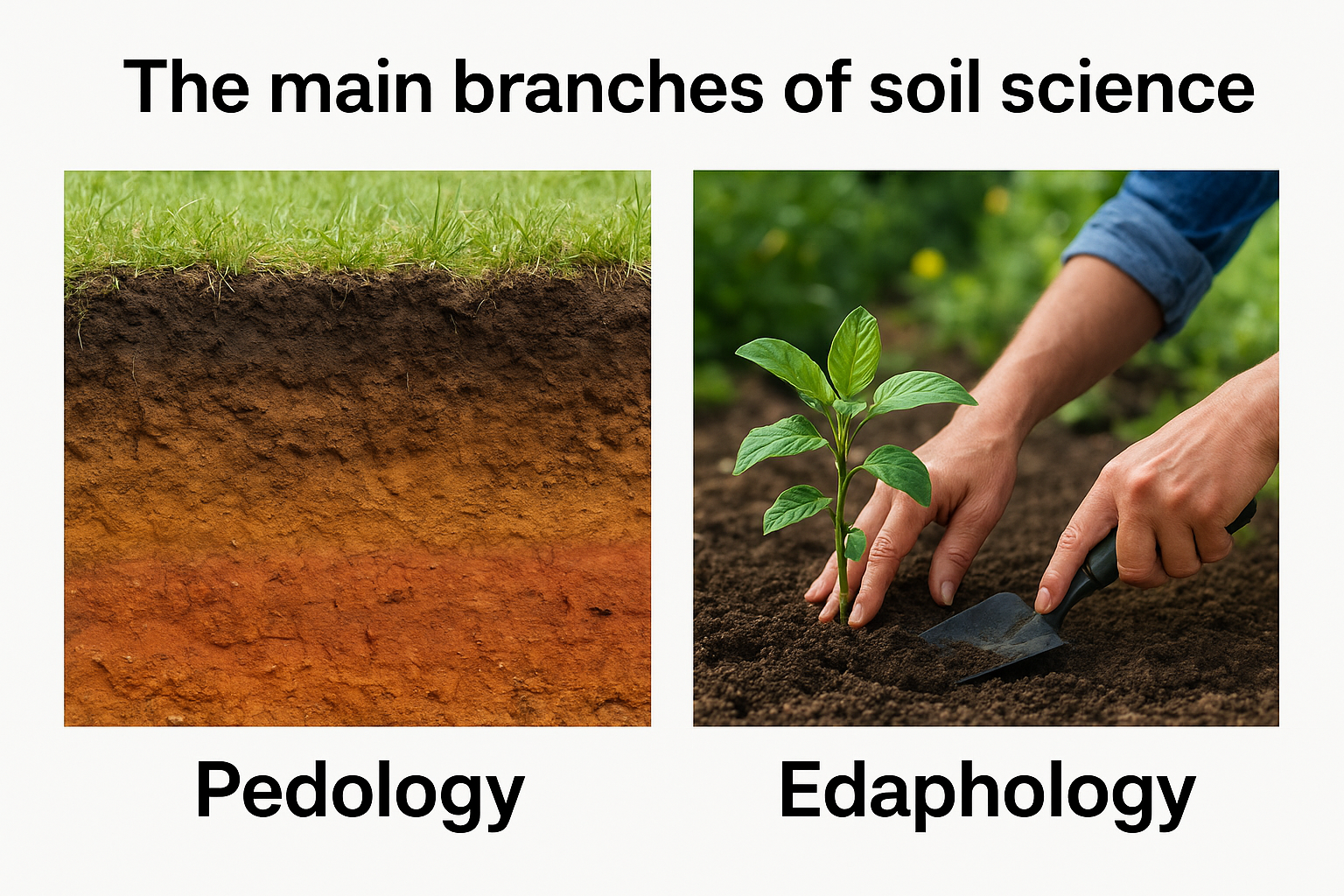
When you look at what is soil science as a whole, you quickly realize it isn't a single unified subject. It breaks into specialized branches, each focusing on a different aspect of how soil forms, functions, and interacts with living systems. Knowing which branch addresses your specific situation helps you find the right expertise and ask the right questions when working with landscape professionals on any garden or land project.
Pedology: how soil forms and classifies
Pedology is the branch concerned with soil as a natural body, studying how it forms over time, how it's classified, and how it's distributed across landscapes. Pedologists look at soil profiles, the distinct layers from topsoil down to the parent rock, to understand how climate, vegetation, topography, and time have shaped a given soil type. For anyone working in Malaysia, pedology explains why laterite soils dominate the highland zones and why peat soils appear across former swamp areas in lowland regions. That geographic context directly informs land preparation and long-term planting strategies.
Understanding pedology at even a basic level helps you anticipate what your soil is doing before you spend money on amendments that may not address the root cause.
Edaphology: soil as a medium for plant growth
Edaphology shifts the focus from soil as a geological feature to soil as a growing environment. This branch examines how soil properties, including texture, pH, nutrient levels, and microbial activity, affect plant health and productivity. It's the branch most directly relevant to garden design and landscape work. When a botanist recommends a specific soil amendment before planting or identifies nutrient deficiencies through a soil test, they're applying edaphological principles.
This branch also connects to land management decisions at a broader scale. Edaphology informs choices around irrigation depth, fertilizer scheduling, and crop rotation in agricultural settings. In a residential or commercial garden context, it guides decisions about which plants suit your existing soil and what it will take to modify conditions for species that wouldn't otherwise thrive in your specific location.
Why soil science matters for people and land
Understanding what is soil science goes beyond academic interest. Soil is the foundation for food production, water filtration, carbon storage, and biodiversity. When soil quality degrades, the consequences ripple outward, affecting crop yields, flooding risk, and long-term land value. For homeowners and property developers in Malaysia, where rapid urban development regularly disturbs and depletes native soil, this matters more than most people initially assume.
Soil's role in food security and ecosystems
Healthy soil feeds the world. Roughly 95% of the food humans consume depends on soil in some form, whether directly through crops or indirectly through animal feed. Beyond food, soil filters groundwater, regulates carbon cycles, and supports millions of species of bacteria, fungi, and invertebrates that keep ecosystems functioning. When a soil degrades through erosion, chemical contamination, or compaction, it rarely recovers quickly on its own. Restoration takes deliberate effort, targeted amendments, and time measured in years rather than weeks.
Losing a centimeter of topsoil can take hundreds of years to rebuild naturally, which is why protecting what you already have is always the smarter approach.
In Malaysia's context, deforestation and development pressure regularly strip topsoil from sites before landscaping begins. The result is degraded land that requires significant soil science knowledge to rehabilitate into something productive and stable.
What it means for your garden and property
For your own outdoor space, soil quality directly determines how much maintenance you'll need and how long your plants will stay healthy. Poor soil leads to chronic problems: waterlogging during heavy rains, nutrient deficiencies that no amount of fertilizer can fix long-term, and root systems that never establish properly. Understanding your soil gives you a more accurate picture of what your land can realistically support.
Addressing soil conditions before planting, rather than after problems appear, saves you money and frustration. It also shapes every decision your landscape designer makes, from plant selection to drainage design to the type and depth of soil amendments recommended during site preparation.
How soil science gets used in real life
Understanding what is soil science in theory is useful, but seeing it applied in practical settings is what makes the knowledge stick. Soil science shows up in far more everyday contexts than most people expect, from the way a landscape designer prepares a site before planting to the way an engineer evaluates ground stability before construction begins. Recognizing where it applies helps you make more informed decisions about your own outdoor space and communicate more clearly with the professionals you hire.
Garden design and site preparation
Every professional landscape design project starts with some form of soil assessment, even if it isn't always labeled as such. Before plant selection begins, understanding the site's texture, drainage behavior, and pH tells the designer what will actually grow without constant intervention. In Malaysia's climate, where soils tend to be acidic and high in clay content, preparation steps like pH adjustment and drainage layer installation are often non-negotiable rather than optional upgrades.
Skipping soil assessment at the start of a garden project is the single most common reason plants fail within the first two years after installation.
Proper site preparation based on soil data also prevents expensive rework. If you discover that your soil has poor permeability after you've already planted, fixing it means excavating beds and starting over, which costs significantly more than addressing the issue before a single plant goes in.
Soil testing and amendment planning
Soil testing is the most direct way to apply soil science to your specific plot of land. A basic test gives you pH levels, nutrient concentrations, and organic matter content, which directly inform what amendments your soil needs before planting. Lime raises pH in acidic soils. Compost improves structure in compacted or sandy conditions. Targeted amendments based on test results outperform generic fertilizer applications every time because they address what your soil actually lacks rather than what a label assumes it needs.
Amendment planning also works in stages. You address structural issues first, then nutrient deficiencies, and then ongoing maintenance through mulching and organic matter additions over time.
Next steps for healthier soil
Now that you understand what is soil science and how it applies to real garden projects, the logical next step is to act on that knowledge. Start with a basic soil test from a local agricultural lab or garden center. That single step gives you a clearer picture of your soil's pH, nutrient levels, and organic matter content than any visual inspection can. From there, prioritize structural fixes before adding any fertilizers or plants, because amendments work best when the soil's physical foundation is already sound.
Building healthier soil is a process, not a one-time task. Regular additions of compost, thoughtful plant selection, and consistent mulching gradually improve both structure and biological activity over time. If you're planning a larger garden or landscape project in Malaysia, working with professionals who apply soil science principles from day one saves you from costly corrections later. Talk to our landscape team to get started with a site assessment built around your soil's actual conditions.