

Malaysia receives an average of 2,500mm of rainfall annually, that's a massive amount of free water literally falling on your property. Yet most of it runs straight into drains. If you've been researching rainwater harvesting system cost Malaysia, you're already thinking smarter than most homeowners and developers about how to put that rainfall to work.
A basic residential setup can start from RM1,500 and climb past RM10,000 depending on tank capacity, filtration level, and how deeply you integrate the system into your property. For commercial or industrial projects, the numbers shift further. The real question isn't just what you'll spend upfront, it's how quickly that investment pays for itself through lower water bills and reduced dependency on municipal supply.
At Konzept Garden, we design outdoor spaces that work with Malaysia's climate, not against it. Rainwater harvesting fits directly into the sustainable landscape solutions we build for residential and commercial clients. In this guide, we break down actual equipment costs, installation price ranges, and the long-term payback math so you can decide whether a rainwater system makes financial sense for your property.
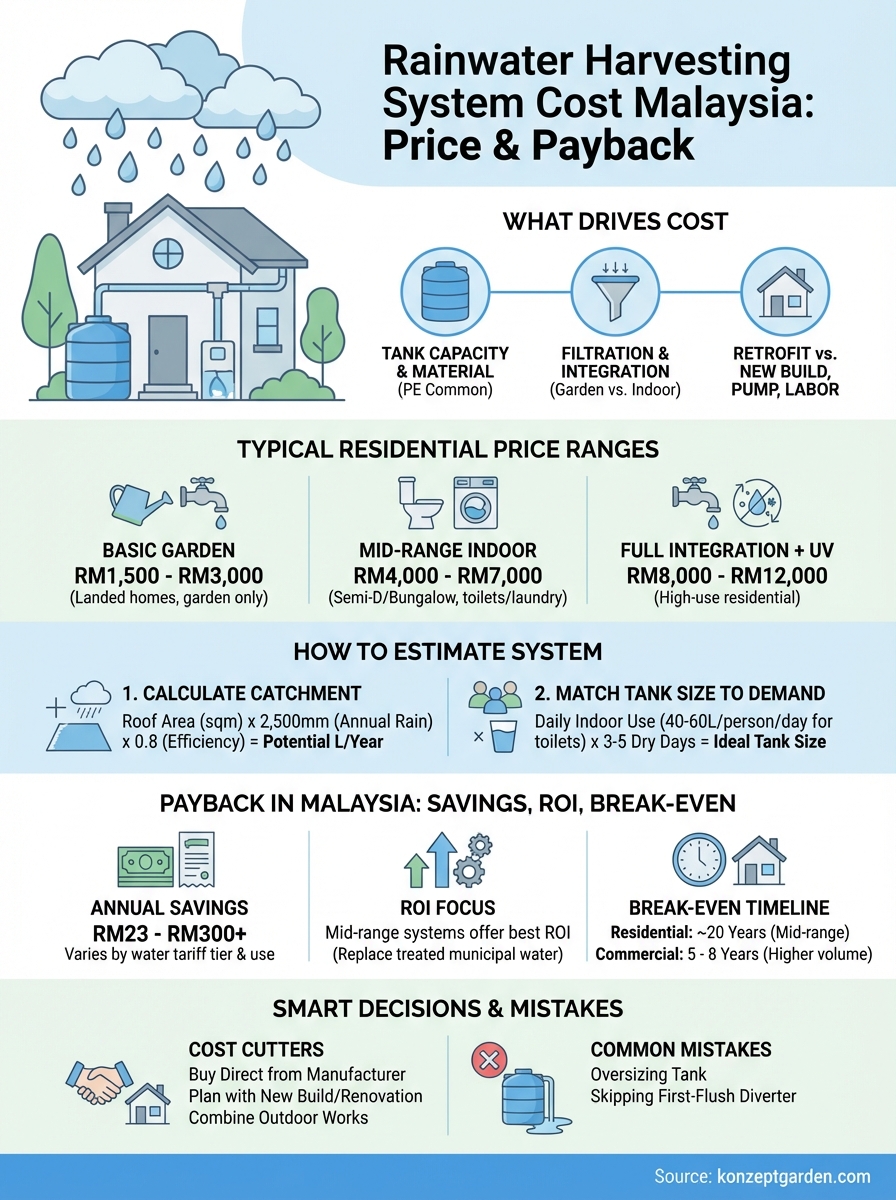
What drives rainwater harvesting costs in Malaysia
When you research rainwater harvesting system cost Malaysia, you quickly discover that the final price depends on a combination of hardware choices, site conditions, and how complex your intended use is. A simple garden irrigation tank works at a very different price point than a fully filtered system supplying toilets, laundry, and tap water inside a home or commercial building.
Tank capacity and material type
The storage tank is usually the biggest cost item in any system. In Malaysia, polyethylene (PE) tanks are the most common choice because they resist UV degradation and humidity well. A 500-liter PE tank costs between RM300 and RM600, while a 5,000-liter tank can push past RM2,500 before you factor in delivery and installation.
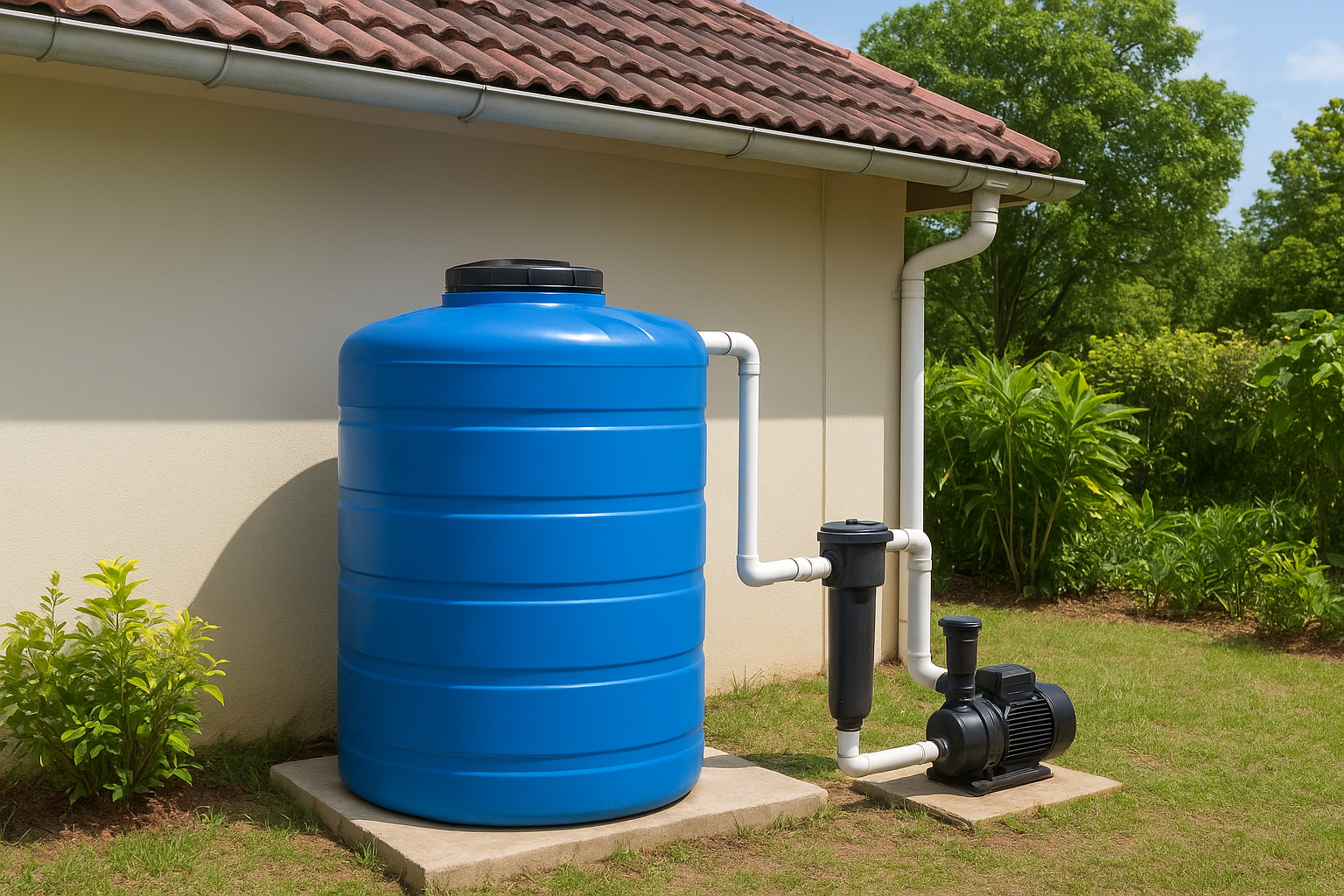
The larger the tank capacity, the better your system handles Malaysia's dry spells between rain events, which directly affects long-term savings.
Your catchment area (usually your roof) also influences tank sizing. A rough rule is that a 100sqm roof in Malaysia can collect roughly 200,000 liters per year, so matching tank size to actual demand prevents overspending on storage you won't use.
Filtration level and system integration
How you plan to use the harvested water shapes filtration costs more than anything else. Basic garden irrigation needs only a simple mesh filter and a pump, keeping costs minimal. Supplying indoor uses like toilet flushing or laundry requires sediment filters, UV treatment, and a pressurized distribution line, adding RM2,000 to RM5,000 to your budget.
Other factors that shift your final number include:
- Retrofitting vs. new build: Existing properties cost more to modify than new constructions
- Pump type: Submersible pumps run RM500 to RM1,500 depending on flow rate
- Labor rates: Costs vary noticeably between Klang Valley and other states
Typical price ranges by system size
Understanding rainwater harvesting system cost Malaysia starts with matching the right system tier to your actual property size and water needs. Costs scale significantly depending on whether you're installing a basic garden setup or a fully integrated supply system for a large building.
Residential systems
For most homes, the budget falls into three clear tiers based on how extensively you plan to use harvested water:
| System Type | Typical Cost Range | Best For |
|---|---|---|
| Basic garden irrigation | RM1,500 - RM3,000 | Landed homes with garden use only |
| Mid-range with indoor toilet/laundry supply | RM4,000 - RM7,000 | Semi-detached and bungalow properties |
| Full integration with UV filtration | RM8,000 - RM12,000 | High-use residential properties |
Spending more on a mid-range or full system usually delivers a faster payback because you're replacing treated municipal water, which costs more per liter than irrigation water.
Commercial and industrial systems
Commercial properties like offices, hotels, and factories operate at a different scale entirely. A basic commercial setup with a 20,000-liter tank and pump system typically starts at RM15,000, with large industrial configurations reaching RM80,000 or more depending on storage capacity and treatment requirements.
How to estimate your system cost and tank size
Before you request quotes or purchase any equipment, a basic calculation saves you from overspending on oversized tanks or underspending on a system that runs dry. Two numbers anchor your estimate: how much water your roof collects, and how much water your household or building actually consumes.
Calculate your roof catchment first
Start with your roof area in square meters multiplied by Malaysia's average annual rainfall of 2,500mm, then apply a collection efficiency factor of roughly 0.8 to account for losses from evaporation and spillage. A 150sqm roof yields approximately 300,000 liters per year, or about 820 liters per day on average.
This daily average gives you a realistic ceiling on how much harvested water your system can actually supply.
Match tank size to daily demand
Once you know your collection potential, compare it against your intended daily use. Toilet flushing in a typical Malaysian home uses 40 to 60 liters per person per day. Size your tank to cover three to five dry days of that demand, which prevents your system from running empty between rain events. For a family of four using harvested water for toilets only, a 1,000 to 1,500-liter tank is usually sufficient, keeping your rainwater harvesting system cost Malaysia firmly within the mid-range residential tier.
Payback in Malaysia: savings, ROI, and break-even
The payback math for rainwater harvesting in Malaysia is straightforward once you know your baseline. Syabas and Air Selangor charge residential customers at tiered rates, with the first 35,000 liters per month at roughly RM0.57 per cubic meter. Every liter of harvested water you use instead cuts directly into that bill.
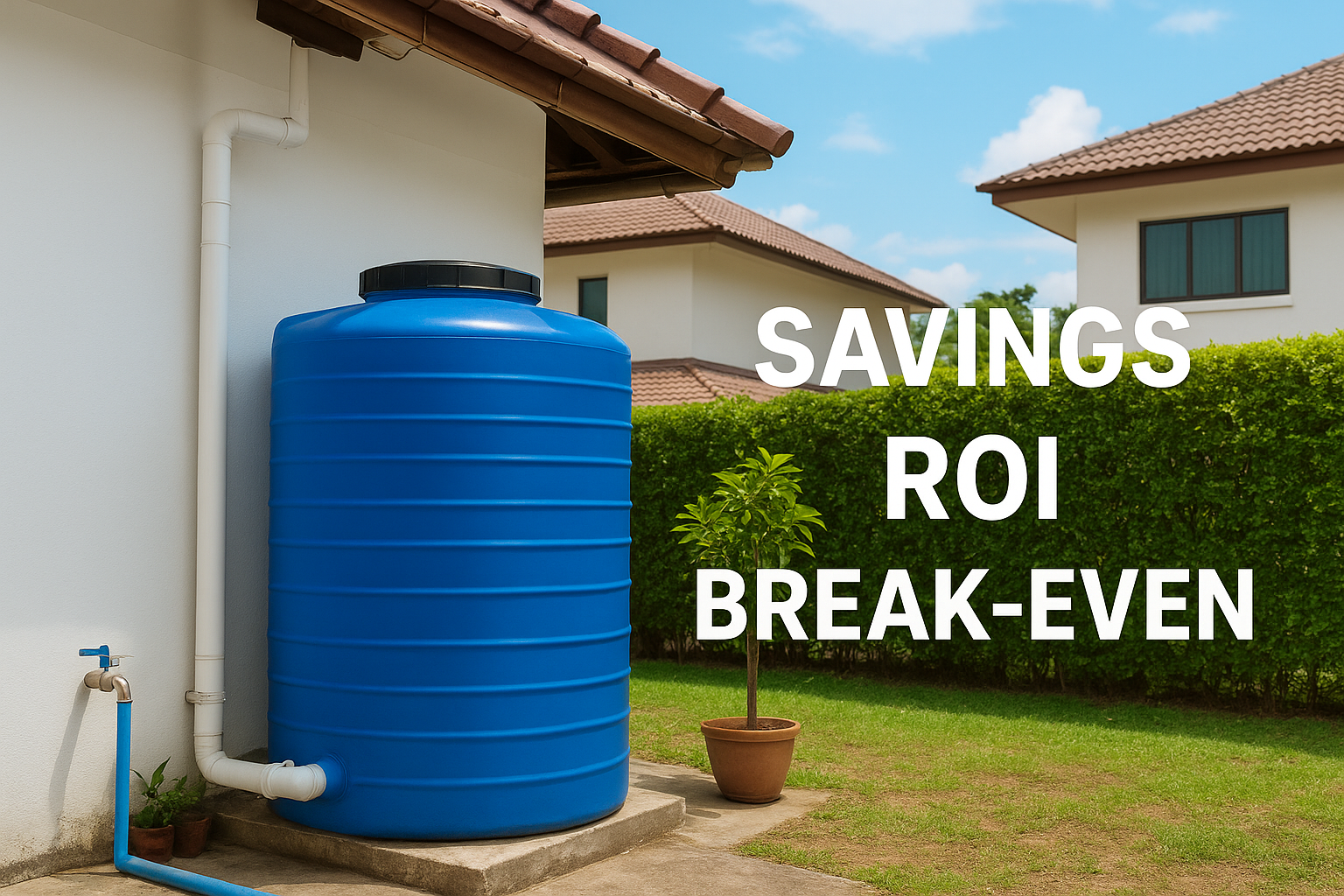
Calculating your annual savings
A family of four flushing toilets with harvested water saves roughly 40,000 to 60,000 liters per year. At current Selangor tariff rates, that translates to approximately RM23 to RM34 annually at the base tier, but households consuming above 35,000 liters monthly pay higher rates, pushing your annual savings toward RM150 to RM300 or more.
Mid-range systems that supply both toilets and laundry generate the strongest ROI because they replace the highest-volume indoor water uses.
Break-even timeline
Factoring in the full rainwater harvesting system cost Malaysia, a RM4,000 mid-range system saving RM200 per year breaks even in roughly 20 years for a typical residence.
Commercial properties with higher water consumption see your break-even drop to five to eight years, making the financial case considerably stronger at that scale.
How to cut costs and avoid common mistakes
Reducing your rainwater harvesting system cost Malaysia comes down to making deliberate choices at the planning stage rather than cutting corners on components that directly affect system performance. A few practical decisions at the start save you significantly more than any last-minute budget trimming.
Smart purchasing and installation decisions
Buying your tank directly from a manufacturer or wholesale supplier rather than through a contractor markup can cut your storage cost by 15 to 25 percent. You should also plan your installation during a new build or major renovation, since retrofitting an existing property adds labor hours and often requires additional pipework that drives up your final bill.
Combining your rainwater system with other outdoor work, like landscaping or drainage upgrades, lets you share mobilization costs across multiple contractors.
Mistakes that inflate your budget
Oversizing your tank is one of the most common errors. Homeowners often buy the largest tank available without checking whether their roof catchment area can actually fill it within a reasonable cycle. You end up paying for storage capacity that sits empty. Equally, skipping a basic first-flush diverter to save RM200 to RM400 upfront leads to sediment buildup that damages pumps and clogs filters, costing more to fix than the diverter itself.
Next steps for your property
The full picture on rainwater harvesting system cost Malaysia shows that the real value depends on how well your system fits your property's actual rainfall catchment, daily demand, and intended use. A mid-range residential system in the RM4,000 to RM7,000 range delivers the best balance of upfront cost and long-term savings for most landed homes in Malaysia, while commercial properties can achieve break-even well within a decade at higher consumption volumes.
Your outdoor space shapes what a harvesting system can realistically achieve. Roof area, drainage layout, and garden footprint all factor into how you size tanks, route pipework, and integrate the system without disrupting your existing landscape. Getting those details right from the start prevents the costly rework that most homeowners encounter after a rushed installation. If you want to plan a sustainable outdoor space that puts Malaysia's rainfall to work, talk to our landscape design team and get a quote tailored to your property.


