


You fill the reservoir, walk away, and somehow your plants stay perfectly hydrated for days. But how do self watering planters work exactly? The answer lies in a simple yet effective principle called capillary action, the same force that helps trees pull water from their roots to their highest branches.
Self-watering planters use sub-irrigation to deliver moisture directly to your plant's root zone, eliminating guesswork and reducing the risk of both overwatering and underwatering. At Konzept Garden, we've seen firsthand how these systems transform plant care for busy homeowners and commercial spaces alike, it's why we developed the Ziant Hydro Planter as part of our garden product range.
This guide breaks down the mechanics behind self-watering technology, explains why capillary action matters for healthy roots, and shows you how to use these planters correctly to avoid common pitfalls like root rot.
Why self-watering planters matter for plant health
Your plants don't just need water, they need consistent moisture levels at the root zone. Traditional hand-watering creates a cycle of feast and famine where soil swings from bone-dry to waterlogged, and most plants struggle to adapt to these extremes. Self-watering planters eliminate this stress by maintaining steady hydration that matches your plant's actual uptake rate, which means healthier growth and fewer problems overall.
They prevent the stress cycle of drought and flood
When you water from the top, the first inch of soil gets soaked while deeper layers stay dry. Your plant responds by pushing shallow roots toward the surface to catch that moisture before it evaporates. Then the soil dries out completely, your plant wilts, and you overcompensate with too much water that sits in the bottom of the pot. This boom-and-bust pattern weakens your plant's immune system and makes it vulnerable to pests and disease.
Self-watering systems deliver moisture from below, so your plant never experiences the shock of sudden drought or the suffocation of waterlogged soil.
Understanding how do self watering planters work helps you see why this matters. The reservoir maintains a stable moisture gradient that your plant can access on demand, similar to how groundwater works in nature.
Your roots develop stronger and deeper
Plants grown in self-watering planters develop more extensive root systems because moisture is available at lower depths. Instead of clustering near the surface where evaporation happens fastest, roots spread throughout the entire soil volume searching for nutrients. This creates a stronger anchor and gives your plant access to more resources, which translates to bushier foliage, better flowering, and improved resistance to environmental stress. You'll notice the difference especially during hot weather when surface-watered plants wilt while self-watered specimens stay upright and vigorous.
How self-watering planters work step by step
Self-watering planters operate through a deceptively simple setup that mimics natural groundwater systems. The design includes a water reservoir at the bottom, a growing chamber above it, and a wicking mechanism that connects the two. When you understand how do self watering planters work at each stage, you can troubleshoot problems and optimize your plant's growth.
The basic components you'll find in every system
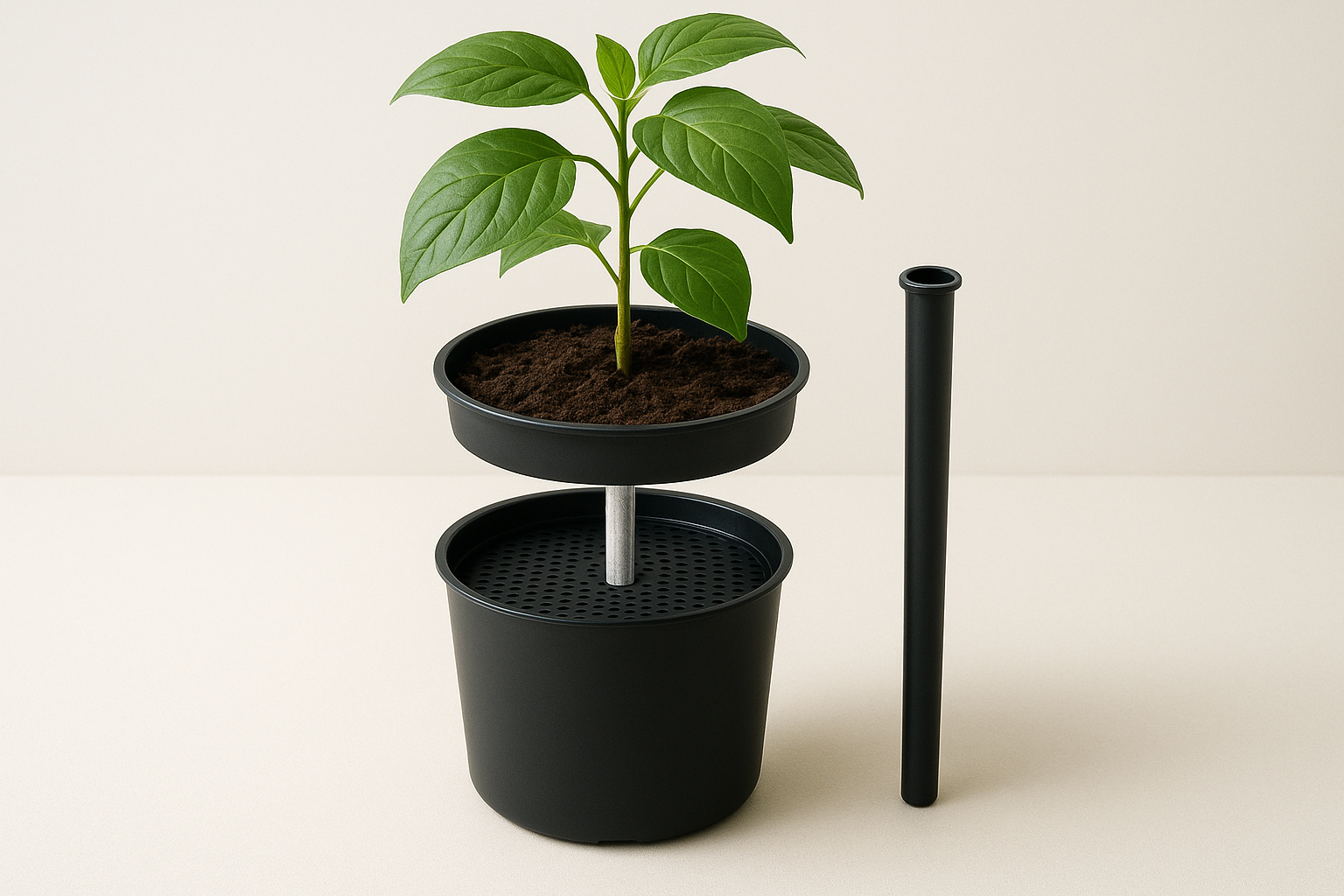
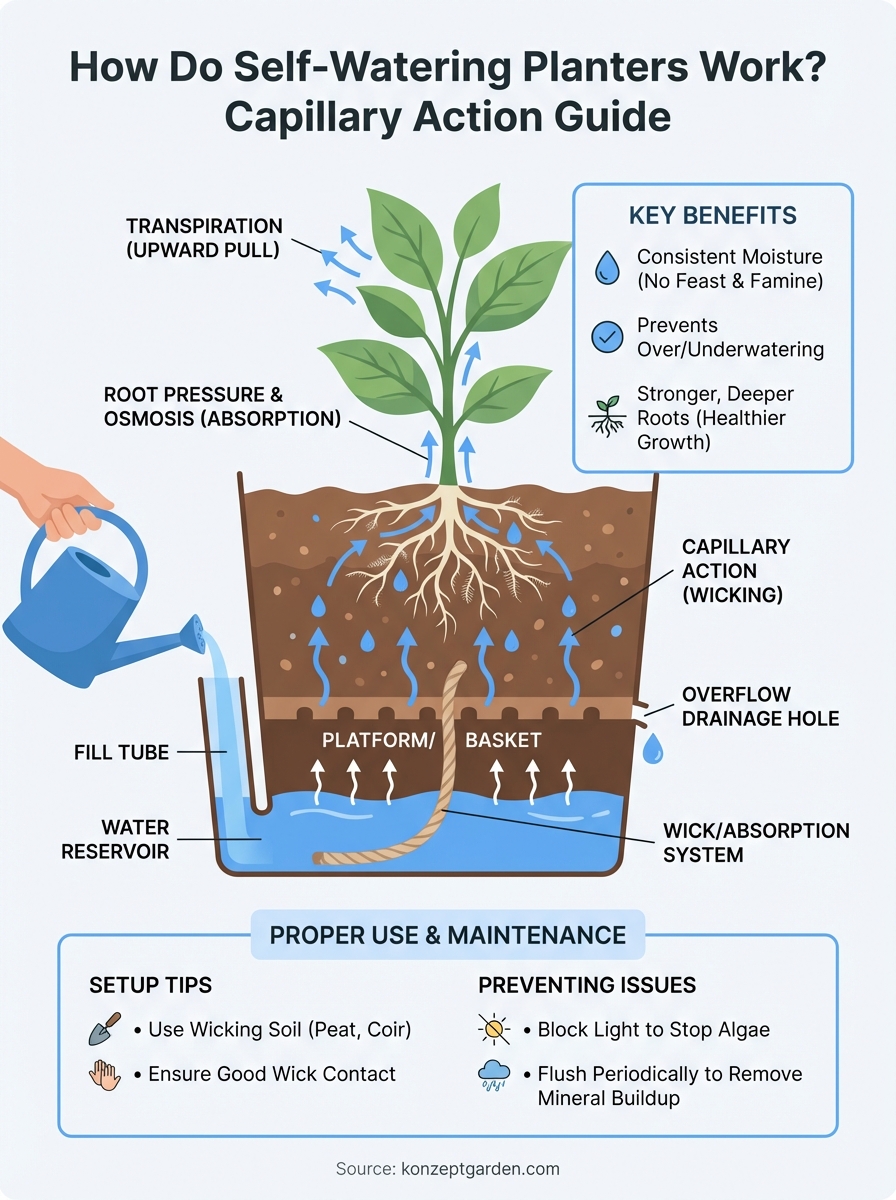
Every self-watering planter contains four essential parts. The bottom reservoir holds water separate from the soil, usually with a fill tube that lets you add water without disturbing your plant. A platform or basket sits above the reservoir to keep your soil elevated and prevent it from getting waterlogged. The wick or absorption system connects the reservoir to the soil through contact points or rope-like materials. Finally, an overflow drainage hole prevents the reservoir from filling beyond capacity during heavy rain or accidental overwatering.
The water cycle from reservoir to roots
Water moves upward through the wick into the soil where capillary forces and root suction pull it toward your plant. The soil acts like a sponge, drawing moisture up through tiny pores between particles. Your plant's roots absorb what they need, and the soil naturally maintains the right moisture level without human intervention.
The beauty of this system is that it's demand-driven: your plant takes water only when it needs it, preventing both drought stress and root rot.
The science behind capillary action and osmosis
Understanding how do self watering planters work requires a look at the physics that make sub-irrigation possible. Two forces drive water upward from the reservoir into your soil: capillary action pulls moisture through narrow spaces between soil particles, while root pressure and transpiration create suction that draws water toward your plant. These processes work together continuously without any pumps or electricity, relying entirely on the natural properties of water molecules and soil structure.
Capillary action moves water against gravity
Water molecules stick to each other through cohesion and cling to soil particles through adhesion. When you pack soil into tiny pores and channels, these attractive forces become stronger than gravity's downward pull. The result is water climbing upward through the growing medium, similar to how a paper towel soaks up a spill. Finer soil particles create smaller pores and stronger capillary action, which is why self-watering planters work best with potting mixes that contain peat, coir, or vermiculite rather than coarse sand or gravel.
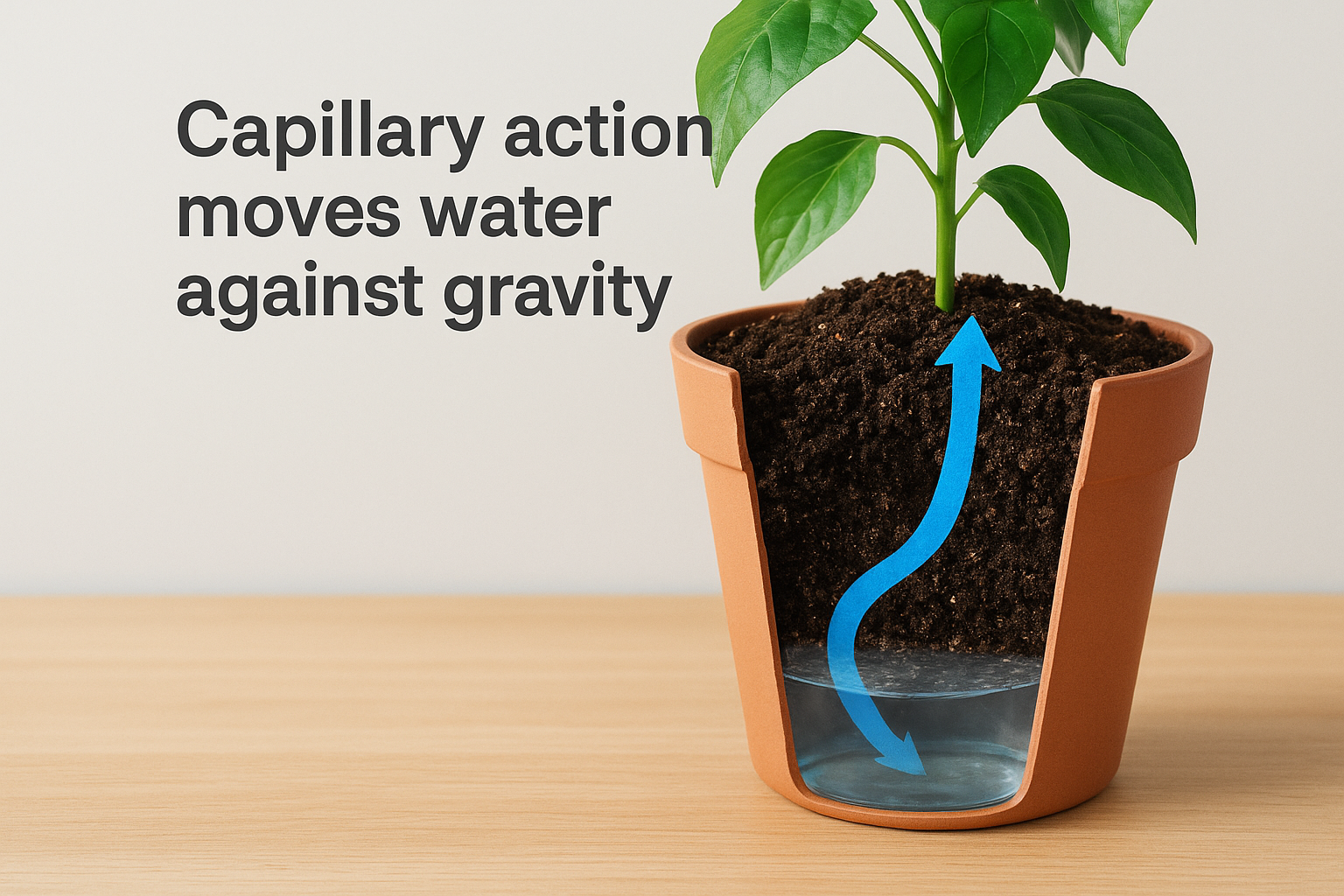
The narrower the gap between particles, the higher water can climb without any external force.
Osmosis and root pressure complete the cycle
Your plant's roots contain higher concentrations of dissolved nutrients than the surrounding soil water, which creates osmotic pressure that pulls moisture inward through root cell membranes. This selective absorption means your plant takes up water while filtering out excess salts. Transpiration from leaves creates additional suction that pulls the water column upward through your plant's vascular system, maintaining the flow from reservoir to foliage.
How to use a self-watering planter the right way
Getting the most from your self-watering system requires proper setup and filling technique. The wrong approach can negate all the benefits we've discussed about how do self watering planters work, turning a maintenance-free solution into a swampy mess. Follow these steps to ensure your plants thrive from day one.
Set up your soil and wick connection properly
Start with a high-quality potting mix that contains peat moss, coconut coir, or vermiculite for strong capillary action. Avoid garden soil or mixes with large bark chunks that create air gaps and interrupt water flow. Press the soil firmly around the wick or contact points to eliminate dry pockets, you need continuous contact between the reservoir system and your growing medium. Fill the container to about one inch below the rim, leaving space for watering your plant from above during the first week.
Your initial setup determines whether water moves efficiently from reservoir to roots, so take time to ensure good soil-to-wick contact.
Fill the reservoir and establish the moisture gradient
Water your plant thoroughly from the top when you first pot it, this saturates the soil and kickstarts capillary action throughout the entire root zone. Wait 3-4 days before filling the reservoir for the first time, giving roots a chance to settle and preventing waterlogged conditions. After that initial period, fill the reservoir through the tube until water appears at the overflow hole, then check weekly and refill when the reservoir runs dry.
Common problems and how to prevent them
Even when you understand how do self watering planters work, a few issues can still crop up if you ignore basic maintenance. The two most common problems involve algae growth in exposed reservoirs and mineral buildup in the soil over time. Both are preventable with simple adjustments to your routine.
Algae and mold in the reservoir
Your water reservoir creates the perfect environment for algae and fungus when light reaches it. Green slime forms on the inside of clear containers, and biofilm can clog your wicking system or overflow holes. Prevent this by choosing opaque planters that block light completely, or wrap clear reservoirs with dark fabric or tape. Change the water every month during hot weather to flush out any spores before they establish colonies.
Algae needs light and standing water to thrive, so eliminating either factor stops the problem before it starts.
Salt and mineral deposits
Fertilizer salts accumulate in self-watering systems because water evaporates while minerals stay behind. You'll notice white crusts on the soil surface or around the rim of your planter. Flush the entire system every 8-12 weeks by watering heavily from the top with plain water, letting it drain through the overflow hole to carry away dissolved salts. This mimics natural rainfall and prevents toxic buildup that can damage roots and reduce your plant's ability to absorb nutrients.
Quick recap
You now understand how do self watering planters work through the combined forces of capillary action and root pressure. The reservoir feeds water upward through wicking systems into your soil, where your plant absorbs moisture on demand without the stress of drought or flood cycles. This demand-driven approach mimics natural groundwater and produces stronger root systems with less maintenance effort.
Your success depends on proper setup with good soil-to-wick contact and choosing potting mixes that support capillary flow. Prevent common issues by blocking light from your reservoir and flushing accumulated salts every few months. The result is healthier plants that thrive with minimal intervention, whether you're growing herbs on your patio or designing a complete outdoor space.
Ready to transform your garden with smart watering solutions? Contact our team at Konzept Garden to discuss how self-watering systems and expert landscape design can simplify your plant care routine.


