
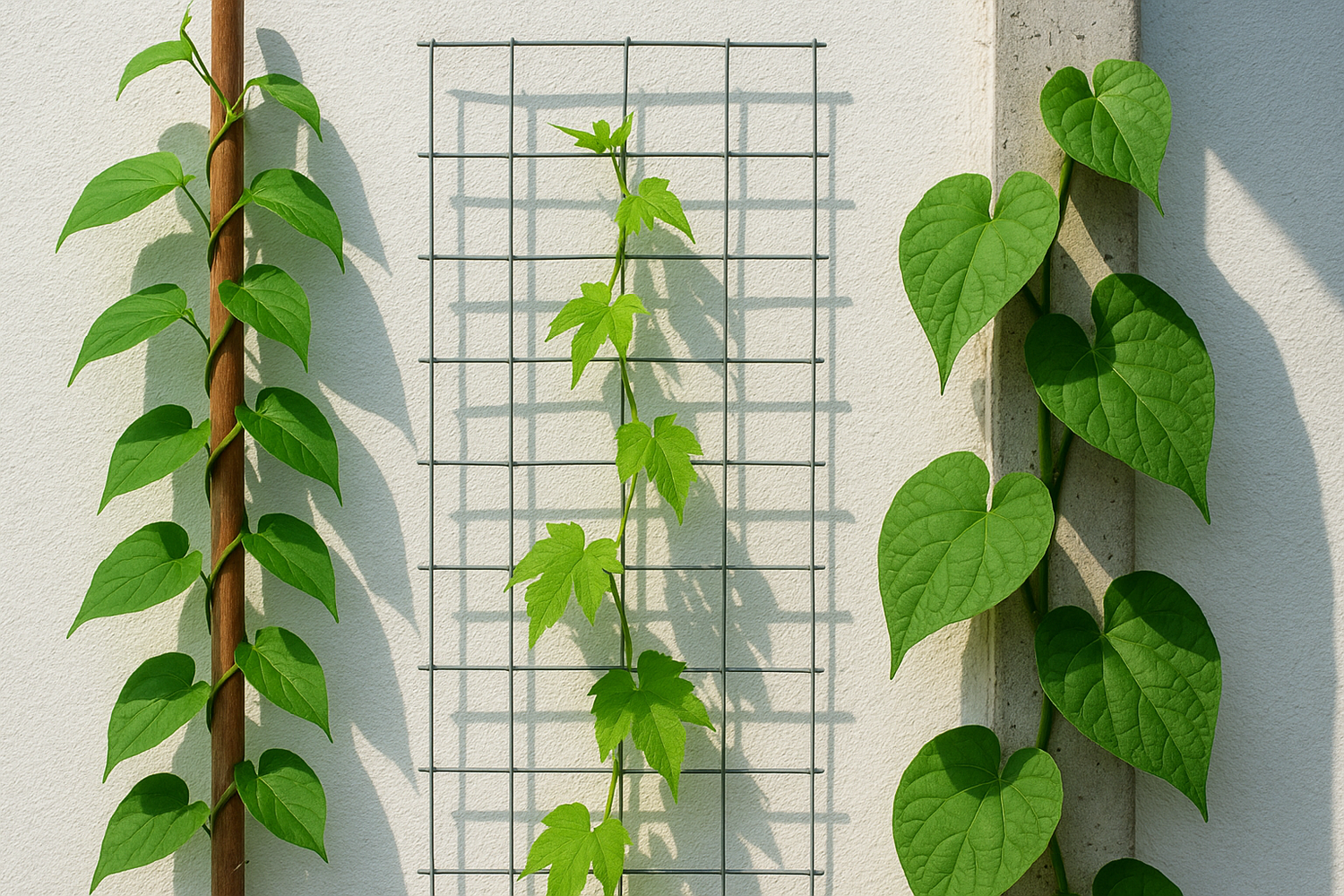
Watch a morning glory spiral up a fence post or a Virginia creeper scale a concrete wall, and a question eventually hits you: how do climbing plants climb? They have no muscles, no joints, no nervous system telling them which way is up. Yet they grip, coil, and ascend with remarkable precision, sometimes covering an entire structure in a single growing season.
The answer lies in a set of specialized biological mechanisms that differ from one climber to the next. Some plants twine their stems around supports. Others shoot out tendrils that latch on with coiling force. A few produce adhesive pads or aerial rootlets that bond directly to flat surfaces. Understanding these methods isn't just interesting biology, it's essential knowledge for anyone designing a garden where climbers play a role, because choosing the wrong support for a particular climbing type leads to poor growth or even structural damage.
At Konzept Garden, we work with climbing plants regularly in our landscape designs across Malaysia, training them onto pergolas, green walls, and trellises to add vertical interest and shade. This article breaks down exactly how each climbing method works at a biological level, which species use which strategy, and how to match the right support structure to your chosen climber, so your plants actually thrive where you put them.
Why climbing plants climb
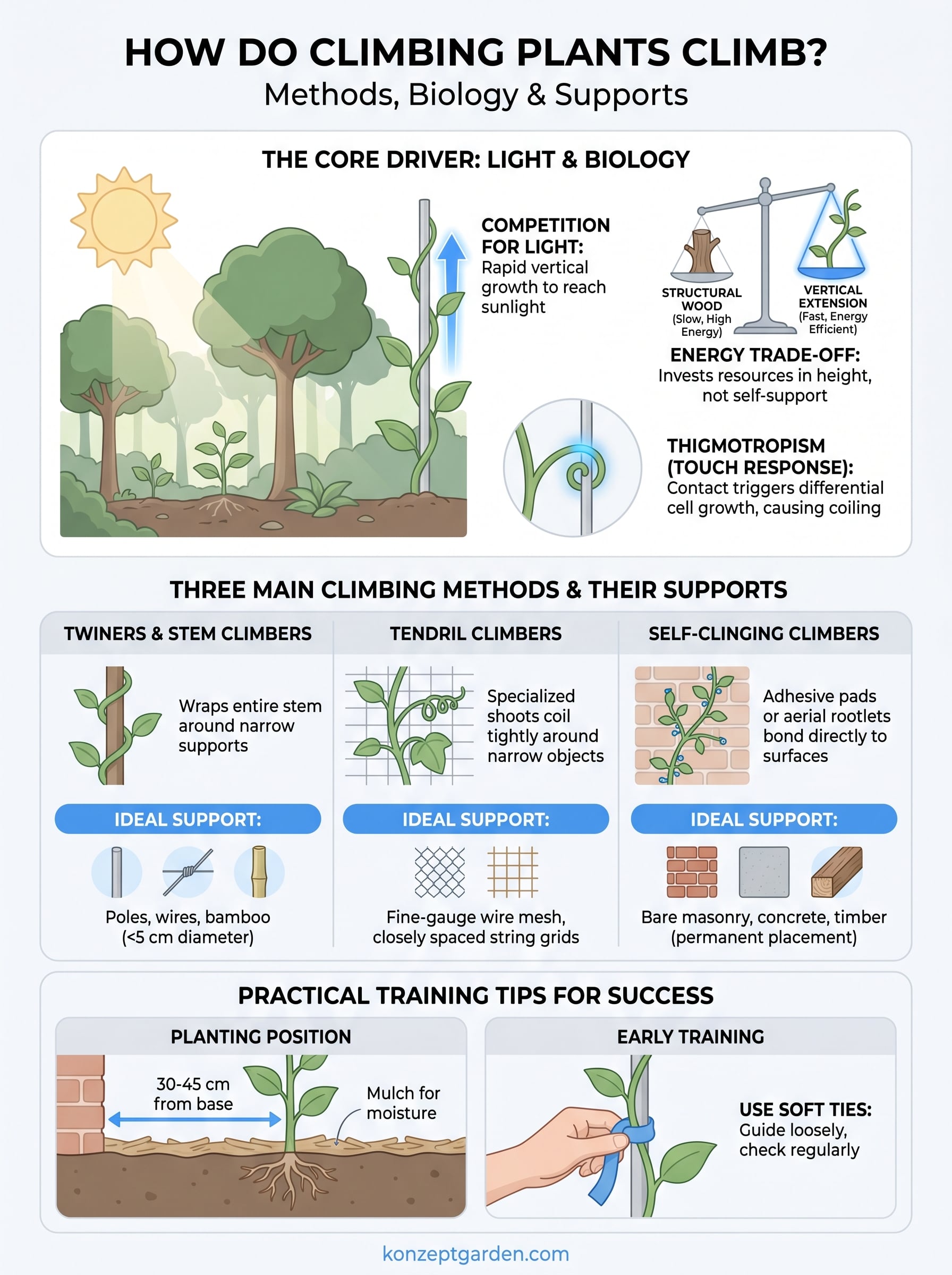
Climbing plants evolved their upward habits for a very practical reason: survival in competitive environments. In dense forests and crowded habitats, the plants that reach light fastest are the ones that reproduce and spread. Building thick, self-supporting woody trunks takes enormous energy and years of growth. Climbing sidesteps that cost entirely, letting a plant invest its resources into rapid vertical extension instead of structural reinforcement.
The competition for light
To fully understand how do climbing plants climb, you first need to understand what they are climbing toward. Sunlight is the fundamental driver. In nature, most climbers originate from environments where taller vegetation already dominates the canopy. A climbing plant cannot out-compete a mature tree by growing a rival trunk from scratch, so it does the next best thing: it uses the tree as a scaffold. By hooking, coiling, or adhering to an existing structure, a climber can reach the upper canopy in a fraction of the time and with a fraction of the biomass a free-standing plant would require.
The climbing strategy is essentially biological freeloading: the plant borrows structural support it never had to build itself.
Competitive pressure is why you see climbers at the edges of forests, along riverbanks, and in disturbed areas where gaps in the canopy exist. Those gaps represent brief windows for rapid upward growth before other vegetation fills the space again. In Malaysian gardens, this same drive shows up clearly when a climber like Thunbergia or Bougainvillea finds a pergola post and accelerates noticeably once it has something to grip.
The energy trade-off that drives the strategy
Because climbers redirect energy away from building structural wood, they tend to grow faster than comparable free-standing shrubs or trees at the same life stage. That speed is useful in a garden context, but it also means they depend entirely on external support to hold their weight. Without a structure to grip, most climbers sprawl along the ground or collapse under their own mass. Their stems are built for flexibility and length, not for standing upright on their own.
This trade-off has shaped every physical adaptation climbers have developed over millions of years. The twining stems, spring-like tendrils, and adhesive pads all exist because the plant's survival strategy revolves around borrowing support rather than creating it. Understanding this trade-off helps you design better support systems for the climbers in your garden, matching the structure to the plant's natural behavior rather than working against it.
How climbing plants find and grip supports
Climbing plants don't randomly stumble onto supports. They use a growth response called thigmotropism, which triggers when part of the plant makes physical contact with a solid object. When a tendril or growing stem tip brushes against a surface, cells on the contact side stop elongating while cells on the opposite side keep growing. The result is a controlled curve toward and around the object, driven entirely by differential cell expansion.
The role of thigmotropism
Thigmotropism is at the core of how do climbing plants climb: physical contact is the trigger, and uneven cell growth is the mechanism. Research has shown that some tendrils respond to contact within seconds, curling visibly in under a minute after touching a surface. The speed of the response varies by species, but the underlying biology is consistent across nearly all climbing plant families.
The faster a tendril responds to contact, the better the plant's chances of securing a hold before wind or movement pulls the stem away from the support.
What happens after initial contact
Once a tendril or stem makes initial contact, the plant reinforces the connection through continued coiling around the support. Many species also deposit adhesive secretions or develop thickened holdfast cells at the contact point to increase grip strength over time.
This two-stage process matters practically for your garden. The initial contact response is quick, but the structural reinforcement takes days to weeks to fully develop. If you reposition a climber too soon after it has touched a support, you break the grip before the plant has anchored itself, forcing it to start the process again from scratch.
Main climbing methods and what they need
Understanding how do climbing plants climb starts with recognizing that not all climbers use the same strategy. Each method places different demands on support structures, and mismatching plant to support is one of the most common reasons climbers underperform or stall in Malaysian gardens.
Twiners and stem climbers
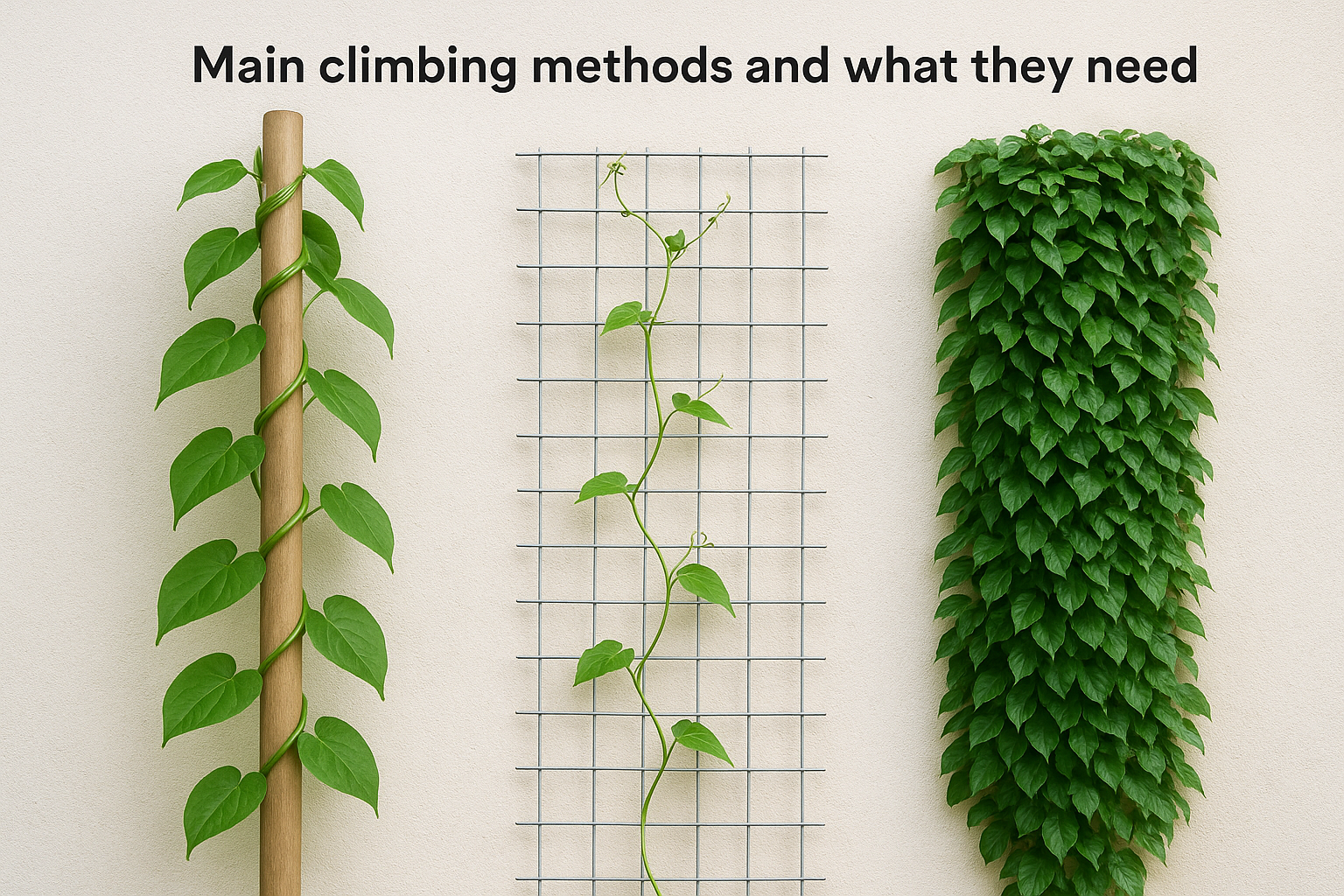
Twiners wrap their entire stem around a support in a continuous spiral, driven by the growing tip rotating as it extends upward. Species like Wisteria, Thunbergia, and Ipomoea all use this approach. They require narrow, rounded supports they can encircle, typically under 5 cm in diameter. A flat wall or wide horizontal beam gives them nothing to wrap around, so vertical poles, taut wires, and bamboo stakes work far better for this group.
Tendril climbers
Tendril climbers extend thin, specialized lateral shoots that coil tightly around any narrow surface they touch. Passiflora and Antigonon rely on this method in tropical garden conditions. These plants perform best on fine-gauge wire mesh or closely spaced string grids where a tendril can loop and grip within its natural reach of a few centimeters. Wide horizontal bars are simply too thick for most tendrils to encircle effectively.
Matching support gauge to tendril thickness is the single most important factor for fast, secure establishment of tendril climbers.
Self-clinging climbers
Self-clingers like Ficus pumila and climbing Hydrangea attach directly to flat surfaces using adhesive pads or aerial rootlets, requiring no trellis or wire support at all. They bond to bare concrete, masonry, brick, and timber through direct contact, making them a practical choice for covering large unbroken wall surfaces. The trade-off is clear: removal is difficult, and holdfast structures leave visible marks on painted or rendered finishes, so place them only where you intend them to stay long-term.
How to choose the right support structure
Choosing the wrong support structure is one of the most avoidable mistakes in garden design. Once you understand how do climbing plants climb and which method your plant uses, matching it to the correct structure becomes straightforward. The key variables to consider are support diameter, surface texture, load-bearing capacity, and whether you plan to remove the plant later.
Build the support to suit the plant's natural behavior, not the other way around, and you will spend far less time correcting problems down the track.
Match support gauge to climbing method
The table below gives you a quick reference for aligning climbing method to support type, saving you time and failed establishment attempts.
| Climbing Method | Ideal Support | Avoid |
|---|---|---|
| Twiner/Stem climber | Poles, narrow wires, bamboo under 5 cm | Wide flat boards, broad beams |
| Tendril climber | Fine wire mesh, string grid | Thick bars, smooth wide surfaces |
| Self-clinger | Bare masonry, concrete, timber | Painted or rendered finishes |
For twiners and tendril climbers, space wires no more than 15 to 20 cm apart so the growing tips always find a grip point within reach of their natural extension.
Factor in growth weight and longevity
Heavy climbers like Bougainvillea and mature Wisteria put significant load on lightweight structures over time, particularly when the stems become dense with foliage during Malaysia's rainy season. Use galvanized steel wire or treated timber frames rather than plastic trellises for any plant you expect to grow more than two meters in any direction.
Untreated timber and thin plastic degrade fast in Malaysia's humidity, so build supports rated for at least three full growing seasons from day one. Replacing a failed structure after a climber is well established causes far more disruption than investing in durable materials upfront.
How to plant and train climbers in Malaysian gardens
Malaysia's year-round heat and humidity create ideal growing conditions for most climbing species, but they also accelerate the consequences of poor early decisions. Positioning and early training determine whether your climber establishes quickly or repeatedly fails to grip its support. Once you understand how do climbing plants climb, setting up the right conditions becomes a straightforward process from the day you put the plant in the ground.
Getting the planting position right
Plant your climber 30 to 45 cm away from the base of its support, not flush against it. Walls and fences cast rain shadows that dry out root zones faster than open ground, especially where roofs or dense canopy sit directly above the planting area.
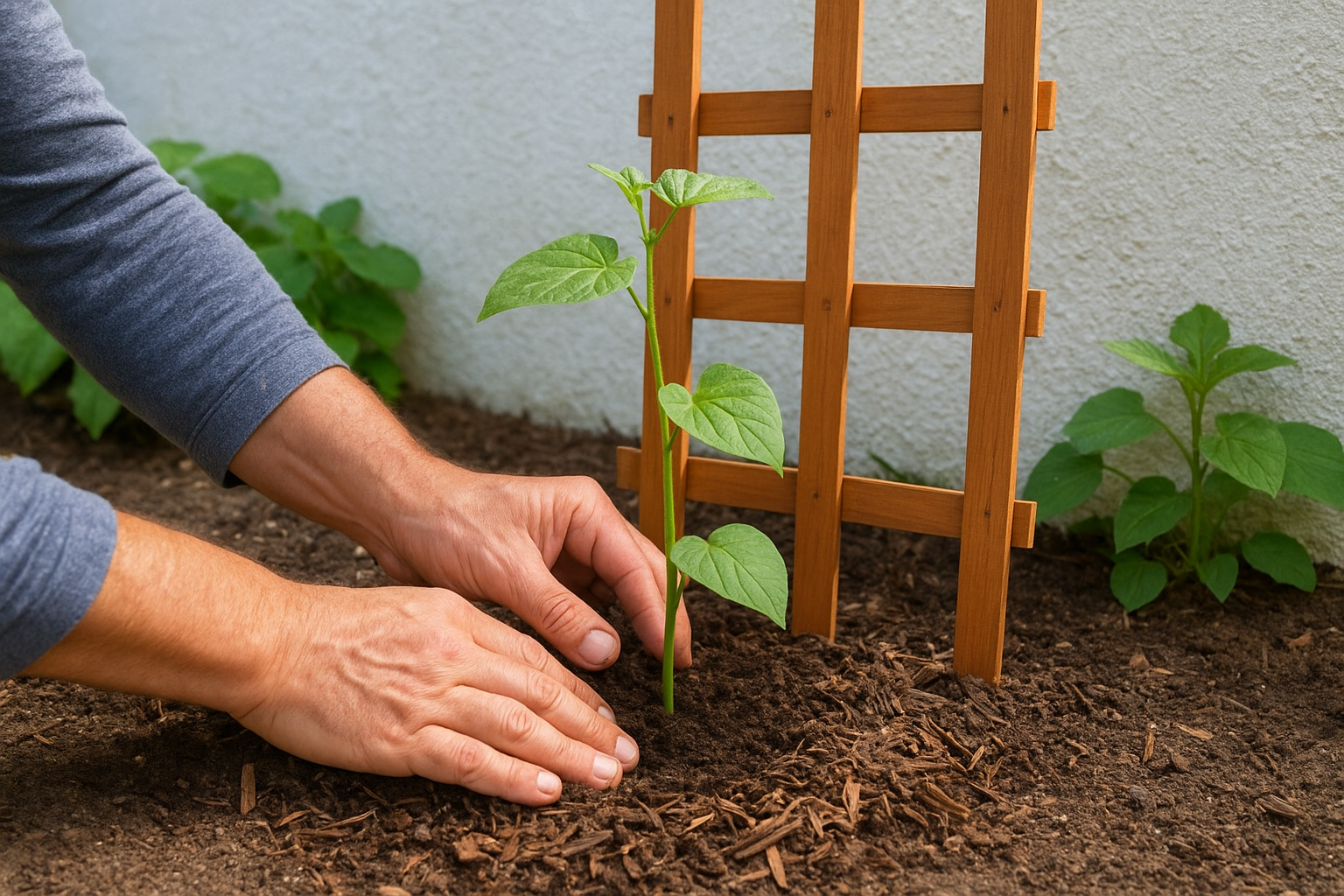
Add a generous layer of organic mulch around the base to buffer soil temperature and hold moisture between dry spells. Well-draining, moisture-retentive soil from the start gives roots the stability they need to push consistent upward growth rather than spreading sideways in search of better conditions.
Training young stems onto supports
The first two months after planting are the most critical window for directing a climber toward its structure.
Use soft fabric ties or plant clips to loosely attach young stems to the support at 15 to 20 cm intervals, angling them toward the structure without pinching the stem. Avoid wire or string, which cuts into soft growth quickly in Malaysia's fast-paced growing conditions.
Once the plant grips on its own, check and loosen each tie every two to three weeks throughout the active season. Ties left in place too long restrict stem thickening and create weak points that become visible only after the damage is already done.
Key takeaways and next steps
Understanding how do climbing plants climb gives you the foundation to make better decisions about species selection, support structures, and training from day one. Twiners need narrow poles and wires, tendril climbers need fine mesh grids, and self-clingers work best on bare masonry where you plan to leave them permanently. Getting these basics right saves you significant correction work down the line.
Your early training work in the first two months shapes how the plant behaves for the rest of its life. Soft ties, correct planting distance from supports, and durable materials suited to Malaysia's humidity are the three factors that separate a thriving vertical garden from one that stalls or collapses midway. Build your support with at least three growing seasons of load in mind before you put a single plant in the ground.
If you want professional guidance on integrating climbers into a full garden design, contact the Konzept Garden team for a free quotation and expert advice tailored to your outdoor space.