
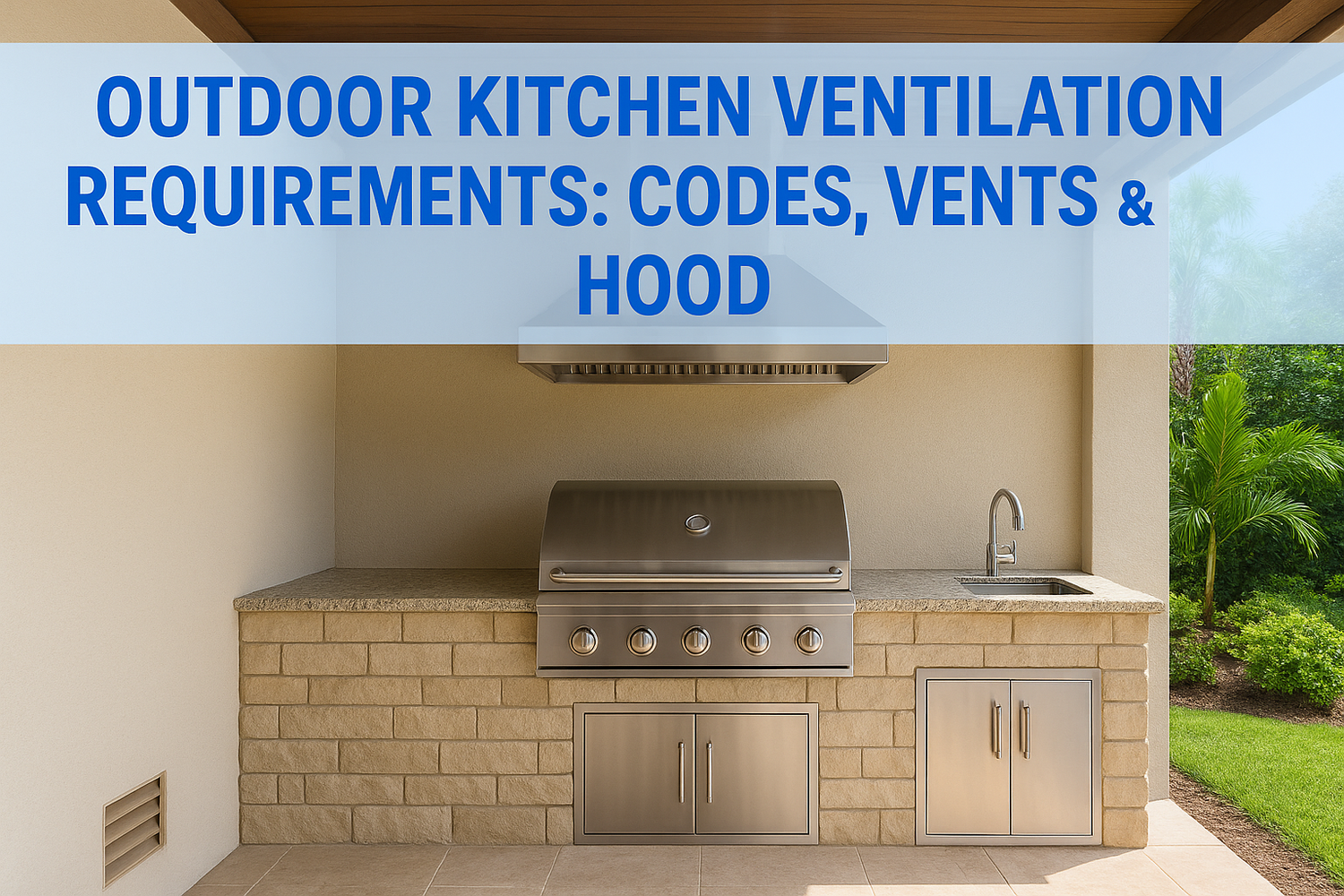
Getting your outdoor kitchen ventilation requirements right isn't just about comfort, it's a safety issue with real consequences. Gas buildup inside enclosed kitchen islands, grease-laden smoke drifting into living areas, and heat damage to surrounding materials are all problems that proper ventilation prevents. Skip this step, and you risk failed inspections, voided warranties, or worse.
Whether you're installing a built-in gas grill on a covered patio or designing a full outdoor cooking station, local building codes and manufacturer specifications dictate exactly how your ventilation should work. That means understanding island vent panel placement to release trapped propane or natural gas, choosing the right range hood CFM rating for your cooktop, and meeting clearance distances required by NFPA and local Malaysian authorities.
At Konzept Garden, we design and build outdoor living spaces that perform as well as they look, and ventilation planning is part of every outdoor kitchen project we take on. This article breaks down the codes, vent types, and hood specifications you need to know before breaking ground. We'll walk you through each requirement so you can make informed decisions alongside your designer or contractor.
What outdoor kitchen ventilation requirements cover
Outdoor kitchen ventilation requirements are a set of rules and specifications that govern how air moves through, around, and out of your outdoor cooking space. They exist because outdoor kitchens combine open flames, combustible gases, grease, and enclosed cabinet structures in ways that create serious hazards when airflow isn't properly managed. These requirements pull from several sources: appliance manufacturer installation manuals, the National Fire Protection Association (NFPA), international building and mechanical codes, and local authority guidelines. Understanding what each category covers helps you prioritize correctly when planning your outdoor kitchen layout.
Gas ventilation and vapor release
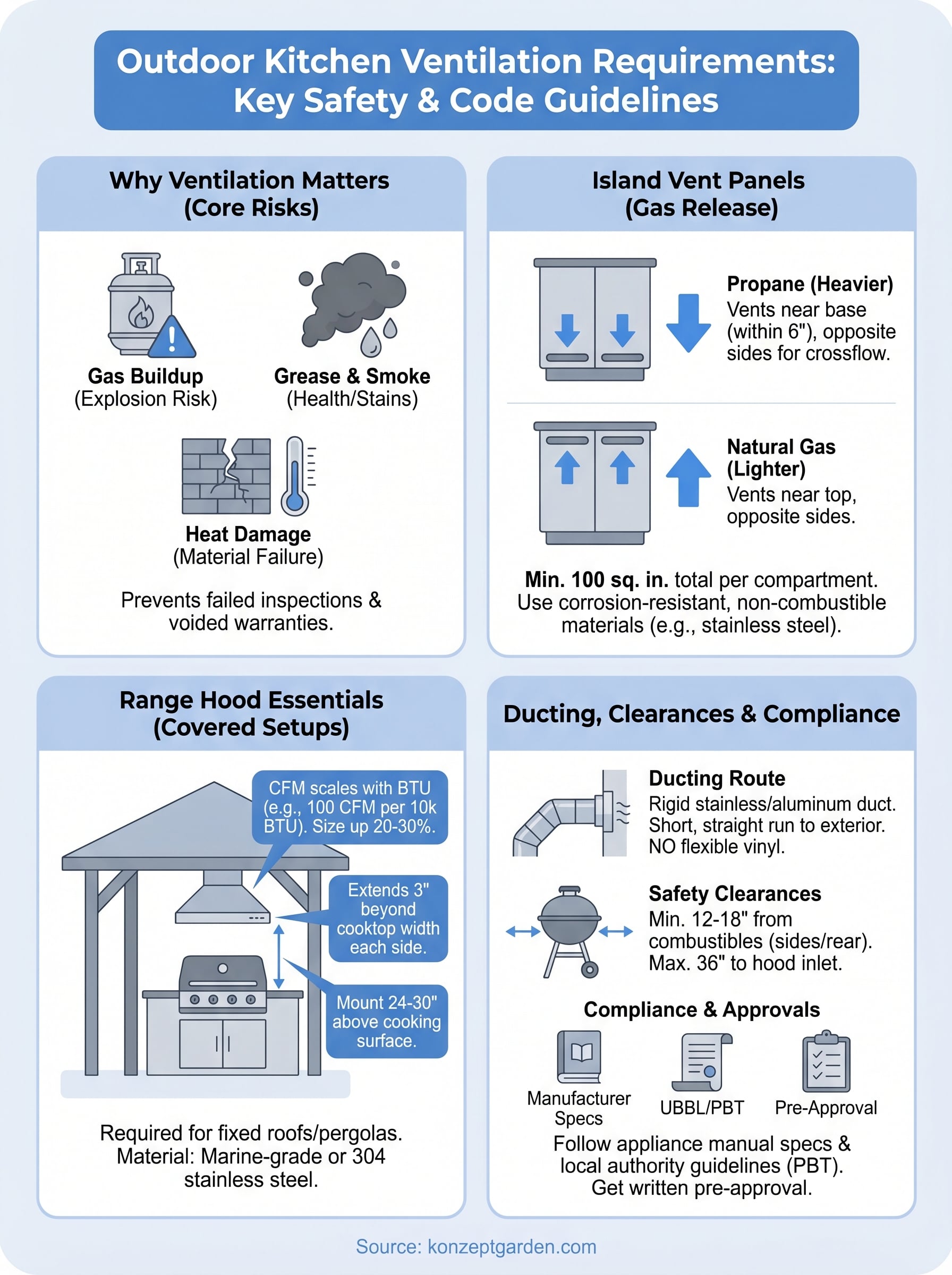
The most critical area within outdoor kitchen ventilation requirements involves gas appliance safety, specifically stopping propane or natural gas from accumulating inside enclosed cabinet spaces. Both gases behave differently when they leak. Propane is heavier than air, so it sinks and pools at the bottom of enclosed islands or base cabinets. Natural gas is lighter and rises toward the top. Your ventilation approach depends heavily on which fuel type your grill and other appliances use.
A gas leak inside an unvented outdoor kitchen island can reach explosive concentrations within minutes, making vapor release venting a non-negotiable requirement, not a design preference.
Enclosed grill islands, built-in refrigerator compartments, and side burner bases all need vent openings at the correct height for the gas type installed. For propane setups, vents go near the base of the cabinet. For natural gas, they go near the top. These openings give trapped vapors a path out before they build to dangerous levels. Getting the placement wrong means the vents do essentially nothing.
Smoke, heat, and grease management
When you cook on a covered patio, beneath a pergola, or inside a pavilion structure, smoke, airborne grease particles, and excess heat need a clear exit path. A range hood or overhead ventilation system becomes necessary any time your cooking area sits under a fixed roof or any structure that limits natural air movement. Without one, grease coats the ceiling and surrounding structures, smoke recirculates back toward the cook, and heat concentrates in a way that makes the space uncomfortable and damages materials over time.
Your hood has to match the heat output of your appliances. A high-BTU gas grill or outdoor wok burner pushes out far more heat and combustion byproducts than a standard residential stove, so the hood's CFM (cubic feet per minute) rating needs to scale with that output rather than being sized for indoor residential use.
Structural and material protection
Ventilation also protects the physical structure of your outdoor kitchen from premature deterioration. Heat and trapped moisture inside enclosed cabinet compartments accelerate corrosion on metal hardware, weaken adhesives, and degrade timber, composite cladding, and masonry substrates faster than normal outdoor exposure would on its own. Consistent airflow through and around your built-in appliances directly extends their lifespan and keeps the surrounding cabinetry structurally sound.
In Malaysia's tropical climate, this concern is amplified considerably. High ambient humidity combined with repeated cooking heat cycles creates near-constant moisture fluctuation inside enclosed spaces. Condensation forms and lingers, especially in shaded outdoor kitchen structures. Treating ventilation purely as a compliance checkbox misses the bigger picture; it is one of the most practical maintenance decisions you make during the design phase, and fixing it after construction is significantly more expensive.
How to meet code and safety expectations in Malaysia
Malaysia does not publish a single standalone document that covers outdoor kitchen ventilation requirements from start to finish. Instead, compliance pulls from multiple overlapping sources: the Uniform Building By-Laws (UBBL) 1984, gas appliance standards from Suruhanjaya Tenaga (the Energy Commission of Malaysia), and the installation manuals from your appliance manufacturers. Your contractor and local municipal authority (Majlis Perbandaran or Majlis Bandaraya) ultimately have final say on what passes inspection in your specific area.
Working with the Uniform Building By-Laws
The UBBL 1984 sets out baseline requirements for ventilation in habitable and semi-enclosed structures, and some of those provisions extend to covered outdoor cooking areas when they attach to or form part of a residential property. Specifically, Section 39 and the associated fire safety provisions address natural ventilation and minimum opening ratios that apply when any combustion appliance operates within an enclosed or partially enclosed structure.
Your best starting point is to submit your completed outdoor kitchen plans to your local authority (PBT) before construction begins. Bringing a finished design to your local Majlis office for pre-approval saves you from costly structural modifications after the build is complete.
Getting written sign-off from your local authority before construction begins protects you legally and practically if any dispute arises later.
Using manufacturer specs as your technical baseline
Where Malaysian codes stay general on specifics, your appliance manufacturer's installation manual becomes the binding technical document. Gas grill manufacturers publish exact vent opening sizes, required clearances from combustibles, and BTU-to-CFM ratios for any hood used above their equipment. These specs are not optional reading; ignoring them voids your appliance warranty and shifts liability to you if an incident occurs.
Suruhanjaya Tenaga regulates gas supply and appliance safety standards in Malaysia, and any registered gas contractor you hire must comply with their requirements for connection, testing, and sign-off. Ask your contractor for their registration number before work begins, and confirm that your gas fittings carry the SIRIM certification mark, which indicates compliance with Malaysian safety standards for gas products.
Island vent panel requirements for gas grill cabinets
Island vent panels are the physical openings cut into the walls of a built-in grill enclosure that let accumulated gas vapors escape before concentrations reach dangerous levels. Most outdoor kitchen ventilation requirements for enclosed islands reference standards from NFPA 54 (natural gas) and NFPA 58 (propane/LPG), along with the installation manual for your specific appliance. These documents define how large those openings must be and exactly where they should sit on the cabinet wall, and your compliance has to satisfy both sources simultaneously.
Vent placement based on gas type
Where you position your vent panels depends entirely on which fuel type your grill uses. Propane (LPG) is heavier than air, so it sinks and collects at the lowest point of an enclosure. For a propane setup, your vent openings go within 6 inches of the cabinet floor on two opposing walls to create cross-ventilation. Natural gas is lighter than air and rises, so vent openings go near the top of the cabinet on opposing sides instead.
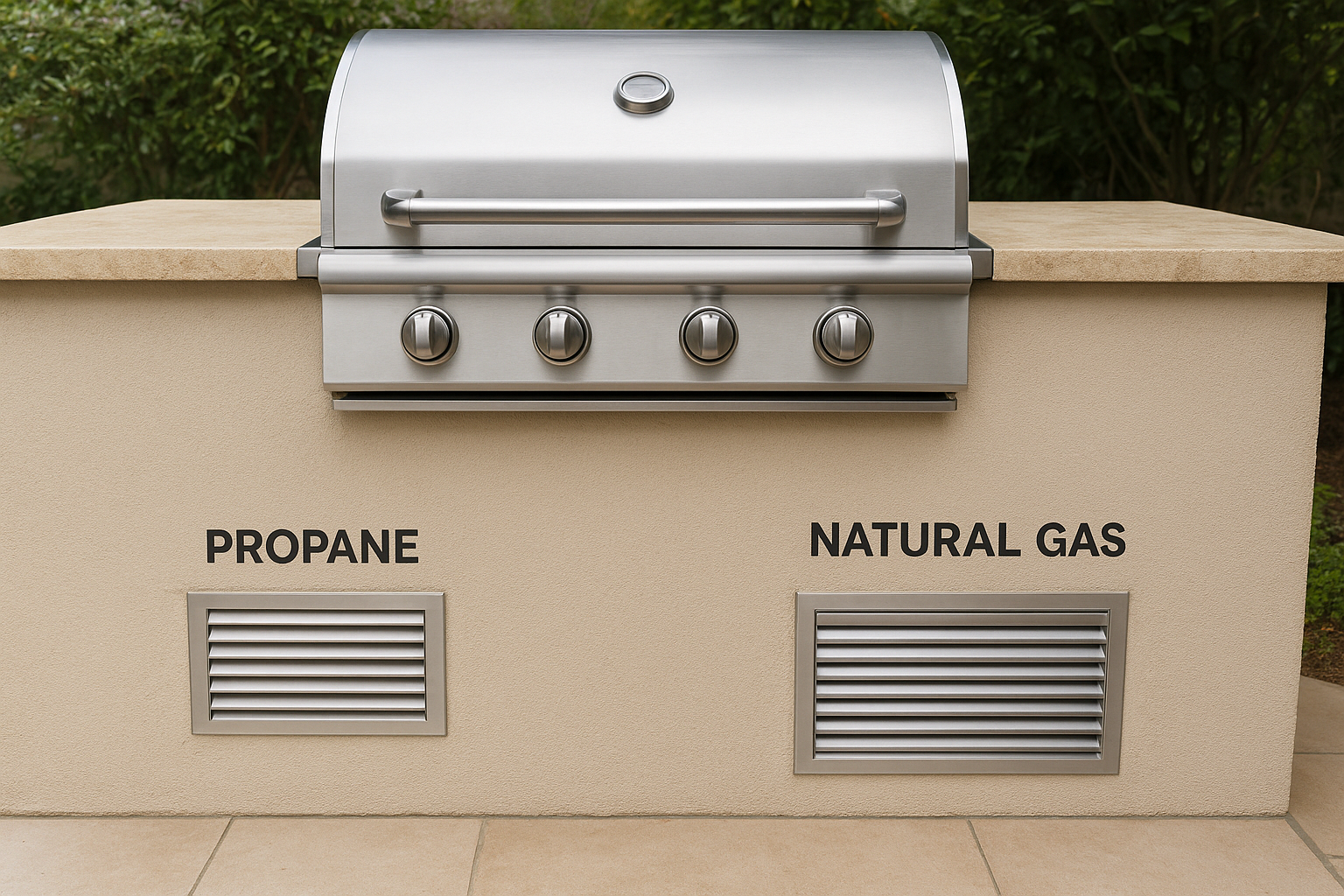
Placing propane vents at the top of a cabinet or natural gas vents at the bottom defeats their entire purpose and gives you a false sense of safety.
Cutting vents on two opposing walls rather than just one side is essential. A single vent allows air to stagnate rather than move through the space. You need a clear inlet and an outlet so that fresh air enters from one opening and pushes accumulated vapors out the other in a continuous exchange.
Minimum vent opening sizes
Most grill manufacturers and NFPA guidelines specify a minimum of 100 square inches of total vent area per compartment for a standard built-in grill installation. That total splits across at least two vent openings, so neither opening needs to carry the full load on its own. Check your specific appliance manual first, since high-BTU grills or multi-appliance islands may require larger openings than the standard minimum.
Your vent panels should use corrosion-resistant, non-combustible materials such as stainless steel louvres or powder-coated aluminum grilles. In Malaysia's humid climate, standard steel mesh rusts quickly and blocks airflow over time, which reduces the panel's effectiveness right when you need it most.
Range hood requirements for covered outdoor kitchens
A range hood becomes a firm requirement the moment your outdoor kitchen sits beneath a fixed roof, pergola, or covered structure that restricts natural airflow. Unlike open-air grilling, cooking under cover traps smoke, grease particles, and combustion byproducts directly above the cooktop. Without a functioning hood, those byproducts coat your ceiling, cycle back toward you, and accumulate on surrounding surfaces. Meeting outdoor kitchen ventilation requirements for covered setups means selecting a hood with the right airflow rating, hanging it at the correct height, and building it from materials that survive constant outdoor exposure.
CFM ratings and BTU output
Your hood's CFM (cubic feet per minute) rating must match the heat output of the appliances beneath it. Outdoor gas grills and side burners typically run between 30,000 and 80,000 BTU, which is significantly higher than most indoor stoves. A widely used calculation from appliance manufacturers is 100 CFM per 10,000 BTU, so a 60,000 BTU grill station requires at minimum a 600 CFM hood.
In practice, many outdoor cooking setups run multiple burners simultaneously, so sizing up by 20 to 30 percent gives you reliable performance at full capacity rather than just at baseline. Running a hood at or near its maximum rated output constantly shortens motor lifespan and raises noise levels noticeably.
Undersizing your range hood CFM is one of the most common outdoor kitchen mistakes, and fixing it after installation usually means replacing the entire unit.
Hood size, mounting height, and materials
Your hood should extend at least 3 inches beyond the width of your cooktop on each side to capture the full smoke and heat plume that rises during cooking. Mounting height matters equally: most manufacturers specify a range of 24 to 30 inches above the cooking surface for optimal capture without risking heat damage to the hood body itself. Drop below 24 inches and you risk overheating the unit; go above 30 inches and the hood loses capture efficiency significantly.
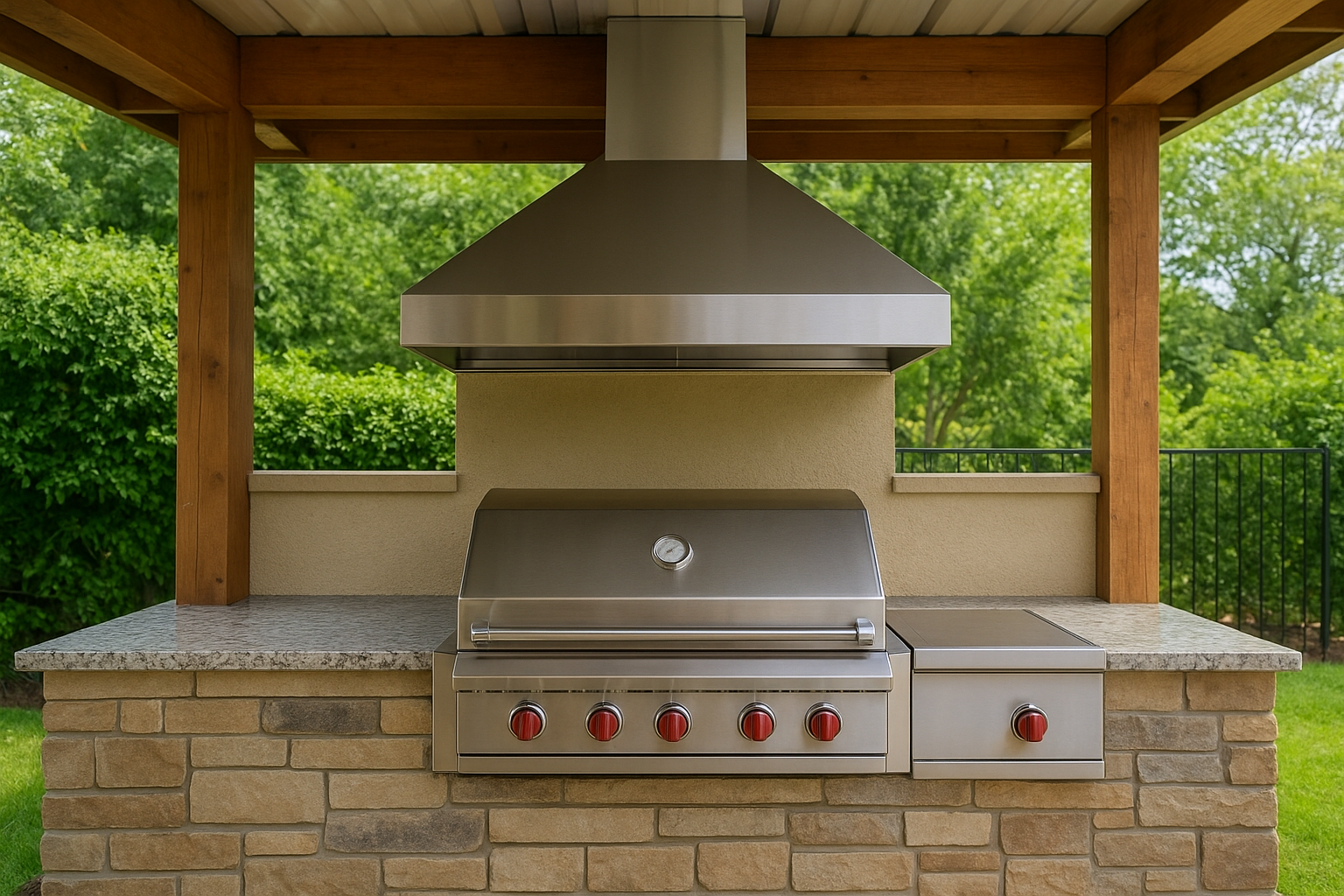
For outdoor use in Malaysia's humid climate, your hood must be constructed from marine-grade or 304 stainless steel rather than standard brushed steel designed for indoor kitchens. Aluminum is a lighter alternative that resists corrosion well, but verify that your specific product carries a rated outdoor installation certification before purchasing.
Ducting, wind, clearances, and fire safety details
Beyond vent panels and hood selection, outdoor kitchen ventilation requirements also govern how your exhaust exits the structure, how far your appliances sit from combustible materials, and how the surrounding environment affects airflow performance. Getting these details right during the design phase prevents structural fire risk and ensures your ventilation system actually works under real cooking conditions.
Ducting and exhaust routing
If your range hood uses a ducted exhaust system, the duct run must terminate outside the structure, never into a wall cavity, ceiling void, or enclosed soffit. Grease-laden air from cooking deposits residue inside ductwork over time, and any enclosed duct run that lacks a clear exterior exit point becomes a fire hazard as grease accumulates. Use rigid stainless steel or aluminum ducting rather than flexible vinyl duct, which collapses under heat and traps grease in its corrugated interior.
Flexible vinyl ductwork is not rated for outdoor kitchen exhaust use and should never be used regardless of cost savings.
Keep your duct run as short and straight as possible. Every 90-degree bend in the duct path reduces the effective CFM your hood delivers at the cooking surface, so long runs with multiple turns require you to compensate by sizing up your hood's rated output accordingly.
Wind, clearances, and fire safety
Wind is a real factor in Malaysian outdoor kitchens, particularly in open-plan garden settings or rooftop structures. Strong prevailing winds can push exhaust back down into the cooking area or draw flames away from burners unpredictably. Position your grill and hood so that the dominant wind direction assists exhaust movement rather than opposing it, and consider a wind baffle above the hood opening if your site experiences consistent cross-winds.
Clearance distances between your appliances and combustible materials follow the specifications in your appliance manual. Most gas grills require a minimum of 12 to 18 inches of clearance from timber, composite cladding, and low-density concrete block on the sides and rear of the unit. Above the cooking surface, a non-combustible ceiling or hood must be present within the distance your manufacturer specifies, typically 36 inches maximum from the cooking grate to the hood inlet.
Next steps for a safer outdoor kitchen
Now that you have a clear picture of what outdoor kitchen ventilation requirements demand, work through them in order of priority. Start with gas type and vent panel placement since those directly affect safety before a single meal gets cooked. Then match your hood CFM to your total BTU output, confirm your duct run exits cleanly to the exterior, and verify all appliance clearances against your manufacturer specs before your contractor locks in the final build. Pulling written approval from your local Majlis authority before construction begins protects you from expensive changes after the fact.
Bringing in an experienced outdoor kitchen designer from day one removes most of that guesswork. Konzept Garden handles complete outdoor kitchen design and implementation, with ventilation planning integrated into every project from the concept stage onward. If you're ready to build an outdoor cooking space that performs safely and looks exactly right, talk to our design team and get your free consultation today.