


The best minimalist garden design ideas all follow one rule: remove decisions. Use three tones, no more than two hard materials, a handful of repeated plants and a single focal point. A restricted palette (idea 1) and straight-line zoning (idea 2) suit anyone starting with bare ground. Swapping the lawn for a flat green surface (idea 3) suits households tired of mowing. Repeated planter groups (idea 4) suit balconies and courtyards. One calm focal point (idea 5) suits people who spend their evenings outside.
The problem is that minimalism is easy to get wrong in a tropical climate. Strip a garden back too far and it looks bare and glares in the midday sun. Choose the wrong surfaces and heavy rain leaves them stained, slippery or green with algae. What you want is a space that looks calm and takes little work.
This article gives you five ideas, and each one has the same two parts. First, how to do it. Second, what to use and who it suits. We design and build gardens in Malaysia at Konzept Garden, so the advice is written for local heat, humidity and monsoon rain.
1. Limit the palette to three tones and two materials
A minimalist palette means three colors and two hard materials, used everywhere in the garden. It is the cheapest idea on this list, and every other idea depends on it.
How to do it
Choose three tones: a light neutral for the ground, a dark tone for accents such as planters and frames, and the green of your plants. You can add one warm timber tone as a fourth. Then limit hard landscaping to two materials, for example paving and timber slats, and repeat them on paths, steps, edging and screens.
Test the finish before you buy. In Malaysia's sun, glossy pale surfaces glare at noon and very dark stone gets hot underfoot. Pick a matte, mid-to-light finish with some texture, so it grips when wet.
Every extra material gives the eye another decision to make, so stop at two.
What to use and who it suits
Compare the common options by how they behave in humidity and rain:
| Material | Look | Care in a humid climate |
|---|---|---|
| Porcelain paving | Clean and uniform, light or dark | Dense and stain-resistant, so choose a matte, slip-resistant finish |
| Gravel or pebbles | Soft texture for borders | Needs firm edging, a weed membrane and occasional leaf raking |
| Hardwood timber slats | Warm contrast on fences and beds | Needs regular sealing against sun and rain |
| Rendered concrete walls | Smooth backdrop for plants | Use exterior paint rated for humid conditions |
This idea suits new builds and renovations where the ground is bare and you can set the palette from day one.
2. Define the space with straight lines and clear zones
Minimalist garden layouts rely on boundaries and straight edges. Divide the plot into a few clear zones and keep everything else open.
How to do it
Start with the boundaries: a clean wall, a slatted fence or a clipped hedge. Then mark out one sitting area, one path and one or two planting strips. Leave more open surface than planted surface, because open space is what makes a small garden feel calm.
Plan the sight lines as well. Run the path toward the focal point you will choose in idea 5, and place stepping stones with narrow, even gaps. In a small terrace garden, a slatted screen blocks the neighbor's window without closing the space in.
Straight lines and empty space do the work that ornaments do in a traditional garden.
What to use and who it suits
Pick from this short list, and stay within your two materials from idea 1:
- Horizontal timber slats or a rendered wall for the boundary
- Large-format paving or stepping stones for paths and seating
- Slim steel edging to separate gravel from planting
- A simple pergola frame if you need shade over the seating area
This layout suits small terrace and courtyard gardens where privacy and shade matter more than lawn.
3. Swap the lawn for a flat green surface
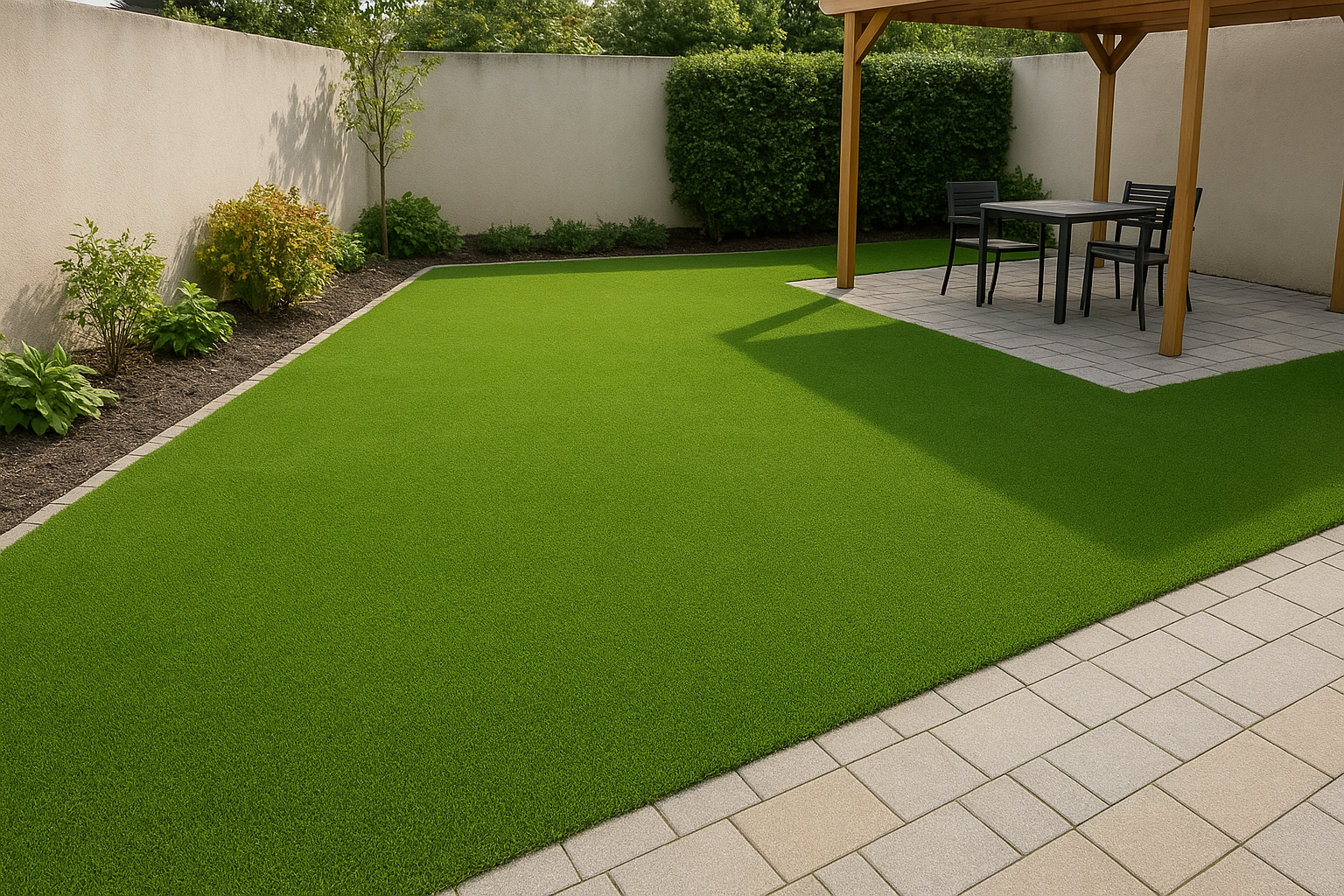
A flat, even green surface gives a minimalist garden its calm base. In Malaysia, a natural lawn struggles in shade and under heavy rain, and it needs constant mowing, so many owners replace it.
How to do it
Remove the old turf, level and compact the base, and make sure water can drain away. Then lay artificial grass in neat rectangles with clean edges. Our NobleGrass Premium 35 comes in 50 cm x 50 cm tiles with a drain cell. One set of four tiles covers 1 m².
Here is a worked example. A 3 m x 4 m patch is 12 m², so you need 12 sets, which is 48 tiles. Order a few spare tiles for cuts. The price depends on whether you buy single pieces or sets, so check the NobleGrass range for current figures. Be aware that any artificial turf can get hot in full midday sun, so put it where a pergola or tree gives some shade.
A lawn you never mow is the quickest way to cut garden chores.
What to use and who it suits
If you prefer a natural look, use gravel with large stepping stones instead. It also drains well, but it needs edging and some raking. Artificial turf suits busy households and families who want a tidy green surface all year. Gravel suits owners who prefer natural materials and do not mind a little upkeep.
4. Plant in repeated groups of three species or fewer
A minimalist planting plan uses very few species and repeats them in tidy groups. It looks intentional, and it makes watering and pruning much easier.
How to do it
Pick three species with different textures: something spiky, something rounded and something fine. Repeat each one along the planting strip or across several planters. Good tropical choices include snake plant (Sansevieria trifasciata), which tolerates drought and low light, and mondo grass for edging. Clumping bamboo works as a screen, but avoid running types, which spread.
Keep containers uniform in color. Black, grey or white planters look best with green foliage and match the palette from idea 1.
Repetition makes a few plants look like a plan instead of a collection.
What to use and who it suits
Two of our products fit this idea well:
- Ziant Hydro Planter 002 S (PE): RM185.00, UV-resistant, self-watering for up to 2 weeks, in black, grey, white or brown
- Snake Plant Golden Hahnii or Superba Laurentii with pot: RM79.90 each, with pots in black, brown, grey or white
This idea suits balconies, courtyards and people who travel, because the self-watering planters keep plants alive while you are away.
5. Add one calm focal point, water or light
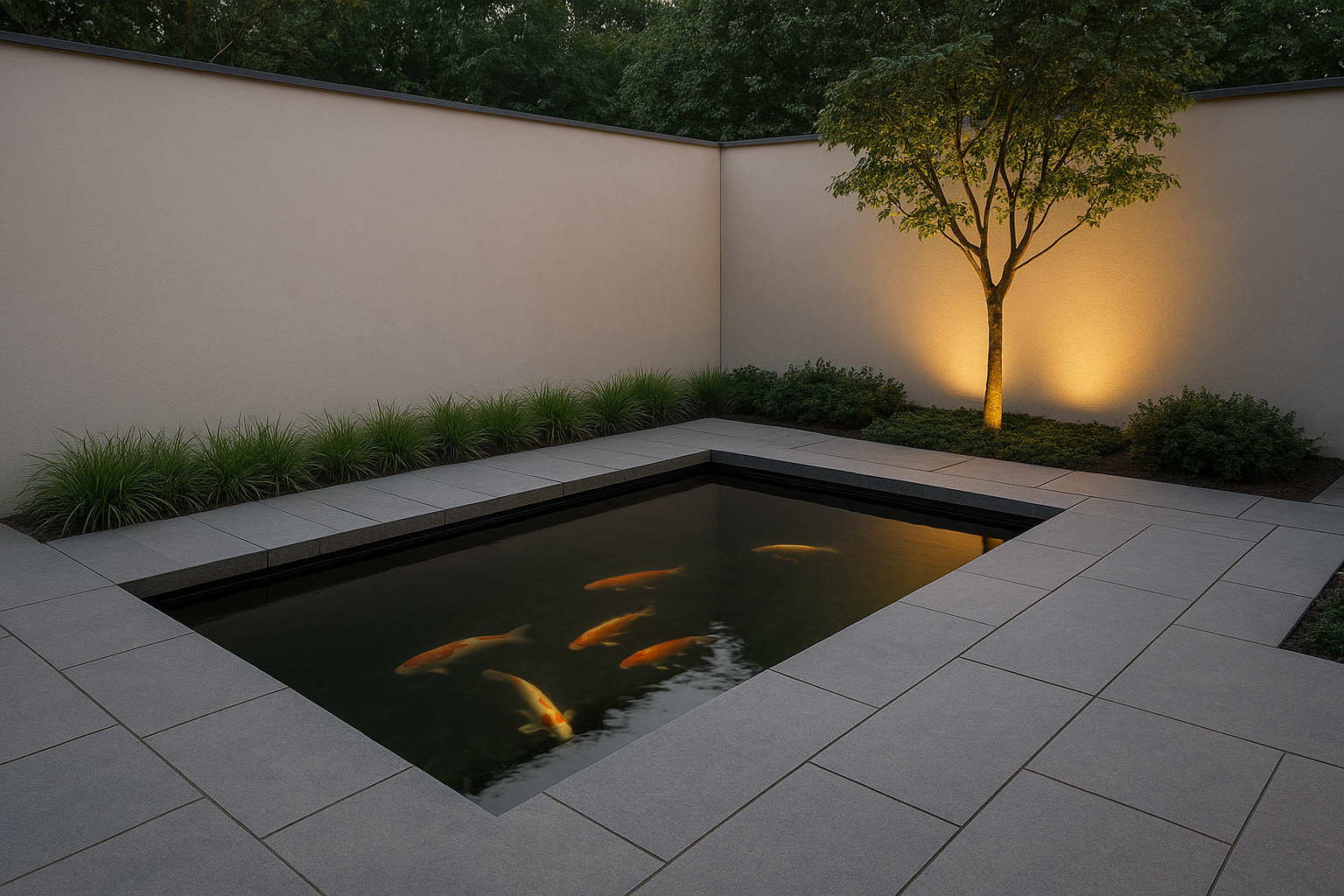
A minimalist garden needs one focal point. Without it, the clean surfaces look unfinished. Water is the strongest choice, and lighting is the cheapest.
How to do it
For water, keep the form simple: a still, rectangular or rock-edged pond placed at the end of your main sight line. A koi pond needs proper filtration, shade and a solid build, so plan it together with the paving, not afterward. We offer the Zen Bio Koi Pond and the Himalaya Rock Koi Fish Pond. Check their pages for specifications before you decide.
For light, use warm, low-level fixtures to wash one wall or one tree. Add under-lighting on steps and raised beds, which also makes the garden feel connected to the house at night. Always use outdoor-rated fixtures.
Choose one focal point and let everything else stay quiet.
What to use and who it suits
Choose between these three focal points based on how you use the garden:
- A koi pond for a living centerpiece, if you can maintain the water
- A single lit feature wall for a low-maintenance option
- One sculptural tree or large planter, lit from below, for the smallest budgets
This idea suits owners who sit outside in the evening and want the garden to look good after dark.
Start with the palette, then add one idea at a time
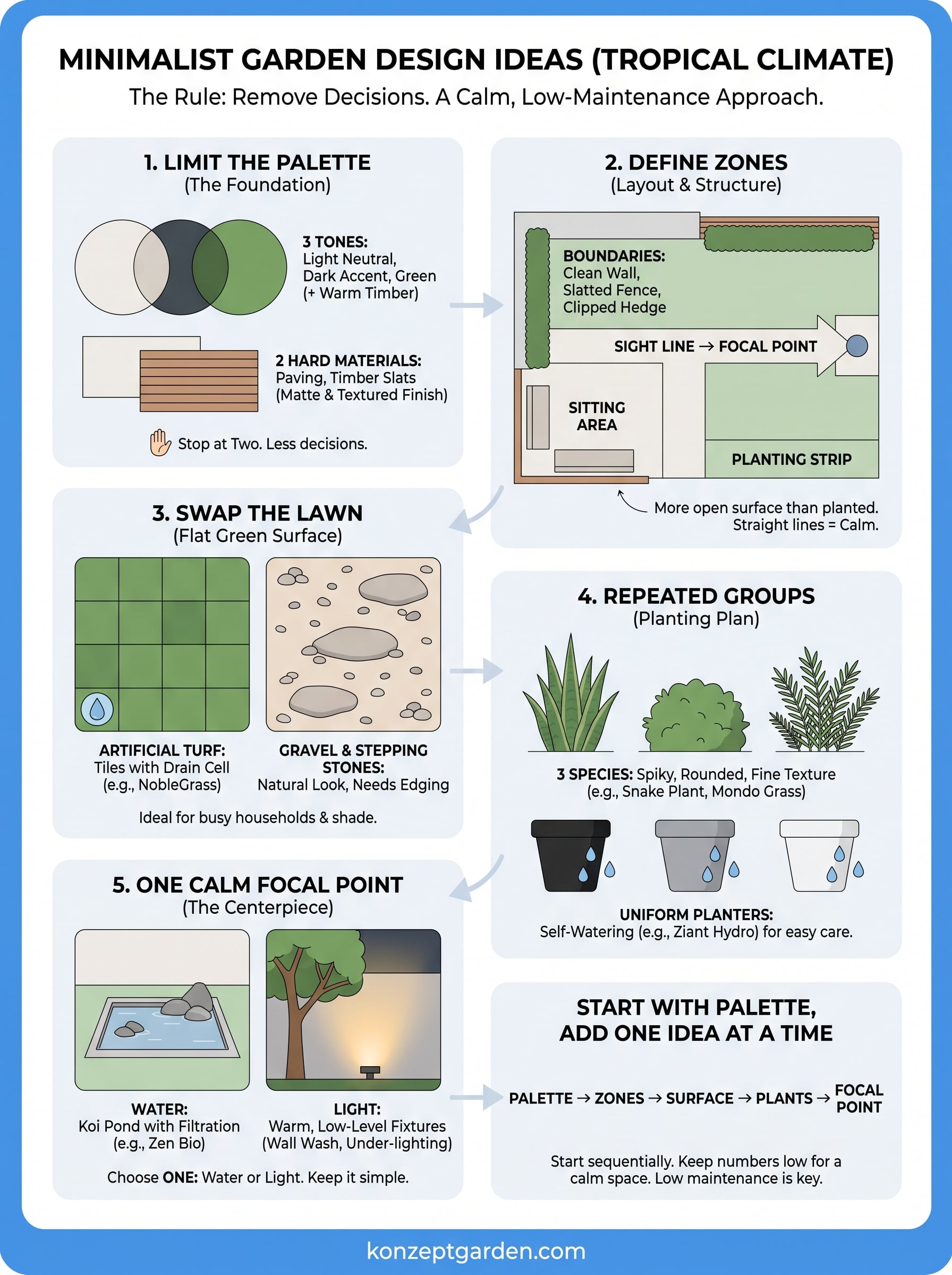
The ideas build on each other. Fix your palette first, then draw the zones, then decide the ground surface, the plants and the focal point. If you do them in that order, you will not need to redo any of them. Whichever idea you start with, keep the number of materials, colors and plant species low, because that is what makes the space feel calm and keeps maintenance small.
If you want help turning these ideas into a plan for your own plot, we can visit and quote. We charge a RM200 site visit fee, which is deducted from your final quotation if you go ahead. Send photos and measurements of your space first. Contact Konzept Garden to plan your minimalist garden.


